
Sudsy Slime
A science experiment to do at home or in the school classroom making gooey slime with soap flakes you can buy from the supermarket.
Adult supervision for setup
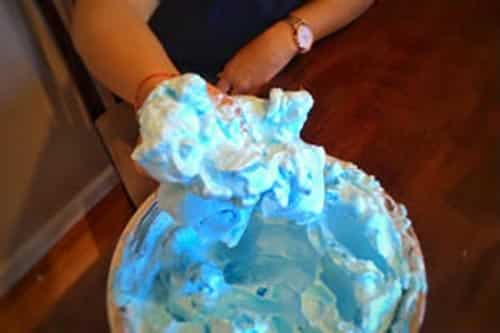
You will need
- 1.5 cups of hot water
- Food colouring (Optional)
- 1 cup of soap flakes
- Electric beater or whisk
- Mixing bowl
- Safety goggles to avoid getting soap in your eyes
Method
-
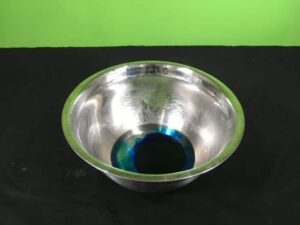
Pour the water and food colouring into the bowl and mix.
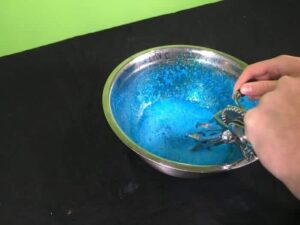
Add the soap flakes and mix with an electric beater on high until a thick foam is produced. This usually takes about five to ten minutes. Be careful, this foam expands exponentially.
-
Play with the soapy slime right away.
-
The more you whip the foam, the more puffed up the slime becomes!
Now let it setter for a few hours, its texture will change.
-
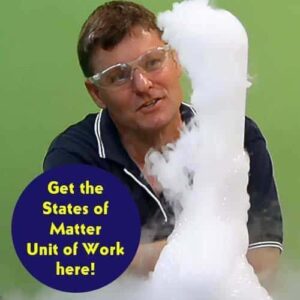
Get the Unit of Work on States of Matter here!
- What are the different states of matter?
- How does heat affect the size of materials?
- How does liquid nitrogen affect materials and much more!
Includes cross-curricular teaching ideas, student quizzes, a sample marking rubric, scope & sequences & more
-
School science visits since 2004!
– Curriculum-linked & award-winning incursions.
– Over 40 primary & high school programs to choose from.
– Designed by experienced educators.
– Over 2 million students reached.
– Face to face incursions & online programs available.
– Early learning centre visits too!

-

The science behind it
How does soap turn into slime?
The Science of Sudsy Slime
Whipping a hot, soapy solution creates a fascinating substance known in chemistry as a foam. Specifically, this is a colloidal dispersion of a gas (air) trapped within a liquid (the soapy water). Because the air bubbles are so tiny and packed so tightly together, the resulting foam feels thick, viscous, and “slimy” to the touch!
The “sliminess” comes from the surface tension of the water and the long-chain molecules found in many soaps. As you whip the mixture, you are increasing the surface area of the liquid, allowing it to trap more and more air. This is why a small amount of liquid can rapidly expand to fill a large tub—making it a very inexpensive way to create mountains of sensory play material.
Interestingly, this is the same science used to create whipped cream or the “head” on a glass of soft drink. The soap acts as a surfactant, which lowers the surface tension of the water and allows the bubbles to stay stable for much longer without popping.
Ready for a different texture? Check out our comprehensive guide to more slime recipes here!
Variables to test
Find out more on variables here.
-
Surfactant Composition
Try different soap types, like hand soap versus dish detergent. Dish detergent is designed to create lots of stable bubbles—does it produce a “slimier” foam than regular soap? -
Thermal Energy
Vary the temperature of the water. Heat usually lowers surface tension; does this make it easier to whip up the foam, or does the foam collapse faster as the water cools? -
Agitation Speed
Does slow or fast mixing make a difference? This tests how much mechanical energy is required to disperse the gas into the liquid. Do faster speeds create smaller, denser bubbles? -
Water Hardness
Does the experiment work better with tank water or tap water? Minerals like calcium in “hard” water can interfere with the soap’s ability to form stable bubbles.
No matter which variable you try, remember to change only one thing at a time. This ensures your results are valid and is the heart of the scientific method!

Teacher's note
Curriculums change, and so does the way you implement them in your classroom. Please use your own experience and knowledge of your students to use these resources to best effect for student learning.
Still want the curriculum links?
Here are the suggested links:
Australian Curriculum (ACARA) Science:
NSW Science syllabuses:
Victorian Curriculum Science:
Want this experiment — and many more — running in your classroom?
Have us visit your school — every student gets three hands-on experiments in 60–90 minutes with a qualified presenter.








