
Sink the foil boat
A science activity that floats kids boats! Actually, it's more about how well kids can create a foil boat that holds lots of weight. Test their skills!
Adult supervision for setup
You will need
- Aluminium foil
- A tub of water
- Marbles, metal nuts or anything else you want to use as weights
- Optional: A scale to measure the weight
- A mess bucket and cleaning materials
Method
-
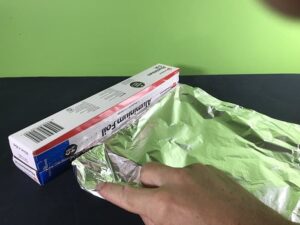
Tear off a square of foil roughly 30cm by 30cm.
-
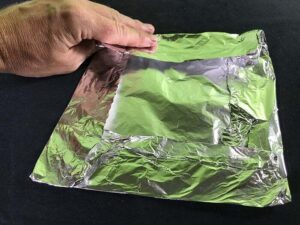
Fold the edges of the foil to form a neat square. This also allows the side of the foil boat to be stronger.
-
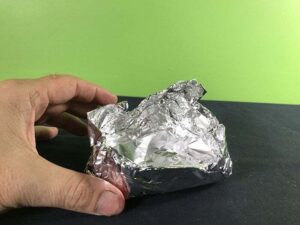
Form the boat sides. Try cube-shaped barges vs. speedboat shapes!
-
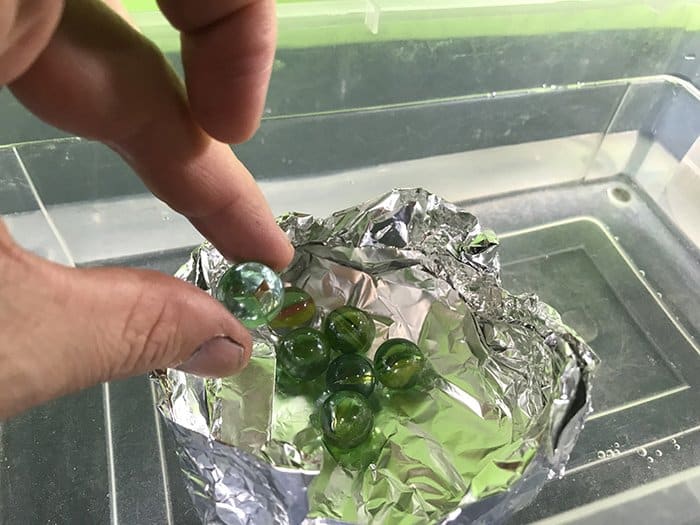
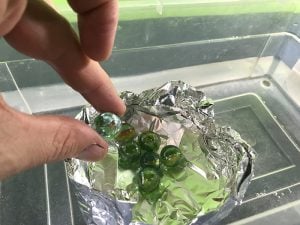
Add marbles or similar weights one by one into the boat until it sinks! You could also measure the weight of each object you add to the boat for additional rigour (it is a competition after all!).
-
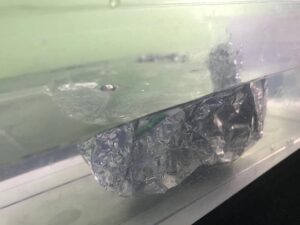
Completely sunk! Try again, can you do better with a different boat design?
-
Get the Unit of Work on Water Science here!
- Explore the water cycle
- Learn about cohesion, adhesion & capillary action
- From water currents to floatation, join us to explore water science!
Includes cross-curricular teaching ideas, student quizzes, a sample marking rubric, scope & sequences & more

-
School science visits since 2004!
– Curriculum-linked & award-winning incursions.
– Over 40 primary & high school programs to choose from.
– Designed by experienced educators.
– Over 2 million students reached.
– Face to face incursions & online programs available.
– Early learning centre visits too!

-

The science behind it
What is happening?
Aluminium Foil Boat Challenge
Things float in water due to displacement and the resultant forces that act back on the object. Displacement occurs when an object pushes a liquid or gas out of the way. When you place your boat into the water, it moves a certain volume of water aside to make room for itself.
According to Archimedes’ Principle:
“Any object, wholly or partially immersed in a fluid, is buoyed up by a force equal to the weight of the fluid displaced by the object.”
- Floating: If the weight of the water displaced is more than the weight of the object, the object will float. This is because the upward buoyancy force provided by the water is stronger than the downward force of gravity acting on the object.
- Sinking: If the weight of the water displaced is less than the object’s weight, the object will sink. In this case, the downward force of gravity wins because the object is denser than the water it is trying to move.
By shaping the aluminium foil into a boat, you increase its volume without increasing its mass. This allow the boat to displace a much larger weight of water than a flat piece of foil or a crumpled ball could, allowing it to support extra “cargo” like marbles!
Variables to trial
Find out more on variables here.
-
Material Efficiency
Can you reduce the total amount of foil used and still hold the same number of marbles? This is all about the “strength to weight” ratio of your design. -
Fluid Density
What happens if you use a liquid other than water, such as salty water or oil? Does the boat sit higher or lower in the liquid? -
Centre of Mass
Does it matter where you place the weights within the boat? If you place all the marbles on one side, how does it affect the stability and displacement?

Teacher's note
Curriculums change, and so does the way you implement them in your classroom. Please use your own experience and knowledge of your students to use these resources to best effect for student learning.
Still want the curriculum links?
Here are the suggested links:
Australian Curriculum (ACARA) Science:
NSW Science syllabuses:
Victorian Curriculum Science:
Want this experiment — and many more — running in your classroom?
Have us visit your school — every student gets three hands-on experiments in 60–90 minutes with a qualified presenter.








