
Colourful currents
See colourful currents of hot and cold water change places in this science experiment all about heat & density! Easy to run & fun to do! Find out more…
Adult supervision for setup
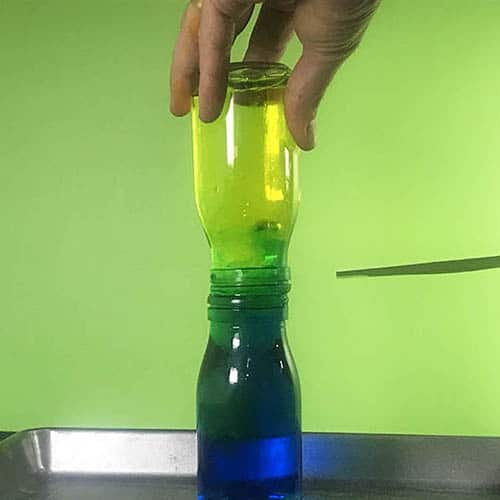
You will need
- 2 glass bottles with wide openings (e.g., milk bottles)
- 2 different food colours (e.g., yellow and blue)
- Hot water from the tap
- Cold water
- A tray
- An index card
- Optional: a freezer, thermometer and a stopwatch
Method
-
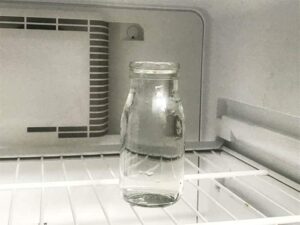
Fill one of the glass bottles to the top with water and place into the freezer. You don’t want to freeze the water, you just want to chill it. Wait roughly 5 to 10 minutes. This step isn’t absolutely essential but it certainly makes the temperature difference between the bottles more pronounced.
-
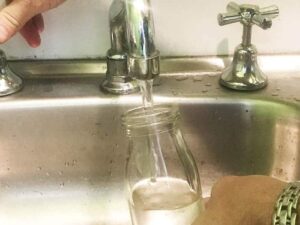
When the cold water bottle is chilled, fill the other bottle with hot water to the top from the tap. Caution – if your tap is very hot use an adult’s help.
-
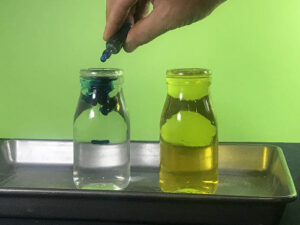
Place both bottles onto the tray. Add blue food colouring to the hot water and yellow food colouring to the cold water.
-
Keeping the index card as flat as possible, place the index card over the top of the yellow cold water bottle. Don’t squish down on the card, you just want to seal the bottle.
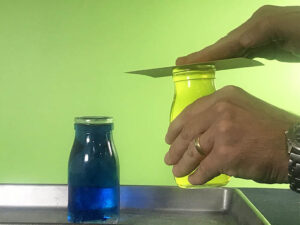
-
Carefully turn the cold yellow water bottle upside-down whilst gently pushing the index card upwards to keep the water sealed by the index card. If the seal is intact, you should be able to take your hand away from underneath the card and the water shouldn’t fall out. This works due to air pressure in the room pushing the water upwards. Full explanation in the upside-down water cup experiment here.
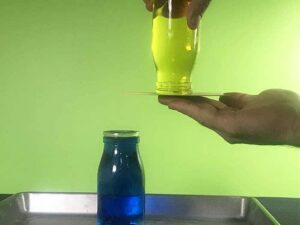
-
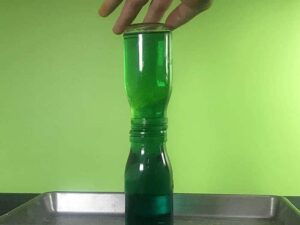
Carefully place the cold yellow water bottle directly over the top of the hot blue water bottle. Make sure that the openings of the bottles line up as close as possible!
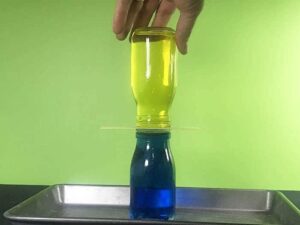
-
Moment of truth! Holding the top water bottle, gently pull the index out of between the two glass bottles. You should see currents of hot blue water rise into the cold water and currents of cold yellow water fall down into the blue water.
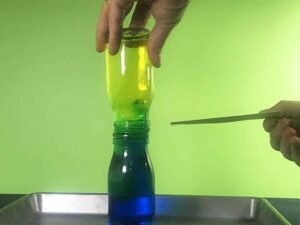
-
As the experiment progresses you should find that the colours mix to form green. The currents will stop moving once both water bottles are the same temperature. How long did this take?
-
Get the Unit of Work on Heat Energy here!
- What actually is heat?
- How does heat move through different materials?
- How does heat change the properties of materials and more!
Includes cross-curricular teaching ideas, student quizzes, a sample marking rubric, scope & sequences & more

-
School science visits since 2004!
– Curriculum-linked & award-winning incursions.
– Over 40 primary & high school programs to choose from.
– Designed by experienced educators.
– Over 2 million students reached.
– Face to face incursions & online programs available.
– Early learning centre visits too!
-

The science behind it
What is going on?
The Science of Colourful Currents
The core principle of this experiment is that hot water rises and cold water falls! This happens because hot water is less dense than cold water. When you removed the index card from between the two bottles, the molecules in the top bottle (if cold) were packed tightly together, making that water “heavy” or dense. It dropped downwards, forcing the “lighter,” less dense hot water from the bottom bottle to rise and take its place.
Why does this matter?
Both liquids and gases move constantly due to these density differences. In our oceans, water moves in massive loops called convection currents. These are driven by uneven heating from the sun and different salinity levels (saltiness).
The Earth’s atmosphere also moves because of uneven heating, which is the primary driver of our global weather patterns. Whenever we see the movement of a fluid (liquid or gas) caused by temperature-driven density differences, we call it convection.
Variables to test
Find out more on variables here.
-
Thermal Gradient
Does the speed of the mixing change if you increase the temperature difference between the two bottles? -
Aperture Size
Does the size of the bottle opening matter? Does a narrower neck slow down the rate of convection? -
Salinity vs. Temperature
Does this experiment work if you use salty water in one bottle and freshwater in the other, even if they are both the same temperature? -
Liquid Viscosity
Does this experiment work as effectively with different liquids, such as vegetable oil or sugar syrup?

Teacher's note
Curriculums change, and so does the way you implement them in your classroom. Please use your own experience and knowledge of your students to use these resources to best effect for student learning.
Still want the curriculum links?
Here are the suggested links:
Australian Curriculum (ACARA) Science:
NSW Science syllabuses:
Victorian Curriculum Science:
Want this experiment — and many more — running in your classroom?
Have us visit your school — every student gets three hands-on experiments in 60–90 minutes with a qualified presenter.








