
Leak Proof Bag
Show off your 'magic' skills as you demonstrate the leak proof bag science experiment! This all about polymers and friction… so easy to do!
Adult supervision for setup
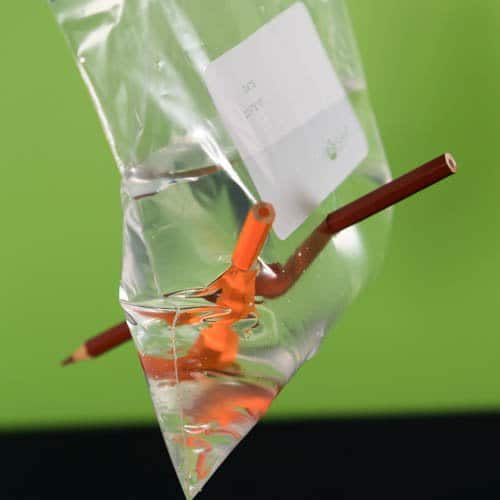
You will need
- One Zip Lock bag
- Water (enough to fill up the Zip Lock bag)
- Five sharp pencils
Method
-
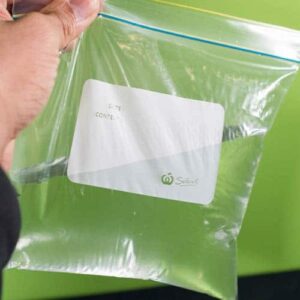
Fill the ziplock bag with water and close it.
-
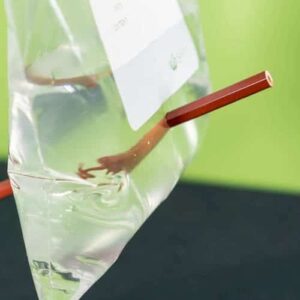
Hold up the ziplock bag and poke it with the sharp end of the pencil. Try fast vs. slow… which works better? Push the pencil all the way through the bag!
-
See how many pencils you can stab into the bag before it starts to leak!
-
Get the Unit of Work on Water Science here!
- Explore the water cycle
- Learn about cohesion, adhesion & capillary action
- From water currents to floatation, join us to explore water science!
Includes cross-curricular teaching ideas, student quizzes, a sample marking rubric, scope & sequences & more

-
School science visits since 2004!
– Curriculum-linked & award-winning incursions.
– Over 40 primary & high school programs to choose from.
– Designed by experienced educators.
– Over 2 million students reached.
– Face to face incursions & online programs available.
– Early learning centre visits too!
-

The science behind it
Why does this work?
The Science of the Leak-Proof Bag
This experiment seems like magic, but it is actually all about polymer chemistry! Most zip-lock bags are made from a plastic called low-density polyethylene (LDPE). This material is a polymer, which means it consists of long, flexible chains of molecules.
When you stab the pencils through the bag, you aren’t actually “breaking” the molecules; instead, the sharp point of the pencil slides between the long polymer chains, pushing them apart. Because these chains are flexible and “stretchy,” they immediately try to return to their original position.
Once the pencil is through, the polymer chains push back tightly against the sides of the pencil. This creates a temporary, watertight seal held in place by friction. As long as the pencil remains in the hole, the water stays inside. If you pull the pencil out, the chains cannot bridge the gap fast enough, and the water will pour out!
Variables to test
Find out more on variables here.
-
Thermal Energy
Does it make a difference with hot vs. cold water? Heat can sometimes make polymers more flexible—does this make the seal better or worse? -
Material Quality
Try different brands of zip-lock bags. Are “heavy-duty” freezer bags more effective than thin sandwich bags? -
Object Diameter
Can you use thin vs. thick pencils? At what thickness does the polymer finally fail to create a seal? -
Surface Texture
What about other objects like bamboo skewers, sewing needles, or tomato stakes? Does a smoother surface create a better seal than a rough one?

Teacher's note
Curriculums change, and so does the way you implement them in your classroom. Please use your own experience and knowledge of your students to use these resources to best effect for student learning.
Still want the curriculum links?
Here are the suggested links:
Australian Curriculum (ACARA) Science:
NSW Science syllabuses:
Victorian Curriculum Science:
Want this experiment — and many more — running in your classroom?
Have us visit your school — every student gets three hands-on experiments in 60–90 minutes with a qualified presenter.








