
How strong is an eggshell?
Just how strong are eggshells? Test their strength in this fun science activity for kids. Lots of fun and is perfect for the home or in the classroom.
Adult supervision for setup
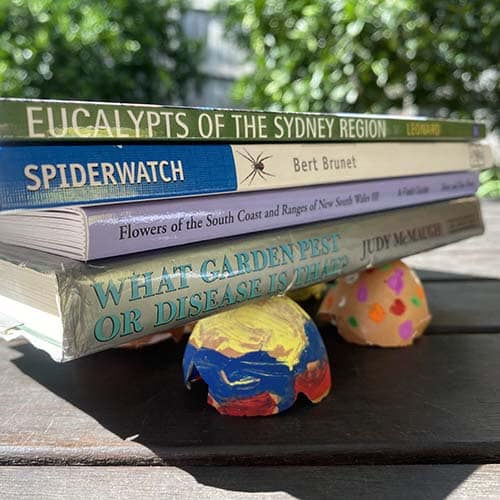
You will need
- At least 2 eggs (we used 4 to be on the safe side)
- A bowl to save the egg yolks and whites (maybe use this for the Baked Alaska science cooking activity!)
- Books
- Optional: paints, paintbrushes and paper
- Be aware of egg vapour allergies in your class
Method
-
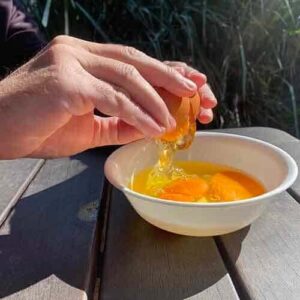
Carefully crack the eggs into a bowl. Don’t waste the egg contents, they are perfect for the Baked Alaska activity or simply for an extra yummy breakfast.
-
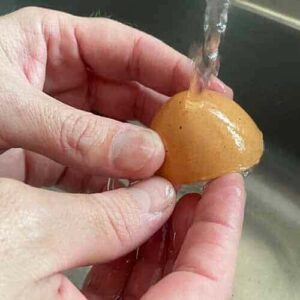
Wash the eggshells under running water and leave them to dry. You may want to trim the edges of the eggshells with scissors too.
-
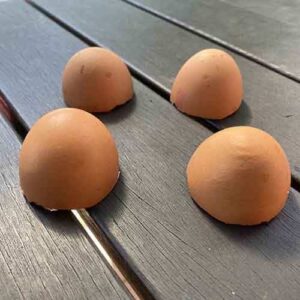
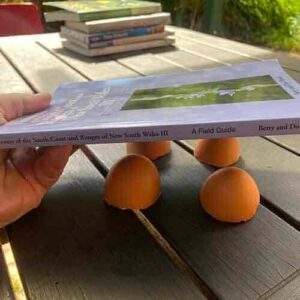
Arrange your eggshells so that they can support your stack of books.
-
Gently place your first book onto the eggshells.
Extension: If you have access to some scales, this is a good chance to measure the mass of each book prior to adding them onto the stack.
-
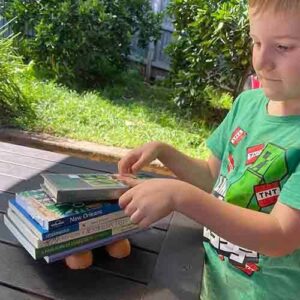
Keep carefully adding books onto the eggshells… how many can they hold?
-
As long as you keep the books centred, they can support quite a bit of weight!

-
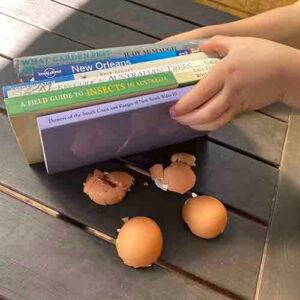
Keep going until the books crush the eggshells!
-
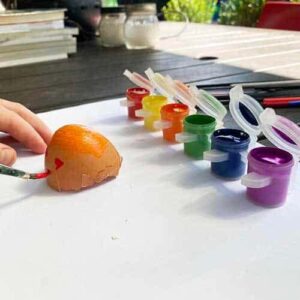
Optional – paint your eggs before testing their strength!
-
Even if the edges of the eggshells are chipped, they still can handle a lot of weight!

-
Get the Unit of Work on Forces here!
- Push, pull
- Friction & spin!
From inertia to centripetal force, this unit covers many concepts about Newton’s Laws!
Includes cross-curricular teaching ideas, student quizzes, a sample marking rubric, scope & sequences & more
-
School science visits since 2004!
– Curriculum-linked & award-winning incursions.
– Over 40 primary & high school programs to choose from.
– Designed by experienced educators.
– Over 2 million students reached.
– Face to face incursions & online programs available.
– Early learning centre visits too!
-

The science behind it
What is going on?
The Incredible Strength of Eggshells
Eggshells are surprisingly strong if they are compressed. The curved shape of the eggshell allows any force applied to the top to be spread both horizontally and vertically throughout the entire shell, rather than focusing it on a single point.
You can think of an eggshell as being like a 360-degree arched bridge. Engineers have known about the strength of arches for thousands of years. Arches are very stable because they convert tensile stress into compression stress, allowing structures to support a lot of weight. In fact, some structures built by the ancient Romans have survived thousands of years due to the clever use of arches in their design.
Road safety application
The curved surfaces of a bike helmet help to distribute impact forces around the skull rather than letting them focus directly onto one spot during a crash. However, it’s not just about the shape; the foam within the helmet is designed to crumple and absorb the impact energy experienced when colliding with the ground.
Curved surfaces also help distribute forces in cars. In a similar way to bike helmets, modern cars have crumple zones. These are specific areas of the vehicle designed to deform and compress during a collision, soaking up the energy of the crash before it reaches the passengers inside.
Variables to test
-
Quantity
What happens if you add more eggshell halves to your experiment? Does the weight capacity increase linearly? -
Configuration
Compare having 3 vs. 4 eggshell halves… does the extra shell allow it to hold a significantly greater weight? -
Egg Types
Try different types of eggs, such as duck eggs or small bantam eggs. Does the thickness of the shell change the result?
Going further
If you’re game… try the standing on eggs experiment too! This takes the concept of force distribution to the extreme. When you stand on a full carton of eggs, your weight is distributed across dozens of arches, making it possible to support a whole person without a single crack!


Teacher's note
Curriculums change, and so does the way you implement them in your classroom. Please use your own experience and knowledge of your students to use these resources to best effect for student learning.
Still want the curriculum links?
Here are the suggested links:
Australian Curriculum (ACARA) Science:
NSW Science syllabuses:
Victorian Curriculum Science:
Want this experiment — and many more — running in your classroom?
Have us visit your school — every student gets three hands-on experiments in 60–90 minutes with a qualified presenter.








