
Vortex rings with a bottle
Create vortex rings with a bottle! Easy to do and fascinating for kids to see. Find out how to set this up easily as your next science activity.
Adult supervision for setup
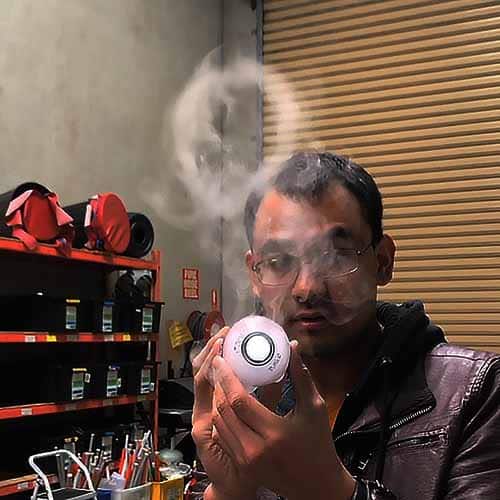
You will need
- A fog machine
- A soft drink bottle (try different sizes!)
Method
-
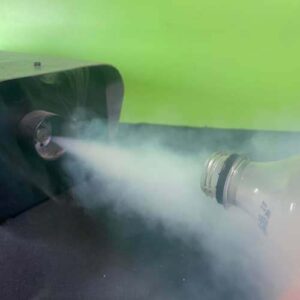
Warm-up your fog machine and then fill your soft drink bottle with stage fog. That’s it, you’re ready to go!
-
Gently squeeze the soft drink bottle in short bursts… you should see a vortex fog ring shoot out of the opening!

-
School science visits since 2004!
– Curriculum-linked & award-winning incursions.
– Over 40 primary & high school programs to choose from.
– Designed by experienced educators.
– Over 2 million students reached.
– Face to face incursions & online programs available.
– Early learning centre visits too!
-

-
Get the Unit of Work on Pressure here!
- Want to dive into air pressure?
- It’s all about air pressure in many ways!
From how storms form to how planes fly, this unit covers many concepts about air pressure.
Includes cross-curricular teaching ideas, student quizzes, a sample marking rubric, scope & sequences & more
The science behind it
What is going on?
Vortex Rings from a Plastic Bottle
We love toroidal vortices! These rings form because air rushes out of the bottle opening at different speeds. As the air is forced out, the molecules hitting the inner edges of the bottle opening slow down due to friction. Meanwhile, the air in the very centre of the opening continues to exit at high speed.
This difference in speed creates a boundary layer effect. The fast-moving central air “rolls” over the slower air at the edges, much like a wheel rolling on the ground. This rolling motion creates the donut-shaped ring that allows the puff of air to travel much further than a messy cloud of smoke would.
The underlying reason for the stability of the ring is a pressure differential. The mathematician Bernoulli discovered that faster-moving air has lower pressure than still air. As the air is squeezed out, the high-pressure air from the surrounding environment pushes toward the low-pressure “fast air” in the middle, helping to pinch and hold the ring shape together as it travels.
Essentially, low air pressure occurs when air is sped up because the energy of the molecules is being used primarily for forward motion rather than bouncing off one another. Slower-moving air molecules from the outside have more “static” energy to push into that space, effectively “contain” the faster-moving air into its vortex shape.
Want to make larger fog rings?
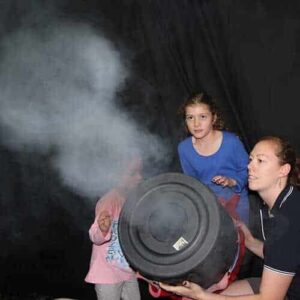
Once you’ve mastered the small bottle, why not scale up? Learn how to make giant fog rings using a rubbish bin and a shower curtain!
Variables to try
Find out more about variable testing here.
-
Aperture Size
Try different sizes of plastic bottles. Does a smaller opening create a faster, tighter ring than a wide one? -
Opening Shape
Does placing a triangle or square shape over the bottle opening create a shaped ring? (Hint: Watch closely to see if the ring eventually turns back into a circle!) -
Force of Squeeze
What happens if you tap the bottle gently versus a hard squeeze? Does the ring stay stable at different speeds?

Teacher's note
Curriculums change, and so does the way you implement them in your classroom. Please use your own experience and knowledge of your students to use these resources to best effect for student learning.
Still want the curriculum links?
Here are the suggested links:
Australian Curriculum (ACARA) Science:
NSW Science syllabuses:
Victorian Curriculum Science:
Want this experiment — and many more — running in your classroom?
Have us visit your school — every student gets three hands-on experiments in 60–90 minutes with a qualified presenter.








