
Book drop gravity activity
Test how gravity works in this classic book drop activity! You can explore one of the fundamental forces of our Universe with very little effort 🙂
Adult supervision for setup
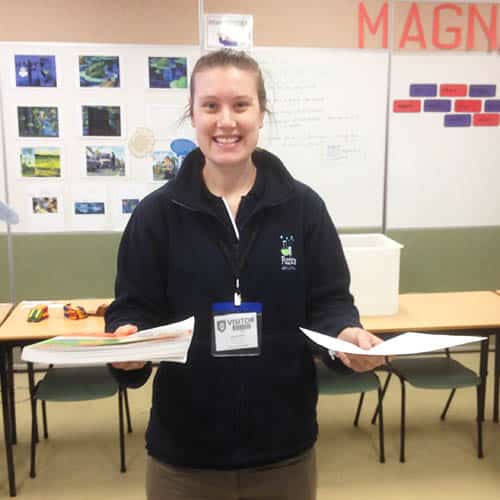
You will need
- A book that you can drop on the floor
- A piece of paper (the same size as the book)
Method
-
Hold a piece of paper and a book at the same height. Let them both go at the same time… which one hits the ground first?

-
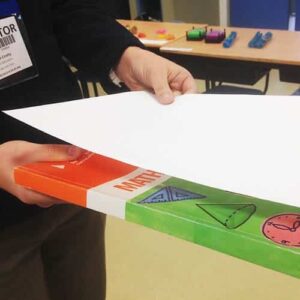
Now place the same piece of paper on top of the book and then drop both the paper and the book at the same time. Does the paper move away from the book or does both the book and the paper fall together at the same speed?
-
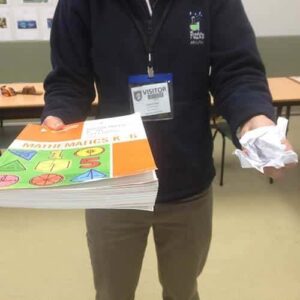
Finally, repeat the experiment by scrunching up the piece of paper and then drop both the book and the paper at the same height again. What do you observe? Why?
-
Get the Unit of Work on Forces here!
- Push, pull
- Friction & spin!
From inertia to centripetal force, this unit covers many concepts about Newton’s Laws!
Includes cross-curricular teaching ideas, student quizzes, a sample marking rubric, scope & sequences & more
-
School science visits since 2004!
– Curriculum-linked & award-winning incursions.
– Over 40 primary & high school programs to choose from.
– Designed by experienced educators.
– Over 2 million students reached.
– Face to face incursions & online programs available.
– Early learning centre visits too!

-

The science behind it
What’s going on?
The Science of Gravity and Air Resistance
One of the most counterintuitive facts in physics is that all objects accelerate toward the Earth at the exact same rate, regardless of their mass. This rate is approximately 9.8 m/s². Whether it’s a giant boulder or a tiny pebble, gravity pulls on them in a way that—in a vacuum—they would hit the ground at the same time.
Why do things fall differently?
In our daily lives, we don’t live in a vacuum; we live in an atmosphere full of air. This experiment breaks down the struggle between gravity (the pull down) and air resistance (the push up).
-
The Flat Paper vs. The Book: When dropped side-by-side, the book wins. Why? The book has more mass, which gives it more force to plow through the air molecules. This is explained by Newton’s Second Law:
F = m × a
F = Force (Newtons)
m = Mass (kg)
a = Acceleration (m/s²)The flat paper has a large surface area but very little mass, so the air molecules easily push back against it, slowing it down.
- The Shielding Effect: By placing the paper on top of the book, you eliminate the air resistance acting on the bottom of the paper. Since the book “clears the path,” both objects fall at the same rate.
- Surface Area and Aerodynamics: Crumpling the paper into a ball doesn’t change its mass, but it drastically reduces its surface area. With fewer air molecules hitting the paper as it falls, it can now keep pace with the book!
Seeing it in Action
To see what happens when you remove air entirely, watch this incredible footage of a bowling ball and a feather in a vacuum chamber, followed by the Apollo 15 moon drop.
Real-World Applications
This isn’t just about paper and books. Engineers use these principles to design aerodynamic cars and planes to save fuel. It also dictates how we explore space!
- On the Moon: Parachutes are useless because there is no atmosphere to provide air resistance. Spacecraft must use rockets to slow down.
- On Mars: The atmosphere is very thin. Parachutes help, but they aren’t enough on their own to stop a heavy rover from smashing into the surface.
Variables to test
Find out more on variables here.
- Mass Variation: Does a heavy textbook fall faster than a thin notebook when both have paper on top? This tests if higher mass provides even more “plowing” power through the air.
- Shape and Surface Area: Try dropping balls of different sizes but made of the same material (e.g., a golf ball vs. a ping pong ball). How does cross-sectional area affect terminal velocity?
- Drop Height: Does the “identical time” rule still hold up if you drop them from a second-story window versus a table? This tests if air resistance has more time to accumulate.
For a fair test, try to release both objects at the exact same millisecond. Even a tiny head start can change your results!

Teacher's note
Curriculums change, and so does the way you implement them in your classroom. Please use your own experience and knowledge of your students to use these resources to best effect for student learning.
Still want the curriculum links?
Here are the suggested links:
Australian Curriculum (ACARA) Science:
NSW Science syllabuses:
Victorian Curriculum Science:
Want this experiment — and many more — running in your classroom?
Have us visit your school — every student gets three hands-on experiments in 60–90 minutes with a qualified presenter.








