
Fireworks in a glass
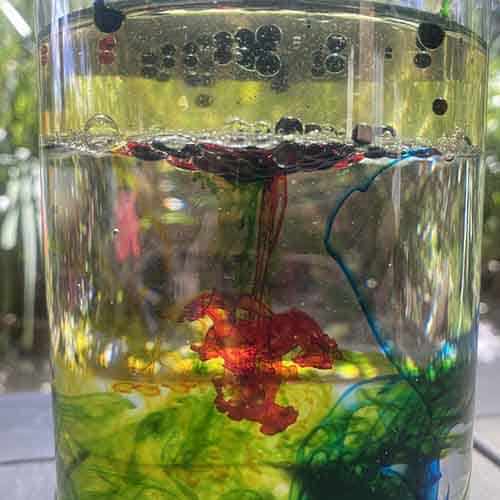
Create fireworks in a glass! This colourful science activity is highly popular with kids and can be used look at buoyancy, density and surface tension.
Adult supervision for setup
You will need
- Food colouring (the little squeeze bottles are very handy here)
- A tall glass or vase filled with water
- Vegetable oil
- Somewhere where you run the experiment without worrying about oil spills
Method
-
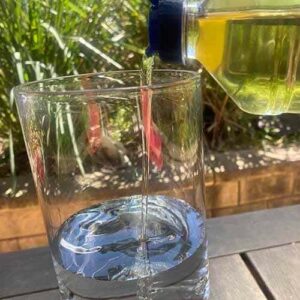
Carefully pour some vegetable oil into a tall glass or vase filled with water. Keep pouring the oil until you have at least 2 cm of oil floating above the water.
-
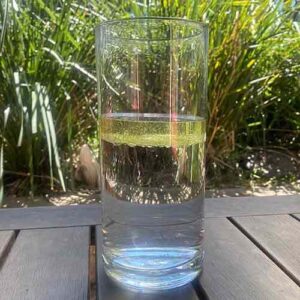
You should find that the oil floats above the water in the glass.
Oil does not mix with water because oil is hydrophobic. This is because water , H2O, is made of 1 oxygen atom which carries two negative charges and the two hydrogen atoms each carry a positive charge. This causes water molecules to be polar in charge, which means that the charge across each molecule is uneven. Oils on the other hand are non-polar, which means their charges are spread evenly across the oil molecule and as such are repelled by the polar water molecules.
Also, the oil floats above the water because it is less dense than water (ie. less mass per volume). Try this density column science activity to look even further at floating liquids!
-
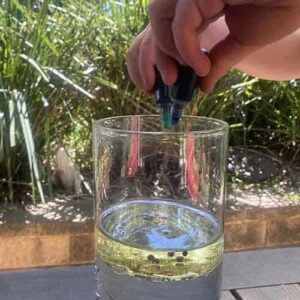
Gently squeeze the bottles of food colouring above the oil. Do this with as many colours as possible!
-
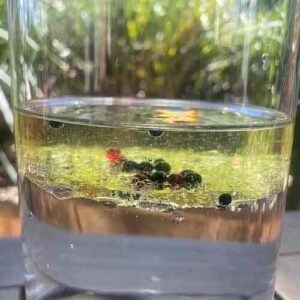
Firstly, the food colour beads drop through the oil as they are denser than the oil.
You should find that the food colour droplets form bead shapes at the boundary between the oil and water layers.The bead shapes form as the water-based food colouring is repelled by the oil and this repulsion from the oil plus the surface tension in the food colouring around each droplet pulls them into a sphere shape.
-
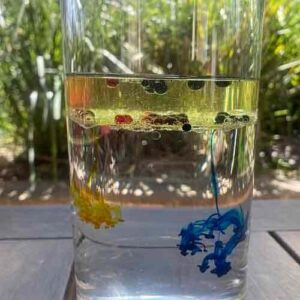
Once the food colouring droplets break the surface tension of the water layer, they stream downwards towards the bottom of the glass. This is because food colouring is denser than water.
You will notice that the food colouring spreads out as it drops through the water. This is because the food colouring is water-based and so is able to mix in water. The food colouring will continue to spread out in the glass as the food colour moves from high concentration to low concentration.
-
The food colour beads will continue to drop out of the oil, producing the classic ‘fireworks in a glass’ image. Keep adding more food colouring and watch the action!

-
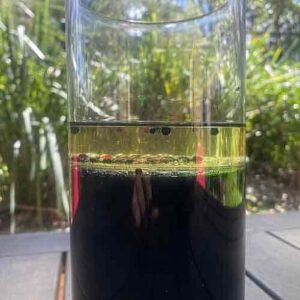
Eventually, the food colouring will spread out throughout the water in the glass, leaving the lighter coloured oil floating above it.
-
School science visits since 2004!
– Curriculum-linked & award-winning incursions.
– Over 40 primary & high school programs to choose from.
– Designed by experienced educators.
– Over 2 million students reached.
– Face to face incursions & online programs available.
– Early learning centre visits too!
-
Get the Unit of Work on Mixtures here!
- How can we separate mixtures?
- What are the different techniques?
- From chromatography to magnetism, join us to explore the variety of ways we can separate mixtures!
Includes cross-curricular teaching ideas, student quizzes, a sample marking rubric, scope & sequences & more
-

The science behind it
Variables to test
Fireworks in a Glass: The Science of Density and Polarity
This experiment is a beautiful way to see density and molecular polarity in action. You will notice that oil and water simply refuse to mix. This is because oil is hydrophobic (“water-fearing”).
At a molecular level, water (H2O) is a polar molecule. The oxygen atom carries a slight negative charge, while the two hydrogen atoms carry a slight positive charge. This uneven charge makes water molecules act like tiny magnets that stick to each other. Oils, however, are non-polar; their charges are spread evenly, so they are effectively repelled by the “magnetic” pull of the water.
Additionally, the oil floats on top because it is less dense than water (it has less mass per unit of volume). The food colour beads, being water-based and denser than the oil, slowly sink through the oil layer until they reach the boundary.
At the boundary between the oil and water, the droplets form distinct beads. They are held there momentarily by surface tension. Once the weight of the droplet breaks that tension, the dye streams downwards. Because the food colouring is water-based, it is able to mix with the water molecules through diffusion, creating the “firework” effect.
Variables to test
Find out more on variables here.
-
Viscosity
Try different oils (e.g., olive oil vs. baby oil). Do the food colour droplets fall through each oil at the same speed, or does the viscosity of the oil slow them down? -
Solution Density
What happens if you add salt or sugar to the water first? Increasing the density of the water may make it harder for the food colouring to “burst” through the surface tension. -
Thermal Energy
What happens if you change the temperature of the oil or water? Heat increases molecular movement, which might make the “fireworks” spread out much faster!

Teacher's note
Curriculums change, and so does the way you implement them in your classroom. Please use your own experience and knowledge of your students to use these resources to best effect for student learning.
Still want the curriculum links?
Here are the suggested links:
Australian Curriculum (ACARA) Science:
NSW Science syllabuses:
Victorian Curriculum Science:
Want this experiment — and many more — running in your classroom?
Have us visit your school — every student gets three hands-on experiments in 60–90 minutes with a qualified presenter.








