
Balancing compass
Create a simple compass using 4 materials! Simple to make and easy for kids of all ages. Part of over 150 free science experiments.
Adult supervision for setup
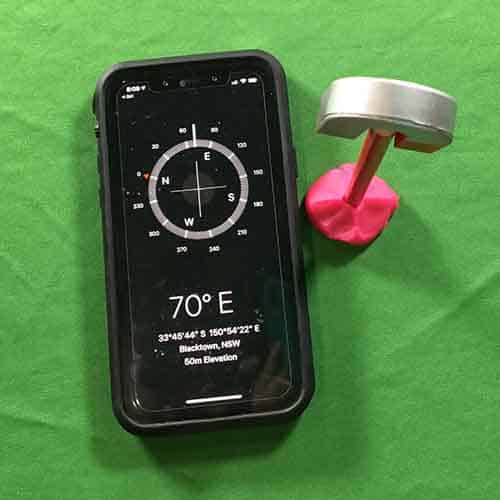
You will need
- A horseshoe magnet (find magnet supplies here)
- Modelling clay or dough
- A sharpened pencil
- A compass
- Optional: A smartphone with a compass app
Method
-
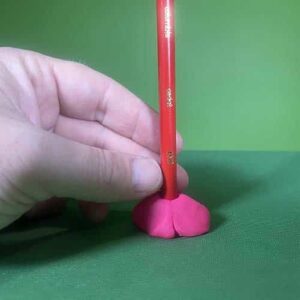
Push the end of a sharpened pencil into a lump of modelling clay or dough and stand it upright on a desk.
-
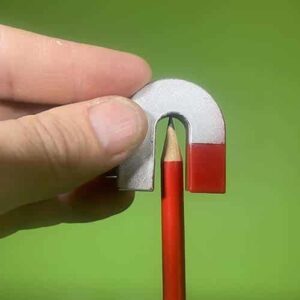
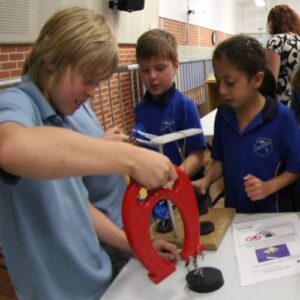
Carefully balance a horseshoe magnet on the tip of the sharpened pencil. The horseshoe magnet should be able to spin freely.
-
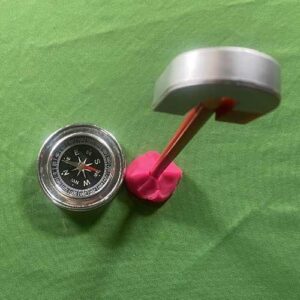
Bring a compass up to the base of the pencil. You should see that the horseshoe magnet has lined up with the same direction that the compass is facing. You’ve found Earth’s magnetic north pole!
You can double-check that compass is not being attracted to the horseshoe magnet by moving it away from the balancing compass you’ve made. If it the compass needle still points in the same northerly direction, you’re ok.
-
OPTIONAL – Use a compass app on a smartphone to instead of a traditional compass.

-
School science visits since 2004!
– Curriculum-linked & award-winning incursions.
– Over 40 primary & high school programs to choose from.
– Designed by experienced educators.
– Over 2 million students reached.
– Face to face incursions & online programs available.
– Early learning centre visits too!
-

-
Get the Electricity & Magnetism Unit of Work here!
- How does electricity actually flow?
- What makes magnets become magnetic?
- Why is there electromagnetism and what does this tell us about electricity & magnetism?
- From series & parallel circuits to conductors & insulators, there’s a lot to explore & learn!
Includes cross-curricular teaching ideas, student quizzes, a sample marking rubric, scope & sequences & more.
The science behind it
What is going on?
The Science of the Balancing Compass
By balancing a magnet so it can spin freely, you have created a magnetic compass. This experiment demonstrates the invisible force that protects our planet: the Earth’s Magnetic Field.
The Geodynamo Effect
Deep beneath our feet, the Earth’s outer core is composed of molten iron and nickel. This liquid metal is constantly swirling in large eddies. Because iron is a conductor, this motion creates electric currents, which in turn produce a massive magnetic field. This process is known as the geodynamo.
- Alignment: Your balanced horseshoe magnet acts like a tiny needle. It aligns itself with the magnetic field lines flowing between the Earth’s poles.
- Magnetic vs. True North: Because the liquid core is always moving, the Magnetic North Pole is not a fixed point; it actually “wanders” over time. This is different from “True North,” which is the fixed geographic axis upon which the Earth rotates.
Variables to test
More on variable testing here.
-
Magnetic Dipole Strength
Does the size or strength of the horseshoe magnet matter? Does a stronger magnet find North more quickly, or does its extra weight create more friction on the pivot point? -
Suspension and Friction
What if you vary how you suspend the magnet? Try hanging it from a string versus balancing it on a pencil. Which method has the least torsional resistance? -
Magnetic Interference
What happens if you bring a second magnet nearby? Can you “trick” your compass, or does the Earth’s magnetic field eventually pull it back? -
Balance Points
Try shifting the magnet slightly off-center on the pencil. How does the centre of mass affect the magnet’s ability to rotate horizontally?
To ensure a fair test, try to conduct your experiment away from large metal objects or electronic devices, as these can create local magnetic fields that interfere with your results!

Teacher's note
Curriculums change, and so does the way you implement them in your classroom. Please use your own experience and knowledge of your students to use these resources to best effect for student learning.
Still want the curriculum links?
Here are the suggested links:
Australian Curriculum (ACARA) Science:
NSW Science syllabuses:
Victorian Curriculum Science:
Want this experiment — and many more — running in your classroom?
Have us visit your school — every student gets three hands-on experiments in 60–90 minutes with a qualified presenter.








