
Balancing hammer & ruler
The balancing hammer on ruler activity explores centre of gravity. Amaze your friends with this simple and fun activity!
Adult supervision for setup
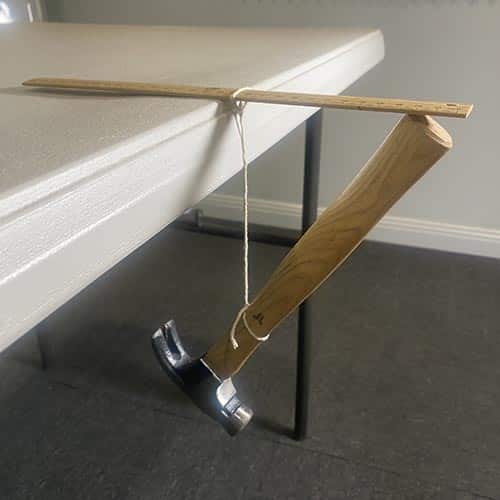
You will need
- A hammer (with a handle tapered towards the head)
- String
- A ruler
- A desk
- Scissors
Method
-
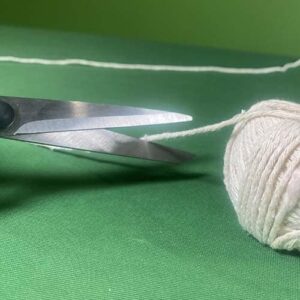
Cut about 20 cm of the string with your scissors.
-
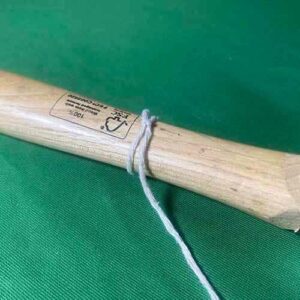
Tie one end of the string tightly around the hammer handle. Make sure that the string can’t slip off the handle.
-
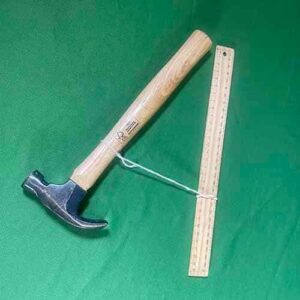
Tie the other end of the string to your ruler.
-
Firstly, check that the floor under your table can handle the hammer to fall on it without breaking. You don’t want to break your kitchen tiles or dent a wooden floor!
Resting the hammer handle on towards the tip of the ruler, place the hammer’s head under the desk and the other end of the ruler on the desk surface. Whilst supporting the hammer, slide the string along the ruler until you can feel that the ruler can support the hammer’s weight. Carefully take your hand away from under the hammer and you should find that your contraption balances itself!
Going further
How far can you move the ruler towards the end of the desk? Do you have to adjust the string’s placement? Why?

-
Get the Unit of Work on Forces here!
- Push, pull
- Friction & spin!
From inertia to centripetal force, this unit covers many concepts about Newton’s Laws!
Includes cross-curricular teaching ideas, student quizzes, a sample marking rubric, scope & sequences & more
-
School science visits since 2004!
– Curriculum-linked & award-winning incursions.
– Over 40 primary & high school programs to choose from.
– Designed by experienced educators.
– Over 2 million students reached.
– Face to face incursions & online programs available.
– Early learning centre visits too!

-

The science behind it
What is going on?
The Science of the Balancing Hammer & Ruler
This experiment looks like it defies gravity, but it is actually a perfect demonstration of static equilibrium and the centre of mass. While it seems the hammer should pull the ruler off the table, the arrangement shifts the balance point of the entire “system” (the hammer, ruler, and string) to a very stable position.
How the Balance Works
The key to this trick is where the heavy head of the hammer is located. Even though the ruler is sticking out over the edge, the hammer’s handle is angled back underneath the table.
- Leverage and Torque: The hammer acts like a lever. As gravity pulls the heavy head down, the end of the hammer’s handle pushes upward against the underside of the ruler.
- The Pivot Point: The string acts as a fulcrum. Because the hammer handle is pushing up on the ruler, it counteracts the downward pull of the ruler’s overhanging end.
- Center of Mass: For an object to be stable, its center of mass must be directly below or above the point of support. By curving the hammer back, the combined center of mass for the ruler and hammer ends up located directly under the table surface.
Variables to test
Find out more on variables here.
-
Structural Integrity
What happens if you use a flexible plastic ruler instead of a wooden one? Does the tensile strength of the ruler change its ability to transfer the upward force from the hammer? -
Fulcrum Positioning
Can you use different length strings? Changing the string length moves the angle of the hammer. How does this shift the center of mass relative to the edge of the table? -
Mass Distribution
Try hammers of different sizes and shapes (e.g., a mallet vs. a claw hammer). How does changing the total mass or the length of the handle affect the stability of the system? -
Ruler Extension
How far out can you move the ruler before the system fails? This tests the moment of force (torque) required to keep the ruler balanced.
To ensure a fair test, try to use the same table edge every time and only change one component of the setup at a time!

Teacher's note
Curriculums change, and so does the way you implement them in your classroom. Please use your own experience and knowledge of your students to use these resources to best effect for student learning.
Still want the curriculum links?
Here are the suggested links:
Australian Curriculum (ACARA) Science:
NSW Science syllabuses:
Victorian Curriculum Science:
Want this experiment — and many more — running in your classroom?
Have us visit your school — every student gets three hands-on experiments in 60–90 minutes with a qualified presenter.








