
Phone book friction
Explore the effects of friction with a classic demonstration using two phone books! Part of >150 free science experiments & activities.
Adult supervision for setup
You will need
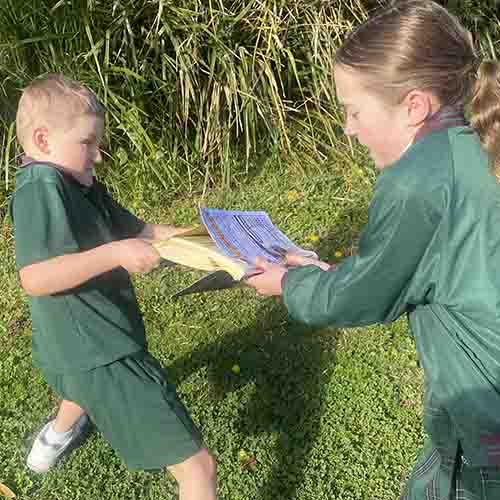
- Two softcover books of the same size. The more pages the better! We use old phone books as we're less concerned if the pages get damaged, plus the soft covers make it easier to get the books together.
- Two people to demonstrate
Method
-
Open the covers of each of the books and lie one cover on top of the other as shown.

-
Begin to layer alternate pages of each book on top of each other. The aim is to get as much contact between the book pages as possible – take your time and do as many pages as you can in the time you have!

-
Keep going until both books are weaved together. You may need to push the two book spines towards each other to keep the books together.

-
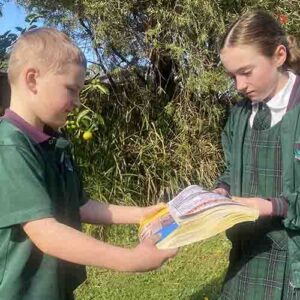
Get your two volunteers to hold the book spines or at least the corners of the books.
-
Moment of truth! Hold the spines as tight as possible and try to pull the books apart. If you have set the books up correctly you’ll find that this is very difficult!
-
Get the Unit of Work on Forces here!
- Push, pull
- Friction & spin!
From inertia to centripetal force, this unit covers many concepts about Newton’s Laws!
Includes cross-curricular teaching ideas, student quizzes, a sample marking rubric, scope & sequences & more

-
School science visits since 2004!
– Curriculum-linked & award-winning incursions.
– Over 40 primary & high school programs to choose from.
– Designed by experienced educators.
– Over 2 million students reached.
– Face to face incursions & online programs available.
– Early learning centre visits too!

-

The science behind it
What is going on?
This demonstration is all about friction!
Friction occurs when two surfaces touch each other. The more contact between two surfaces, the more friction is generated. Friction opposes movement; this means the higher the friction between two surfaces, the harder it is for those surfaces to slide along each other.
By weaving as many book pages together as possible, you create a massive amount of surface area where the pages are touching. While the friction between two individual pages is small, when you multiply that by hundreds of pages, the cumulative frictional force becomes enormous. Because there is so much total friction between the books, you need to apply a huge amount of force to separate them!
You would have found that the books were much easier to separate if you wiggled the pages to move them apart. Often in the classroom, the only reason the books separate is that volunteers pull them side-to-side and up-and-down as well as backwards. This wiggling reduces the constant contact between the book pages, allowing them to eventually slide free. Under controlled, linear conditions, it is much harder to separate the books than you might expect.
The Mythbusters Test
The Mythbusters tested this phenomenon using two tanks to measure the incredible forces involved!
In Todd Sampson’s Life on the Line, he took this to another level by bungee jumping with phone books connected (definitely not an experiment to replicate at home!).
Would you bungee jump with only the friction between two phone books stopping your fall? @toddsampsonOz‘s #LifeOnTheLine starts March 21. pic.twitter.com/XtzBMkOfN2
— abctv (@ABCTV) March 6, 2017
Road safety application
Tyres keep you in contact with the road. This contact provides the friction that allows you to quickly brake your vehicle or change direction. Always keep your tyres in good condition; the tread is essential to disperse water so that the rubber remains in direct contact with the road surface. Without that contact, you lose the friction you need to stay safe!
Variables to test
Find out more on variables here.
-
Book Size
Try using different sized books. Does a larger surface area make them harder to pull apart? -
Paper Texture
Does glossy paper (like a magazine) vs standard paper make a difference to the grip? -
Page Count
What happens if you only interweave every 5th or 10th page instead of every single one?

Teacher's note
Curriculums change, and so does the way you implement them in your classroom. Please use your own experience and knowledge of your students to use these resources to best effect for student learning.
Still want the curriculum links?
Here are the suggested links:
Australian Curriculum (ACARA) Science:
NSW Science syllabuses:
Victorian Curriculum Science:
Want this experiment — and many more — running in your classroom?
Have us visit your school — every student gets three hands-on experiments in 60–90 minutes with a qualified presenter.








