
Make a simple seismograph
Create a simple seismograph! An easy science activity that replicates an ancient design from China. Part of over 150 free experiments 🙂
Adult supervision for setup

You will need
- A plastic or paper plate
- A cardboard roll (like from toilet paper or paper towel, if you can’t find these a rolled-up piece of paper will do)
- A ping pong ball (or some other light ball that you can balance on top of the cardboard roll – you can even try making a ball from aluminium foil)
- Sticky tape or masking tape
Method
-
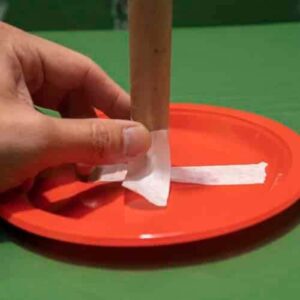
Use the sticky tape to stick the roll to the centre of the plate so that the roll stands upright when you place the plate on a table.
-
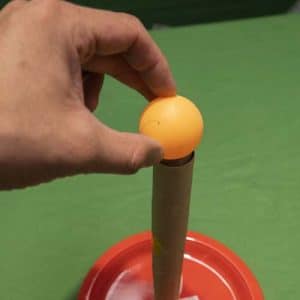
Balance the ball on top of the cardboard roll.
-
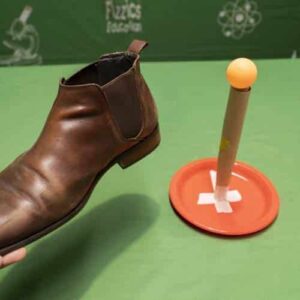
Hit the table either using the palm of your hand or an object such as a shoe or book. (Do not do on a glass/fragile table!).
Could you make the ball fall off?
Did you notice that the ball fell towards the direction that you hit the table?
Troubleshooting
If the ball doesn’t drop:
- Use a thinner roll, you can just roll up paper.
- Hit the table harder (don’t break anything!)
If the ball falls in the wrong direction:
- If the ball falls in the wrong direction it is likely that your table has cross-braces built into its frame, changing the way the table vibrates. Use a different table and try again!
-
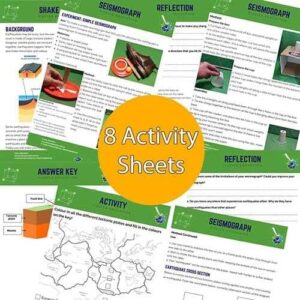
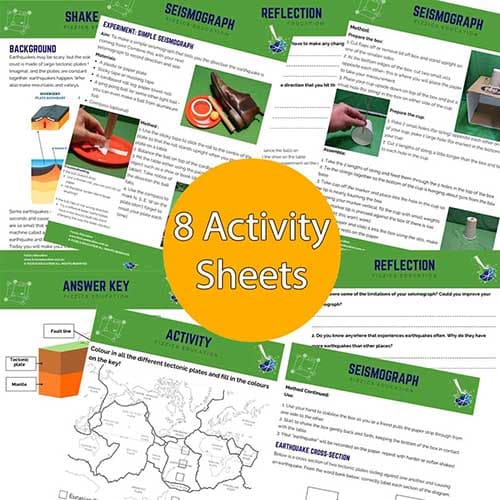
Go further – buy 8 x student activity sheets as extension worksheets.
This student science booklet has been created by experienced science educators from the Fizzics Education team.
Use these student worksheets as blackline masters for your science class!

-
Get the Unit of Work on Geology here!
- The Earth’s layers, the rock cycle, volcanoes, earthquakes & more!
From soil science to mineral testing, these hands-on experiments your students will discover the importance of natural resources and the role of plate tectonics in shaping our world.
Includes cross-curricular teaching ideas, student quizzes, a sample marking rubric, scope & sequences & more
-
School science visits since 2004!
– Curriculum-linked & award-winning incursions.
– Over 40 primary & high school programs to choose from.
– Designed by experienced educators.
– Over 2 million students reached.
– Face to face incursions & online programs available.
– Early learning centre visits too!
-

The science behind it
What is going on?
This design is similar to an ancient Chinese seismograph built in 132AD in that it does not tell you the size of the earthquake but rather the direction it is coming from. The ancient Chinese seismograph featured eighth dragons around a bronze urn and each dragon faced either N, S, E, W, NE, NW, SE or SW. When an earthquake occurred a metal ball in the dragon’s mouth would drop into the mouth of a frog below. Indicating the direction that the earthquake had come from. So, if the north most dragon dropped its ball, then the earthquake came from the north.
Variables to test
- Try different size balls
- Try different size tubes to balance the balls on
- Try different directions to hit the show on the table
- Can you replicate this by running the experiment on the ground?
Classroom activity sheets for this experiment
Create, reflect & extend!


Teacher's note
Curriculums change, and so does the way you implement them in your classroom. Please use your own experience and knowledge of your students to use these resources to best effect for student learning.
Still want the curriculum links?
Here are the suggested links:
Australian Curriculum (ACARA) Science:
NSW Science syllabuses:
Victorian Curriculum Science:
Want this experiment — and many more — running in your classroom?
Have us visit your school — every student gets three hands-on experiments in 60–90 minutes with a qualified presenter.








