
DIY Barometer
Make a simple DIY barometer using household materials. Learn about the weather and air pressure plus track changes in your local weather over time.
Adult supervision for setup
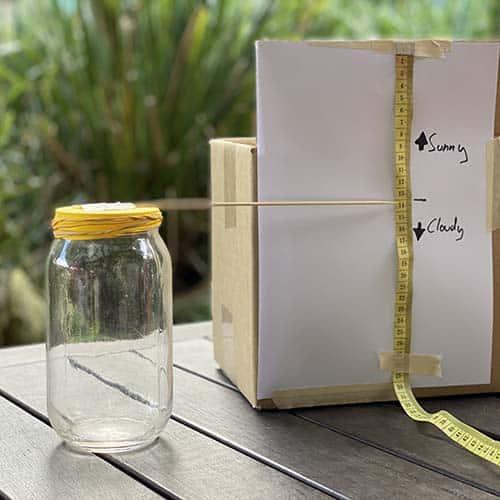
You will need
- A balloon
- Glass jar or metal tin
- Rubber bands
- Sticky tape or superglue
- Paper
- Marker
- Measuring tape
- Kebab stick or straw
- Scissors
- Optional box (otherwise use a wall)
Method
-
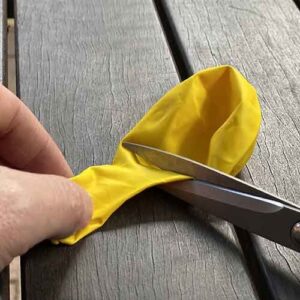
Cut the neck off the balloon and keep the larger part of the balloon for the next step.
-
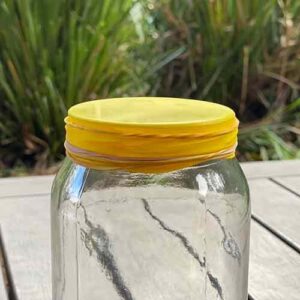
Secure the balloon over the opening of a glass jar with rubber bands.
Make sure that the balloon is stretched tight
-
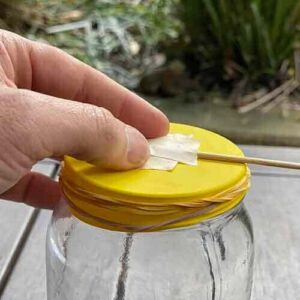
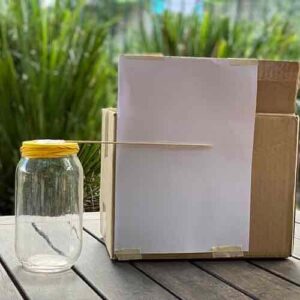
Tape the wooden kebab stick onto the centre of the balloon. If your tape is not sticking well, you might need to use craft glue or superglue.
-
Tape a white piece of paper to a box or onto a wall. Bring your DIY barometer up next to this piece of paper for the next step.
-
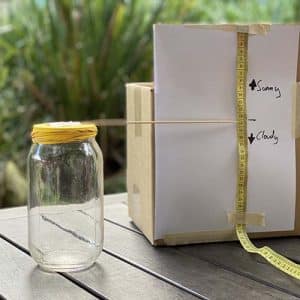
Secure the measuring tape onto the paper and make a mark where the kebab stick is currently pointing. Place arrows pointing up and down, above and below this mark as shown (sunny on the up arrow and cloudy on the down arrow).
The DIY barometer is now ready! Take daily measurements to see any changes of the position of the kebab stick (especially when the weather becomes sunny or rainy). Compare what you are seeing barometric pressure readings from local weather stations, weather maps or even your own barometer.
-
School science visits since 2004!
– Curriculum-linked & award-winning incursions.
– Over 40 primary & high school programs to choose from.
– Designed by experienced educators.
– Over 2 million students reached.
– Face to face incursions & online programs available.
– Early learning centre visits too!
-

-
Get the Unit of Work on Pressure here!
- Want to dive into air pressure?
- It’s all about air pressure in many ways!
From how storms form to how planes fly, this unit covers many concepts about air pressure.
Includes cross-curricular teaching ideas, student quizzes, a sample marking rubric, scope & sequences & more
The science behind it
What is going on?
How your DIY Barometer Works
Your DIY barometer relies on changes in air pressure to change the volume of air trapped inside the jar. Because the jar is sealed, the air inside acts like a spring that responds to the “weight” of the atmosphere pushing down on it from the outside.
As you sealed the balloon tightly across the jar opening, you trapped a set amount of air molecules within the container. From this point on, two main things can occur:
- Expansion (Low Pressure): If the air pressure outside the jar drops, there is less force pushing down on the balloon. This allows the air trapped inside the jar to expand more easily, pushing the balloon upwards. This movement causes the kebab stick to pivot downwards towards ‘cloudy’.
- Contraction (High Pressure): If the air pressure outside the jar increases, the “heavier” outside air pushes the balloon inwards. This causes the air inside the jar to compress, making the kebab stick point upwards towards ‘sunny’.
Note: Because air volume is also affected by temperature (the Ideal Gas Law), your barometer will also react if the room gets very hot or cold, which is why scientists usually keep professional barometers at a constant temperature!
Variables to test
Find out more on variables here.
-
Seal Tension
What happens if the balloon is not stretched tightly across the jar opening? Does it become more or less sensitive to pressure changes? -
Indicator Material
Does using a straw instead of a kebab stick make any difference to the stability or the movement of the pointer? -
Container Size
Does having a different volume of jar or tin change the results? Consider if a larger volume of air creates a bigger “push”. -
Heat Influence
If you heat the jar with a hair dryer, what happens? Does this simulate high or low pressure? -
Cooling Influence
If you cool the jar with ice or iced water, what happens to the pointer?

Teacher's note
Curriculums change, and so does the way you implement them in your classroom. Please use your own experience and knowledge of your students to use these resources to best effect for student learning.
Still want the curriculum links?
Here are the suggested links:
Australian Curriculum (ACARA) Science:
NSW Science syllabuses:
Victorian Curriculum Science:
Want this experiment — and many more — running in your classroom?
Have us visit your school — every student gets three hands-on experiments in 60–90 minutes with a qualified presenter.








