
Balloon and nut hummer
Learn about the relationship between pitch and vibration speed with the balloon and nut hummer science experiment. A simple science experiment for the kids!
Adult supervision for setup
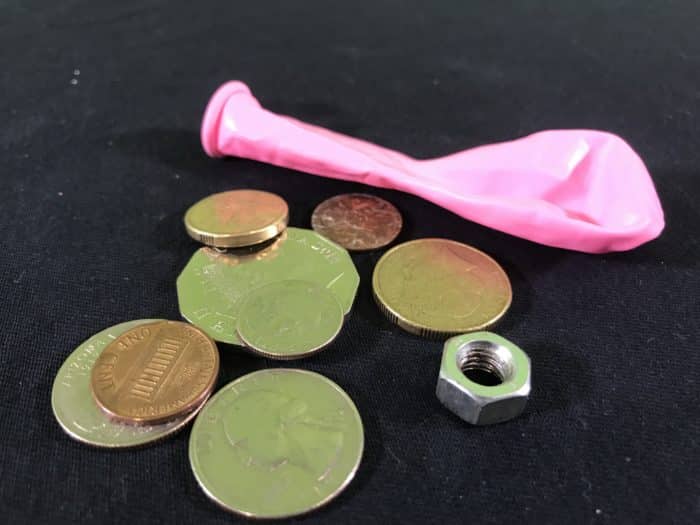
You will need
- One Balloon
- One 8mm metal nut (have different size ones on hand too!)
Method
-
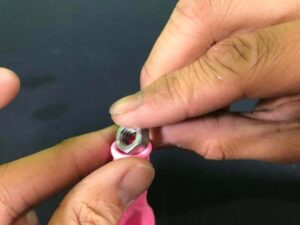
Insert the nut into the balloon.
-
Blow up the balloon and tie its end.
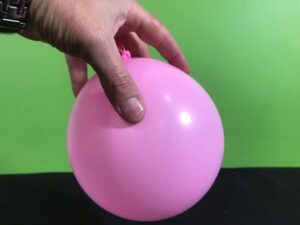
Hold the balloon in one hand at the end you have tied.
-
Gently swirl the balloon around in a circle.
Swirl the balloon faster and slower. What happens?
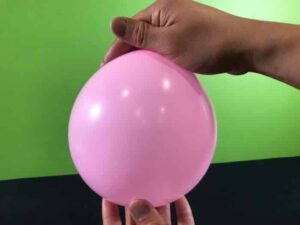
Your fingers can get in the way here so you may need to hold the balloon higher up. Sometimes holding the balloon from below as well can help.
-
School science visits since 2004!
– Curriculum-linked & award-winning incursions.
– Over 40 primary & high school programs to choose from.
– Designed by experienced educators.
– Over 2 million students reached.
– Face to face incursions & online programs available.
– Early learning centre visits too!

-

-
Get the Unit of Work on Sound here!
- What is amplitude?
- What is frequency?
- How does sound travel and what does it look like and more!
Includes cross-curricular teaching ideas, student quizzes, a sample marking rubric, scope & sequences & more

The science behind it
Why Does This Happen?
The Science of the Balloon and Nut Hummer
The “Balloon and Nut Hummer” is a brilliant way to explore two different areas of physics at once: Acoustics (sound) and Centripetal Motion (circular movement). When you spin the balloon, the hex nut inside creates a unique “screaming” or humming sound that changes as the nut moves faster.
Vibration and Pitch
The sound you hear is caused by vibrations. Because a hex nut has flat sides and sharp corners, it doesn’t roll smoothly like a marble would.
- Mechanical Vibration: As the nut circles the inside of the balloon, its corners strike the latex skin repeatedly. This makes the balloon vibrate rapidly.
- Frequency and Pitch: The faster you spin the balloon, the more times per second the corners hit the latex. This increases the frequency of the vibrations, which our ears perceive as a higher pitch.
Rotational Physics
This experiment also demonstrates how objects behave when they move in a circle. This is similar to the “Gravitron” ride at an amusement park or the spin cycle of a washing machine.
- Inertia: According to Newton’s First Law, the nut wants to keep moving in a straight line. It is constantly trying to “escape” out of the side of the balloon.
- Centripetal Force: The curved walls of the balloon provide a centripetal force—a “centre-seeking” force that pushes back against the nut, forcing it to follow a circular path instead of flying off in a straight line.
Variables to test
Find out more on variables here.
-
Velocity
Change the speed of your balloon rotations. At what point does the “hum” turn into a “scream”? How does angular velocity affect the pitch? -
Mass and Shape
Change the size of the nut or swap it for a coin. Does a larger mass create a deeper sound? What happens if you use a perfectly round marble instead of a hex nut? -
Material Tension
Change the type of balloons used. Does a thicker, higher-quality balloon produce a different timbre (tone quality) than a cheap, thin one? -
Volume
Change the size of the balloons. Does a larger balloon act as a better resonator, making the sound louder?
To ensure a fair test, try to use the same hex nut when testing different balloons, so you know any change in sound is definitely due to the balloon itself!

Teacher's note
Curriculums change, and so does the way you implement them in your classroom. Please use your own experience and knowledge of your students to use these resources to best effect for student learning.
Still want the curriculum links?
Here are the suggested links:
Australian Curriculum (ACARA) Science:
NSW Science syllabuses:
Victorian Curriculum Science:
Want this experiment — and many more — running in your classroom?
Have us visit your school — every student gets three hands-on experiments in 60–90 minutes with a qualified presenter.








