
Make A Simple Thermometer
Create a simple thermometer using simple materials. A great acitivty for kids to learn about measurement & heat at home or in class. Find out more!
Adult supervision for setup
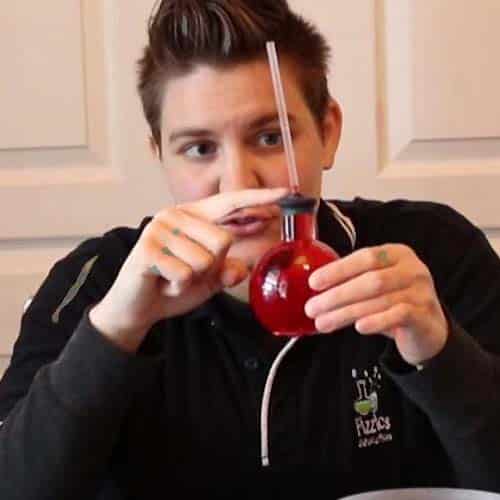
You will need
- One Screw top container
- One Clear Straw
- Something to make a hole with eg. nail or hand drill
- Food Colouring
- Hot water bath, ice bath and hair dryer (Optional)
- Moulding clay and a permanent marker
- Balloons or Water Balloons (Options available also Blu-Tak or Plasticine)
- Container
- Scissors
- Straw
- Adult Help
Method
-
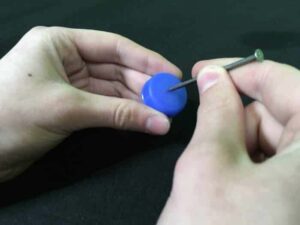
Carefully, and with the help of an adult, bore a hole into the middle of the containers’ lid. Make
sure that the hole made is only slightly bigger than the diameter of your straw.SAFETY: If children are to do this, make sure that the hand drills are not electrically powered.
Alternatively, hand drill the lids prior to children commencing the experiment or use balloons
instead of a plastic lid.ALTERNATE VERSION: Use a bottle that already has a small opening (e.g. soft drink bottle) or
Use balloon or water balloon.
-
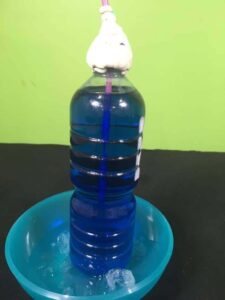
Thread the straw through the hole and seal the joint with the moulding clay (Important: Roll the
moulding clay around the edge of the lid making sure of a good airtight seal.You can also use a balloon with a hole in it to make a tight seal around the straw and bottle
opening.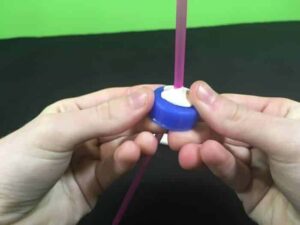
-
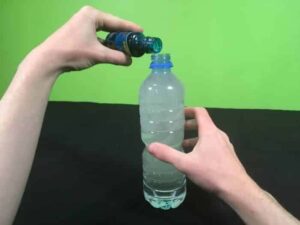
Fill your container to the brim with water and add in a couple of drops of food colouring.
-
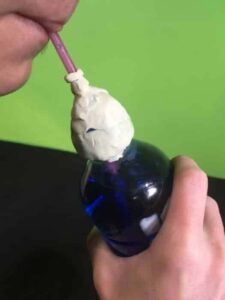
Gently blow into the straw – blowing hard may cause the water to rush up into your face!
-
Blowing into the straw forces air into an enclosed space, thereby increasing the pressure within
the container. If your seals are airtight, you will find that water will rise up the straw once you
stop blowing. This may require some trouble shooting!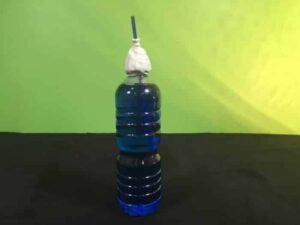
-
Mark the water level on the straw with the marker – this mark identifies where the water will be
when at room temperature.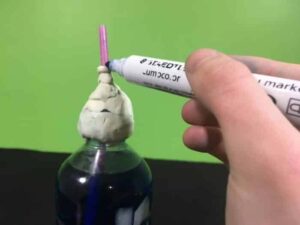
-
Now hold the container between your hands, thereby gently heating the water inside.
Alternatively you can use the hot water bath or even a hairdryer.If all has gone well you will find that the water will have travelled up the straw.
SAFETY: Using electrical appliances near water can be dangerous, please have an adult
demonstrate this experiment.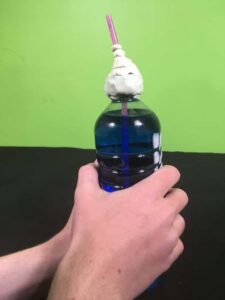
-
Now try placing the home made thermometer into an ice bath, what will happen to the water?
-
School science visits since 2004!
– Curriculum-linked & award-winning incursions.
– Over 40 primary & high school programs to choose from.
– Designed by experienced educators.
– Over 2 million students reached.
– Face to face incursions & online programs available.
– Early learning centre visits too!

-
Get the Unit of Work on Heat Energy here!
- What actually is heat?
- How does heat move through different materials?
- How does heat change the properties of materials and more!
Includes cross-curricular teaching ideas, student quizzes, a sample marking rubric, scope & sequences & more

-

The science behind it
Why Does This Happen?
The Science of Thermal Expansion
The basic principle of a thermometer is thermal expansion. When liquids are heated, their molecules gain kinetic energy and begin to move more vigorously. As they vibrate and collide, they push further apart, causing the liquid to take up more space and expand.
In your DIY thermometer, the expanding water has nowhere to go but up the straw! This same principle helps scientists to model the movement of ocean currents around the world, as warmer, less dense water expands and moves differently than colder, denser water.
This is exactly how a traditional mercury thermometer works. Mercury is used because it remains a liquid at temperatures as low as -39°C and expands at a very predictable, rapid rate when heated. Additionally, its convex meniscus (the way the top of the liquid curves upwards) allows for very accurate temperature readings against a scale.
Variables to test
Find out more on variables here.
-
Sensitivity
Can you make a thermometer with a wider straw? Does a wider straw make the thermometer more or less sensitive to small changes in temperature? -
Liquid Properties
What happens if you change the liquid to vegetable oil or methylated spirits? Different liquids have different coefficients of expansion, meaning some will rise much faster than others.
Safety Note: Do not expose methylated spirits to any heat source, including direct sunlight. -
Insulation
What happens if you wrap the bottle in Aluminium foil? Does it take longer for the water inside to react to the outside temperature?

Teacher's note
Curriculums change, and so does the way you implement them in your classroom. Please use your own experience and knowledge of your students to use these resources to best effect for student learning.
Still want the curriculum links?
Here are the suggested links:
Australian Curriculum (ACARA) Science:
NSW Science syllabuses:
Victorian Curriculum Science:
Want this experiment — and many more — running in your classroom?
Have us visit your school — every student gets three hands-on experiments in 60–90 minutes with a qualified presenter.








