
Create a Cave
Learn about chemical reactions and how the caves of the world are formed through this fun, simple science experiment for home or the classroom!
Adult supervision for setup

You will need
- A chalk block, the bigger the better
- Vinegar or a weak acid
Method
-
Carve out a small hole inside the chalk block. You can just crush up the chalk to speed the reaction.
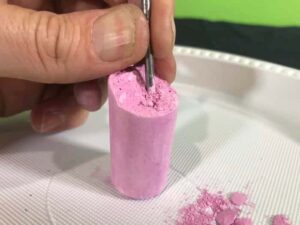
-
Fill the hole with vinegar and allow the vinegar to react with chalk, you should see small bubbles.
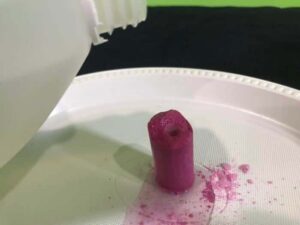
-
Pour out the liquid once you see no more bubbles, this may take some time.
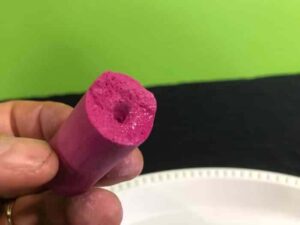
-
Add some fresh acid, vinegar, into the hole and allow the liquid to react again with the chalk. Repeat & repeat.
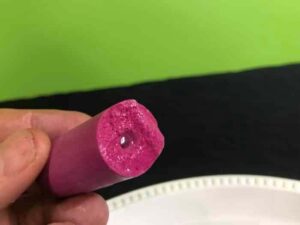
-
Is the hole starting to get bigger? Why? Where does the chalk go in the reaction? Check below…
-
Get the Unit of Work on Geology here!
- The Earth’s layers, the rock cycle, volcanoes, earthquakes & more!
From soil science to mineral testing, these hands-on experiments your students will discover the importance of natural resources and the role of plate tectonics in shaping our world.
Includes cross-curricular teaching ideas, student quizzes, a sample marking rubric, scope & sequences & more
-
School science visits since 2004!
– Curriculum-linked & award-winning incursions.
– Over 40 primary & high school programs to choose from.
– Designed by experienced educators.
– Over 2 million students reached.
– Face to face incursions & online programs available.
– Early learning centre visits too!

-

The science behind it
Why Does This Happen?
Chalk is made up of a type of limestone, a compound made of Calcium and Oxygen. Chalk is formed by the shells of microscopic marine organisms, often containing fossils from ancient seabeds. Vinegar reacted with the chalk to produce Carbon Dioxide gas, water and an aqueous compound.
2CH3CO2H(aq) + CaCO3(s) > 2Ca(CH3CO2)2(aq) + CO2(g) + H2O(l)
Limestone caves are formed when the limestone itself is dissolved by weak acids present in groundwater. This process occurs over many years and can eventually lead to forming massive formations as seen in the Jenolan Caves.
A similar process occurs when acid rain touches marble statues, this is a major issue in historic areas.
Variables to test
- Try using lemon juice as the acid instead of vinegar.
- With your science teacher’s supervision and safety glasses & PPE, try stronger acids

Teacher's note
Curriculums change, and so does the way you implement them in your classroom. Please use your own experience and knowledge of your students to use these resources to best effect for student learning.
Still want the curriculum links?
Here are the suggested links:
Australian Curriculum (ACARA) Science:
NSW Science syllabuses:
Victorian Curriculum Science:
Want this experiment — and many more — running in your classroom?
Have us visit your school — every student gets three hands-on experiments in 60–90 minutes with a qualified presenter.








