
Egg inertia
What does an egg, a little bit of water and Isaac Newtons first law of motion make? A crazy fun experiment for everyone to enjoy!
Adult supervision for setup
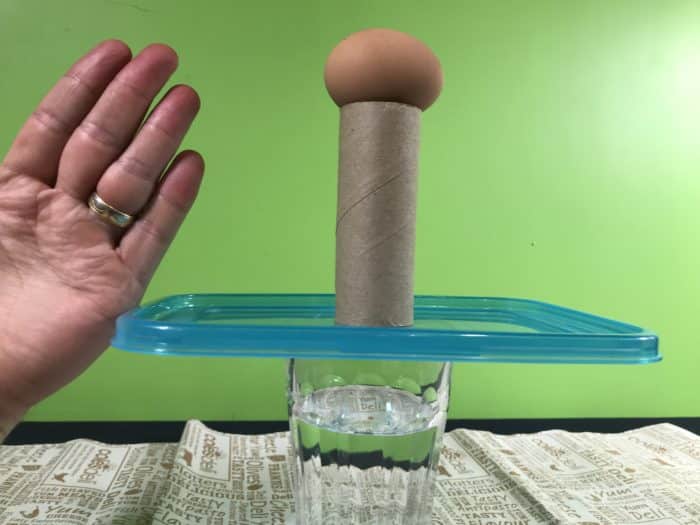
You will need
- One drinking glass, three-quarters full of water
- One sheet of newspaper
- One cardboard toilet roll
- One plastic tray or plate (must be flat on the bottom with a raised lip)
- One egg (or a water bomb for those with allergies)
Method
-
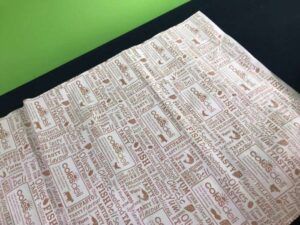
Place the newspaper on the table, to stop the splashing water getting the table wet.
-
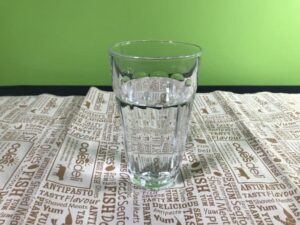
Place the glass of water in the middle of the newspaper.
-
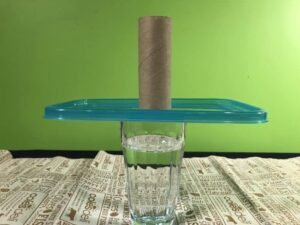
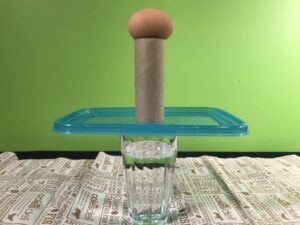
Place the tray/plate on top of the glass, and stand the toilet paper roll on top of it. Note: Make sure the toilet paper roll is directly above the glass of water. We don’t want our egg to hit the table instead of the water!
-
“Ready for a karate chop!”
Add your egg on top of the toilet paper roll. Use a water bomb if there a egg allergies in the room.
-
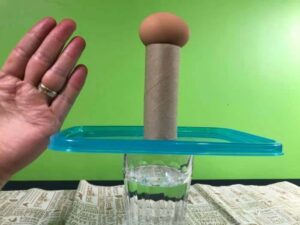
Now for the tricky part. You need to very quickly knock the tray/plate sideways, using a kind of “sideways karate chop” technique. The tray will fly horizontally, and the raised lip on the edge will catch the toilet roll, and the egg should fall straight down into the water, and stay un-cracked!
Variation: Try this experiment without the water in the glass!
-
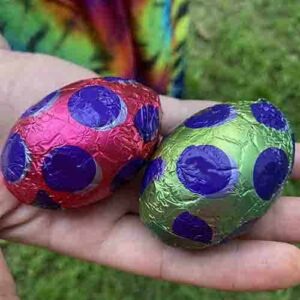
For a bit of fun at Easter, use chocolate eggs for the ‘egg-speriment’ instead 🙂
-
Get the Unit of Work on Forces here!
- Push, pull
- Friction & spin!
From inertia to centripetal force, this unit covers many concepts about Newton’s Laws!
Includes cross-curricular teaching ideas, student quizzes, a sample marking rubric, scope & sequences & more
-
School science visits since 2004!
– Curriculum-linked & award-winning incursions.
– Over 40 primary & high school programs to choose from.
– Designed by experienced educators.
– Over 2 million students reached.
– Face to face incursions & online programs available.
– Early learning centre visits too!
-

The science behind it
Why Does This Happen
The Science of Egg Inertia
The “Egg Drop” trick is a fantastic way to witness Newton’s First Law of Motion in action. This law states that an object at rest will stay at rest, and an object in motion will stay in motion, unless acted upon by an external force. This resistance to change in motion is called inertia.
Why does the egg fall straight down?
While the egg is balanced on the toilet roll, it is stationary and “wants” to stay that way. When you hit the tray, you apply a sudden horizontal force.
- The Transfer of Force: The tray moves sideways, and because of the friction or the raised lip, it takes the toilet roll with it.
- The “Inert” Egg: Because the tray and roll move so quickly, very little horizontal force is transferred to the egg. For a split second, the egg remains suspended in mid-air!
- Gravity Takes Over: Once the support is gone, the only major force acting on the egg is gravity, which pulls it straight down into the glass of water.
This is exactly how the famous “tablecloth trick” works. If the magician pulls the cloth fast enough, the inertia of the plates and cutlery keeps them in place while the cloth slips out from underneath.
Road Safety Application
Inertia is a life-saving concept in car design. If a car is traveling at 60 km/h and stops suddenly in a crash, your body—due to inertia—will continue to travel at 60 km/h until a force stops it.
Seatbelts provide that necessary counter-force, slowing your body down safely. Without them (or if there are loose objects in the back seat), inertia turns people and items into dangerous projectiles.
Variables to test
Find out more on variables here.
- Applied Force: How lightly can you hit the tray and still have the egg fall into the glass? If you hit it too slowly, friction will have more time to act on the egg, dragging it sideways with the tray.
- Object Mass: Does this work if you swap the egg for a much heavier object (like a large orange) or a lighter object (like a ping pong ball)? Objects with more mass have more inertia—does that make the trick easier or harder?
- Surface Friction: What if you sprinkle a little flour or salt on the tray? Does increasing the coefficient of friction between the roll and the tray change the outcome?
To keep your experiment valid, try to use the same glass and water level for every test so the egg has a consistent “landing zone.”

Teacher's note
Curriculums change, and so does the way you implement them in your classroom. Please use your own experience and knowledge of your students to use these resources to best effect for student learning.
Still want the curriculum links?
Here are the suggested links:
Australian Curriculum (ACARA) Science:
NSW Science syllabuses:
Victorian Curriculum Science:
Want this experiment — and many more — running in your classroom?
Have us visit your school — every student gets three hands-on experiments in 60–90 minutes with a qualified presenter.








