
Create Glowing Messages
Create glowing messages under UV light easily with kitchen materials. Part of over 150 free science experiments on the Fizzics Education website.
Adult supervision for setup
You will need
- A black light
- Petroleum jelly
- Paper
- A dark room
Method
-
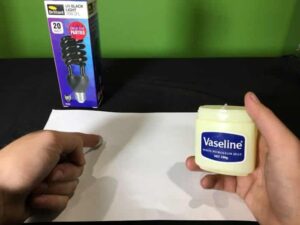
Dip your finger into the petroleum jelly and write a secret message on the paper.
-
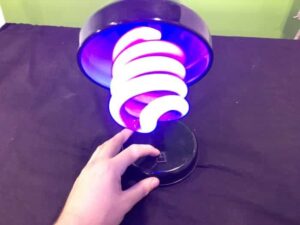
Turn on the black light and turn off the lights in your room.
-
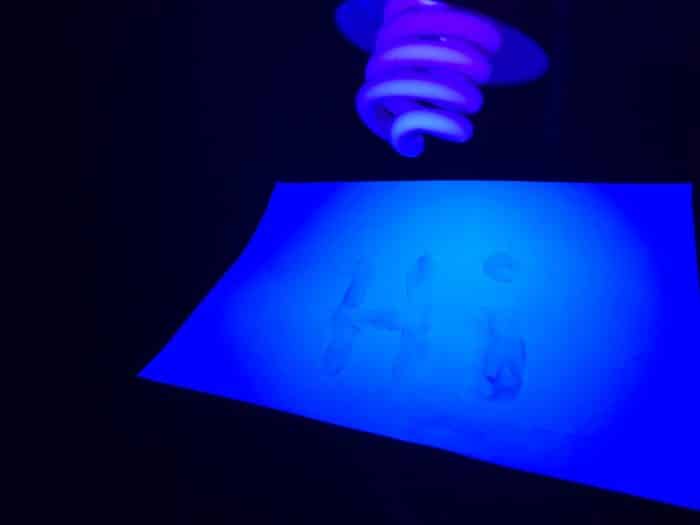
Shine the backlight onto the paper. Can you read the message clearly/
-
School science visits since 2004!
– Curriculum-linked & award-winning incursions.
– Over 40 primary & high school programs to choose from.
– Designed by experienced educators.
– Over 2 million students reached.
– Face to face incursions & online programs available.
– Early learning centre visits too!
-

-
Get the Unit of Work on Light & Colour here!
- What is colour addition vs subtraction?
- What is opacity, translucence & transparency?
- What is the difference between refraction & reflection?
- Explore UV light, lenses, thermochromism and more!
Includes cross-curricular teaching ideas, student quizzes, a sample marking rubric, scope & sequences & more
The science behind it
Why Does This Happen?
Visible light ranges in frequency from VIOLET (400nm) to RED (700nm).
Black lights emit the invisible ultraviolet light called UV-A, which has less energy than the sunburn causing UV-B light.
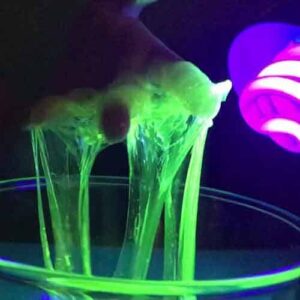
Some chemicals can absorb energy from invisible UV-A light and emit it as visible light.
These chemicals are said to be fluorescent and can occur in everyday items such as
laundry detergents, driver’s licences, air mail, nail polish, oils and even money!
All materials are made up of atoms, whereby electrons move in layered orbits or ‘shells’ around a central nucleus of protons and neutrons (except the nucleus of Hydrogen which contains only a proton). Fluorescence occurs when the UV-A light energizes the electrons surrounding the atoms that make up the paper. As the electrons get energized, they move to the outer orbit (or electron shell). Once the electrons lose their additional energy they fall back to their original orbit, releasing any remaining extra energy as visible light.
Forensic scientists can use fluorescence of chemicals to link a crime scene to the guilty person!
Variables to test
- Try different brands of petroleum jelly.
- What happens if you use different colours of paper?

Teacher's note
Curriculums change, and so does the way you implement them in your classroom. Please use your own experience and knowledge of your students to use these resources to best effect for student learning.
Still want the curriculum links?
Here are the suggested links:
Australian Curriculum (ACARA) Science:
NSW Science syllabuses:
Victorian Curriculum Science:
Want this experiment — and many more — running in your classroom?
Have us visit your school — every student gets three hands-on experiments in 60–90 minutes with a qualified presenter.








