
Drops on a coin
Explore surface tension with the drops on a coin science experiment! Kids of all ages love this activity and it is so easy to setup.
Adult supervision for setup
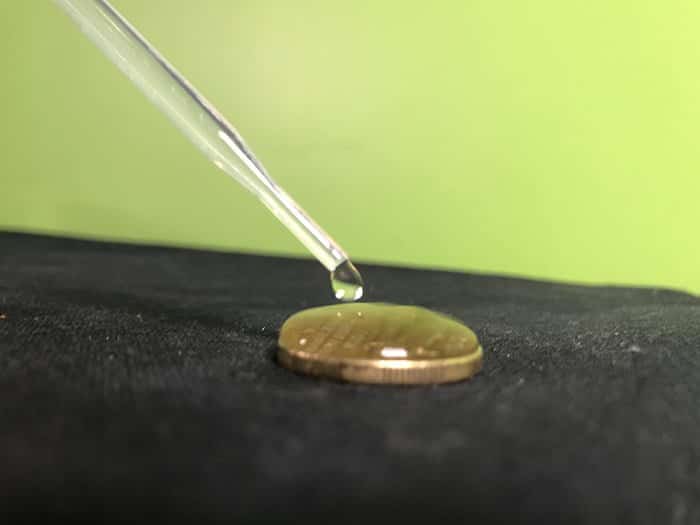
You will need
- A coin
- A pipette, eyedropper or a straw
- Clear water
- A mess bucket and cleaning materials
Method
-
Place the straw in some water and then put your finger over the end. You can now remove the straw and keep the water inside (this works due to air pressure holding the water up). You could use a pipette to make this science activity easier too.
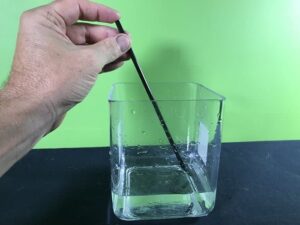
-
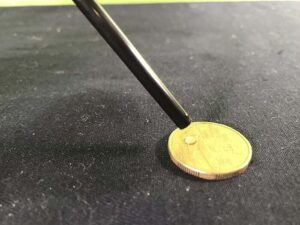
If you’re using the straw, carefully remove your finger to release your first drop of water.
-
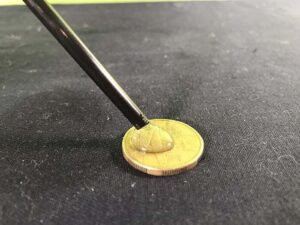
Keep adding water drops, counting each one!
-
If you look from the side, you should start to see the water begin to bulge over the side of the coin
We find a pipette easier for this part of the experiment.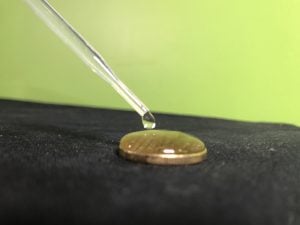
-
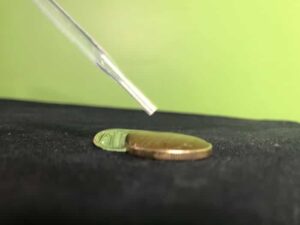
Keep going until the water spills over the side of the coin.
-
Get the Unit of Work on Water Science here!
- Explore the water cycle
- Learn about cohesion, adhesion & capillary action
- From water currents to floatation, join us to explore water science!
Includes cross-curricular teaching ideas, student quizzes, a sample marking rubric, scope & sequences & more
-
School science visits since 2004!
– Curriculum-linked & award-winning incursions.
– Over 40 primary & high school programs to choose from.
– Designed by experienced educators.
– Over 2 million students reached.
– Face to face incursions & online programs available.
– Early learning centre visits too!
-

The science behind it
What is happening?
The Science of Drops on a Coin
Water molecules really want to hang out with each other! This is due to the way they are built. Each water molecule (H2O) contains two hydrogen atoms and one oxygen atom. Because the oxygen atom is better at “pulling” on electrons, it becomes slightly negative, while the hydrogen atoms become slightly positive.
When the positive hydrogen from one water molecule is near the negative oxygen of another, they are attracted to each other. This is called hydrogen bonding. When you scale this up to a single droplet of water, there are billions of molecules all pulling on each other. This internal “stickiness” between the same type of molecules is known as cohesion.
At the surface, the molecules are touching fewer other molecules (since there is only air above them). This causes them to bond more strongly to their neighbours beside and below them, creating a tension that holds the water in place over the coin. This surface tension acts like a stretchy “skin,” allowing the water to mound up into a dome shape and stopping it from spilling for much longer than you would expect.
Variables to test
Find out more on variables here.
-
Thermal Energy
Hot vs. cold water—does it make a difference? Heat makes molecules move faster; does this extra energy make it harder for the hydrogen bonds to keep the “skin” of the water intact? -
Surfactant Interference
What happens when the water has detergent in it? Detergent molecules are “surface-active agents” (surfactants) that wedge themselves between water molecules, significantly weakening the surface tension. -
Surface Contamination
Dirty vs. clean coins. Does the presence of oils or dirt change how the water molecules interact with the metal surface? This looks at adhesion—the attraction between different types of molecules. -
Surface Area
Does the size of the coin change the height of the water dome? Compare different size coins to see if a larger surface area allows for more total drops before the weight of the water overcomes the surface tension.
No matter which variable you try, remember to change only one thing and keep the rest of the experiment the same. This ensures your results are valid and is the foundation of the scientific method!

Teacher's note
Curriculums change, and so does the way you implement them in your classroom. Please use your own experience and knowledge of your students to use these resources to best effect for student learning.
Still want the curriculum links?
Here are the suggested links:
Australian Curriculum (ACARA) Science:
NSW Science syllabuses:
Victorian Curriculum Science:
Want this experiment — and many more — running in your classroom?
Have us visit your school — every student gets three hands-on experiments in 60–90 minutes with a qualified presenter.








