
Pepper & surface tension
Ever wondered what surface tension is? Well with this fantastic pepper & detergent science experiment explore the way surface tension works!
Adult supervision for setup
You will need
- White pepper
- One white plate
- Clear water
- Detergent
- A mess bucket and cleaning materials
Method
-
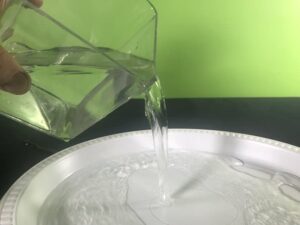
Pour water into a shallow plate
-
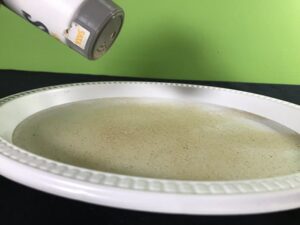
Sprinkle white pepper over the surface of the water.
-
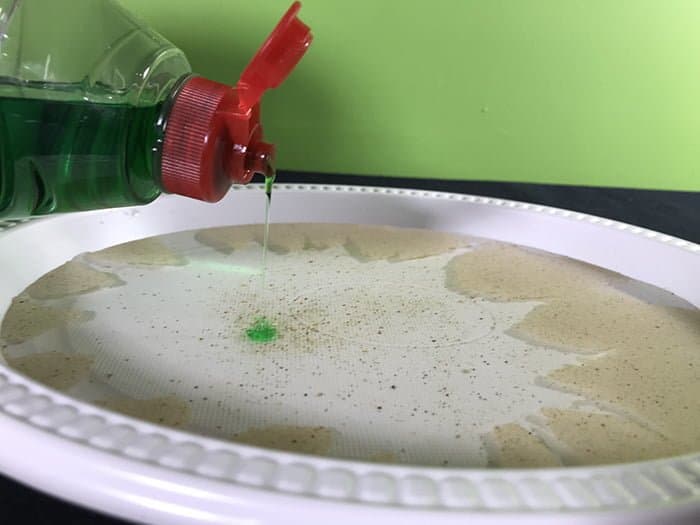
Add a drop of detergent into the center of the plate and watch the pepper spread out!

-
Get the Unit of Work on Water Science here!
- Explore the water cycle
- Learn about cohesion, adhesion & capillary action
- From water currents to floatation, join us to explore water science!
Includes cross-curricular teaching ideas, student quizzes, a sample marking rubric, scope & sequences & more
-
School science visits since 2004!
– Curriculum-linked & award-winning incursions.
– Over 40 primary & high school programs to choose from.
– Designed by experienced educators.
– Over 2 million students reached.
– Face to face incursions & online programs available.
– Early learning centre visits too!

-

The science behind it
What is happening?
The Science of Pepper & Surface Tension
All liquids have surface tension, a result of intermolecular forces pulling the liquid molecules together. At the surface, water molecules are more strongly attracted to each other than the air above them, creating a stretchy, elastic-like “skin”. This “skin” is strong enough to support light materials, like the pepper flakes in your experiment, or even small insects like water striders.
When you add a drop of detergent, you are introducing a surfactant. Detergent molecules have a “water-loving” (hydrophilic) head and a “water-fearing” (hydrophobic) tail. As the detergent spreads, it pushes between the water molecules, breaking the hydrogen bonds and significantly reducing the surface tension in the centre of the plate.
This creates a “tug-of-war” where the higher surface tension at the edges of the plate pulls more strongly than the weakened centre. This is known as the Marangoni effect. The water flows rapidly from the area of low surface tension toward the high surface tension at the edges, carrying the pepper flakes along with it. Essentially, the water surface was pulled outwards, and the pepper just went for the ride!
Variables to test
Find out more on variables here.
-
Thermal Energy
Hot vs. cold water—does the initial surface tension change with temperature? Heat makes molecules move faster, which naturally lowers surface tension even before the detergent is added. -
Liquid Viscosity & Type
What happens if you use different liquids like milk or vegetable oil? Milk contains fats and proteins that interact with detergent differently than pure water. -
Particle Mass & Size
Try using different materials like cinnamon, glitter, or large salt crystals. Does the weight (mass) of the particle affect how quickly it is pulled to the edge by the Marangoni effect? -
Surfactant Concentration
Does a tiny drop of diluted detergent work as well as a large drop of concentrated soap? This tests the potency of the surfactant.
Ready for more? You can use these same forces to make cardboard boats shoot across water!


Teacher's note
Curriculums change, and so does the way you implement them in your classroom. Please use your own experience and knowledge of your students to use these resources to best effect for student learning.
Still want the curriculum links?
Here are the suggested links:
Australian Curriculum (ACARA) Science:
NSW Science syllabuses:
Victorian Curriculum Science:
Want this experiment — and many more — running in your classroom?
Have us visit your school — every student gets three hands-on experiments in 60–90 minutes with a qualified presenter.








