
How do plants find up?
How do plants find up? In this wacky experiment we're gonna take some plants and a cupboard and test to see if plants grow up!
Adult supervision for setup
You will need
- A dark cupboard and blanket
- Two Tomato plants that are about 10 cm tall
- One plastic bag
Method
-
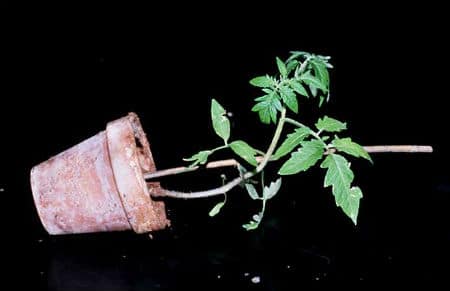
Turn a plant pot on it’s side and wait 2-3 days.
-
You should find that the plant stem has ‘bent’, i.e. growing vertically again. Place this plant pot inside the plastic bag and tie the ends around the plant stem (to trap the soil). Tip the plant pot upside down and see if it tries to grow vertically again.
-
Get the Unit of Work on Plant Biology here!
- Learn about the parts of a flower
- Discover how vascular tissue transports water & sugars around the plant
- Learn about plant pigments and adaptations to the environment
- From photosynthesis to transpiration & more, there’s a heap covered!
Includes cross-curricular teaching ideas, student quizzes, a sample marking rubric, scope & sequences & more
-
School science visits since 2004!
– Curriculum-linked & award-winning incursions.
– Over 40 primary & high school programs to choose from.
– Designed by experienced educators.
– Over 2 million students reached.
– Face to face incursions & online programs available.
– Early learning centre visits too!
-

The science behind it
Why Does This Happen
The movement of plants due to gravity is called ‘gravitropism’. ‘Tropism’ means to move.
Plants are remarkable organisms that have the ability to grow towards or away from different stimuli, such as light, touch, and gravity. One way in which plants use this ability is through a process called gravitropism, which helps them to find “up.”
Gravitropism is the response of plants to the force of gravity. When a seed is planted, the plant’s roots grow downwards, while the stem grows upwards. This is because the roots are positively gravitropic, meaning they grow towards the force of gravity, while the stem is negatively gravitropic, meaning it grows away from gravity.
Plants use specialized cells called statocytes to sense the force of gravity. These cells are located in the root cap and contain tiny starch granules that move in response to changes in the plant’s orientation. When the plant is upright, the starch granules settle at the bottom of the cell, providing a signal to the plant to grow downwards. When the plant is tilted, the starch granules move to the side of the cell, indicating that the plant is no longer upright and needs to adjust its growth accordingly.
Experiments by NASA have shown that plants in space grow in weird spirals. One idea is that gravity makes heavy starch granules inside plant cells fall to the bottom of cells. This may trigger the plant’s ability to find ‘up.
Make a clinostat
One way to observe the effects of gravitropism is by using a clinostat, which is a device that rotates plants slowly, simulating a microgravity environment. A clinostat can be easily made in the classroom using Lego or Meccano.
To make a clinostat, you will need a rotating platform, a motor, and a power source. You can use Lego or Meccano to build the platform, attaching the motor to the bottom of the platform to provide the rotation. Place a small plant or seedling in a pot on top of the platform, and turn on the motor. The plant will slowly rotate, and you can observe the effects of microgravity on the plant’s growth and orientation.
Variables to test
- Try making your own clinostat and vary the speed that the plants rotate at. Does this make a difference?

Teacher's note
Curriculums change, and so does the way you implement them in your classroom. Please use your own experience and knowledge of your students to use these resources to best effect for student learning.
Still want the curriculum links?
Here are the suggested links:
Australian Curriculum (ACARA) Science:
NSW Science syllabuses:
Victorian Curriculum Science:
Want this experiment — and many more — running in your classroom?
Have us visit your school — every student gets three hands-on experiments in 60–90 minutes with a qualified presenter.








