
Make a cloud in a jar
Learn how to make a cloud in a jar with easy to get materials. An effective demonstration of why clouds form and simple to do!
Adult supervision for setup
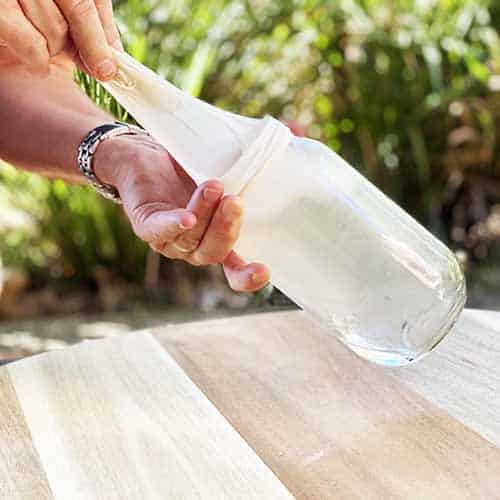
You will need
- 1 clear glass jar
- 1 match
- A kettle with water
- A rubber glove
Method
-
With adult help, boil your kettle and allow the water to sit until it cools a little. You don’t need really hot water, just enough for it to be still steaming.
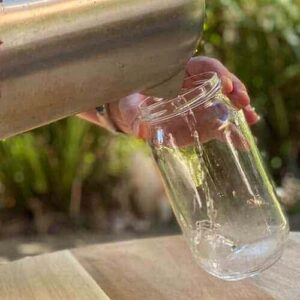
Once the kettle has cooled a bit, carefully pour a small amount of water into the glass jar (just enough to cover the bottom of the jar).
-
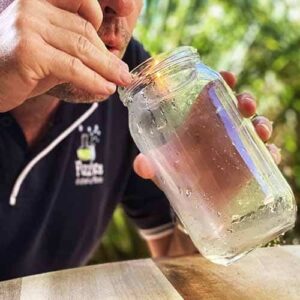
With adult help, light a match and allow it to burn for a couple of seconds. Now blow the match out and drop it into the glass jar to put out the smouldering match in the water.
-
Quickly stretch your rubber glove over the entrance of the glass jar. The rubber glove should be stretched tightly across the jar but still loose enough to be able to move up and down without tearing.
- Using a latex glove:
We’ve found that it is easier to then clamp your hands around the side of the jar so that the rubber glove fingers are not involved in the experiment.
- Using a laundry rubber glove:
If you are using a laundry glove (and you have a large enough jar), another way is to place the glove fingers all the way into the jar and then roll the opening of the glove over the entrance of the jar. The glove should then be entirely inside the jar and be upside down when you place the jar on the table.
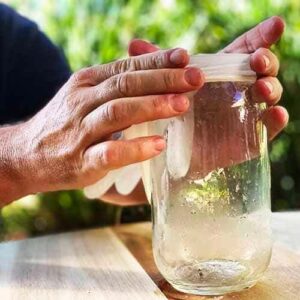
- Using a latex glove:
-
Now it’s time to make your cloud in a jar!
- Using a latex glove
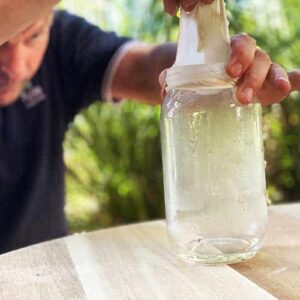
Pinch the middle of the stretched rubber and pull upwards.
- Using a laundry rubber glove:
Place your hand as far into the upside-down glove as you can. Now pull the glove upwards.
In both versions, you should see a cloud momentarily form in the jar. You can then repeat the demonstration by pushing the glove back inside the jar and then pulling the glove out again.
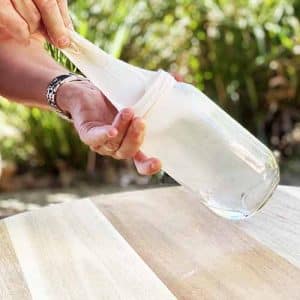
- Using a latex glove
-
Troubleshooting
- If you find there is too much condensation inside your jar to see the cloud, your water is too hot.
- If the cloud doesn’t form when you pull on the glove, either not enough water vapour is in the air inside the jar or you don’t have enough smoke inside the jar or finally the glove is not being out far enough to change the volume enough for the cloud to form.
-
School science visits since 2004!
– Curriculum-linked & award-winning incursions.
– Over 40 primary & high school programs to choose from.
– Designed by experienced educators.
– Over 2 million students reached.
– Face to face incursions & online programs available.
– Early learning centre visits too!

-

-
Get the Unit of Work on Pressure here!
- Want to dive into air pressure?
- It’s all about air pressure in many ways!
From how storms form to how planes fly, this unit covers many concepts about air pressure.
Includes cross-curricular teaching ideas, student quizzes, a sample marking rubric, scope & sequences & more
The science behind it
What is going on?
How to Make a Cloud in a Jar
Adding hot water into the jar allows water vapour to fill the space. This significantly increases the humidity, but at this stage, it is too warm for the vapour to condense into visible droplets.
Temperature is essentially a measure of how quickly molecules are moving and colliding. When you pull on the rubber glove, you rapidly increase the volume of the air space inside the jar. This causes the air pressure to drop and the molecules to spread out, leading to adiabatic cooling. Because there are fewer collisions between the molecules, the temperature drops instantly.
A cloud forms when the temperature becomes low enough for the water vapour to condense. However, water needs a “starting point” to latch onto. The smoke particles from the match (or hairspray) act as cloud condensation nuclei. Without these tiny floating particles, the water vapour would have nothing to cling to, and the cloud wouldn’t form!
Variables to test
Find out more on variables here.
-
Thermal Threshold
Try different temperatures of water in the jar. What is the minimum temperature needed for a visible cloud to form when you pull the glove? -
Nuclei Type
Try using hairspray instead of smoke from a match. Does the density of the particles make it easier or harder to see the cloud? -
Volume and Pressure
Try using large vs small jars. Does a larger volume of air require a bigger “pull” on the glove to create enough of a temperature drop?

Teacher's note
Curriculums change, and so does the way you implement them in your classroom. Please use your own experience and knowledge of your students to use these resources to best effect for student learning.
Still want the curriculum links?
Here are the suggested links:
Australian Curriculum (ACARA) Science:
NSW Science syllabuses:
Victorian Curriculum Science:
Want this experiment — and many more — running in your classroom?
Have us visit your school — every student gets three hands-on experiments in 60–90 minutes with a qualified presenter.








