
The coin battery experiment
Learn the science behind the batteries powering cars and other vehicles with this safe, simple and fun experiment, using only coins, vinegar and paper!
Adult supervision for setup
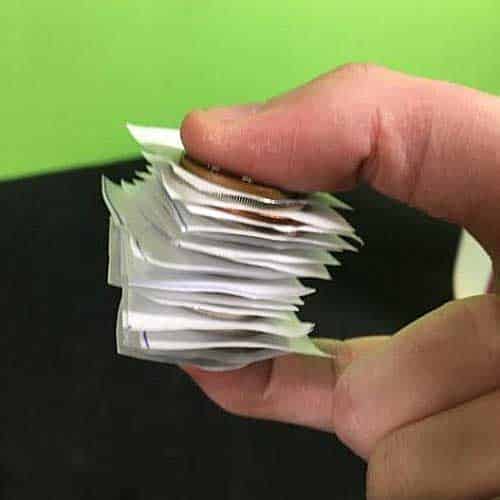
You will need
- One bowl of vinegar
- Nineteen strips of paper (3cm square in size)
- Ten 'silver' coins (mainly Zinc)
- Ten copper coins
- A test subject!
Method
-
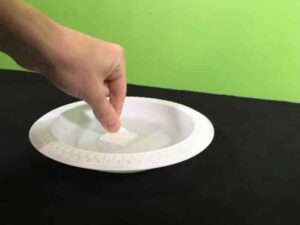
Moisten the strips of paper in the vinegar
-
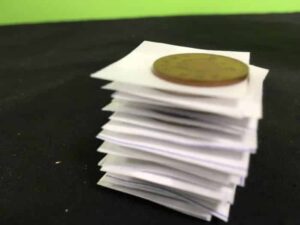
Stack together a column of coins and vinegar soaked paper, alternating between each material in the following order; copper coin, paper and silver coin.
-
Moisten your fingertips in vinegar.
Hold the column, on its ends, between your vinegar soaked fingers.
Feel a buzz?
-
Get the Electricity & Magnetism Unit of Work here!
- How does electricity actually flow?
- What makes magnets become magnetic?
- Why is there electromagnetism and what does this tell us about electricity & magnetism?
- From series & parallel circuits to conductors & insulators, there’s a lot to explore & learn!
Includes cross-curricular teaching ideas, student quizzes, a sample marking rubric, scope & sequences & more.
-
School science visits since 2004!
– Curriculum-linked & award-winning incursions.
– Over 40 primary & high school programs to choose from.
– Designed by experienced educators.
– Over 2 million students reached.
– Face to face incursions & online programs available.
– Early learning centre visits too!
-

The science behind it
Why Does This Happen?
The Science of the Coin Battery
You have just constructed a wet cell battery, also known as a voltaic pile. This is the same basic technology used by Alessandro Volta in 1800 to create the world’s first continuous source of electricity.
How the Battery Works
A battery requires three main components: two different metals (electrodes) and an acidic solution (electrolyte).
- Electrochemistry: The two different metals have different “affinities” for electrons. One metal (the anode) wants to give up electrons, while the other (the cathode) wants to receive them.
- The Role of the Electrolyte: The vinegar-soaked paper acts as the electrolyte. It contains ions that allow a chemical reaction to occur, moving charge between the metals while keeping the electrons flowing through the external circuit.
- Electron Flow: This chemical reaction creates a steady stream of electrons. As long as the metals and the acid are present and connected, the electric current will continue to flow.
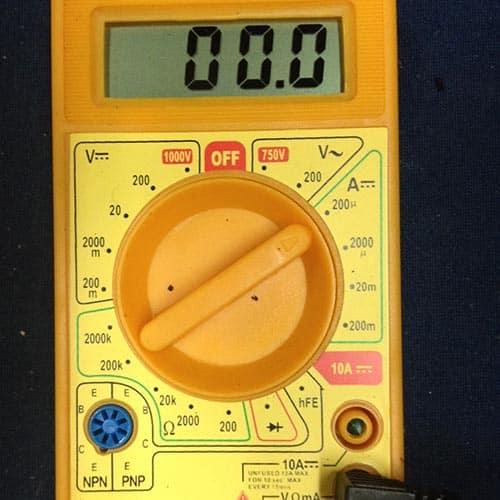
WExtension: Use a multimeter to measure the exact voltage or current your coin battery produces!
Real-World Applications
The most common wet cell batteries used today are found in cars. These lead-acid batteries provide the high surge of current needed to start the engine.
Safety Note: Do not experiment with car batteries. They contain strong sulfuric acid and can produce enough electricity to be extremely dangerous.
Variables to test
Find out more on variables here.
- Metal Combinations: Which combination of coins (copper, nickel, zinc) produces the highest voltage? Different metals have different electrode potentials.
- Electrolyte Acidity: Try lemon juice (citric acid) instead of vinegar (acetic acid). Does a stronger or different acid change the rate of the chemical reaction?
- Material Porosity: Try using baby wipes, dishcloths, or filter paper as the spacer. Does the absorbency of the material affect how much electrolyte is held between the coins?
- Surface Area: Does cleaning the coins with steel wool first increase the current? This removes oxidation and provides a better contact surface for the reaction.

Teacher's note
Curriculums change, and so does the way you implement them in your classroom. Please use your own experience and knowledge of your students to use these resources to best effect for student learning.
Still want the curriculum links?
Here are the suggested links:
Australian Curriculum (ACARA) Science:
NSW Science syllabuses:
Victorian Curriculum Science:
Want this experiment — and many more — running in your classroom?
Have us visit your school — every student gets three hands-on experiments in 60–90 minutes with a qualified presenter.








