
Make a pop pop boat
Learn about Newton's third law of motion with this exciting experiment that can be made at school or at home, with easily obtainable materials!
Adult supervision for setup
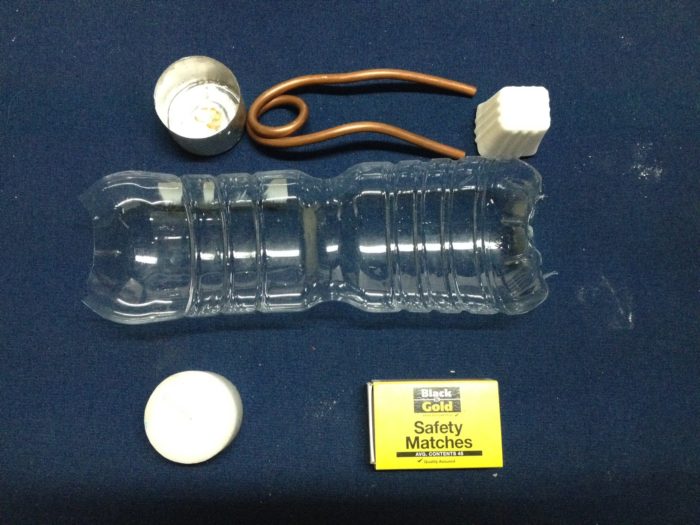
You will need
- One 600 mL plastic soft drink bottle, cut in half lengthways using scissors.
- One tea-light candle.
- Matches or cigarette lighter.
- 25 cm of 6 mm copper tubing.
- BBQ Firelighter. We've found this to be far more reliable than the candle-powered versions.
- One tub of water.
- Hacksaw to cut the tubing to size
- A bench vice-to hold the tubing safely.
- A drill press with 3.5 mm drill bit-to clean out the holes.
- Two hand pliers to bend the copper tube into shape.
- Safety goggles
- Adult supervision!
Method
-
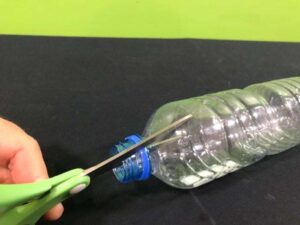
Cut your soft drink bottle in half lengthways.
-
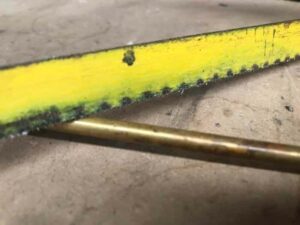
Fit your copper tube in the bench vice and use a hacksaw to cut a length of 6mm copper tubing to a 25cm length. The ends of the copper will need a small drill bit to clean out the metal burrs that can cover the opening of the tubing (we used a drill press for safety).
-
Use the pliers to bend the copper pipe into the shape as shown below.

-
Separate the tea-light candle from its metal holder and arrange the materials in the boat as shown below. The candle acts as a counterweight for the copper tubing at the back of the boat.

-
Cut notches in the bottle so that the tubing can rest in the back of the boat.

-
Add the firelighter the metal container and you’ve set the boat up!
Now put in some water, light the firelighter and watch it go! You may need to pre-fill the tubing with water to speed the process up. Try filling the tube and then pouring most of the water out so the inside of the tube is damp.
If there are balance issues you can sort this out with additional weights (use metal nuts if needed). Make sure that the tubing is bent so that it can reach the surface of the water. You may need to make slight adjustments to this design but in essence, this is a robust science experiment that kids will love to build. Enjoy!

-
Get the Unit of Work on Heat Energy here!
- What actually is heat?
- How does heat move through different materials?
- How does heat change the properties of materials and more!
Includes cross-curricular teaching ideas, student quizzes, a sample marking rubric, scope & sequences & more

-
School science visits since 2004!
– Curriculum-linked & award-winning incursions.
– Over 40 primary & high school programs to choose from.
– Designed by experienced educators.
– Over 2 million students reached.
– Face to face incursions & online programs available.
– Early learning centre visits too!
-

The science behind it
Why Does This Happen?
How a Pop Pop Boat Works
The science of a pop pop boat is all about heat and pressure. The firelighter flame heats the water trapped inside the copper tubing until it reaches its boiling point. Because water expands massively when it turns into steam, it is forced out of the tubes at high velocity.
This expulsion of heated water and steam produces the thrust needed to send the boat forwards. This is a perfect demonstration of Newton’s 3rd Law of Motion, which states that “for every action, there is an equal and opposite reaction.” As the water is pushed out the back, the boat is pushed forward!
Once the steam is expelled, it creates a temporary low-pressure area (a partial vacuum) within the tubing coil. Any remaining steam inside the coil quickly condenses back into liquid water, further reducing the internal pressure. Because the air pressure pushing down on the surface of the tub is now higher than the pressure inside the tube, fresh water is sucked back into the copper tubing. This water is then heated, flash-evaporates into steam, and the cycle repeats—creating the characteristic “pop pop” sound!
Variables to test
Find out more on variables here.
-
Tubing Diameter
Try using different diameter copper tubing. Does a wider tube produce a louder “pop” or a faster boat? -
Coil Configuration
If you don’t coil the tubing and keep it straight instead, does the boat still work? Consider how the coil helps to trap the heat from the flame. -
Heat Intensity
What happens if you use a larger flame or two firelighters? Does the increased heat increase the frequency of the steam pulses?

Teacher's note
Curriculums change, and so does the way you implement them in your classroom. Please use your own experience and knowledge of your students to use these resources to best effect for student learning.
Still want the curriculum links?
Here are the suggested links:
Australian Curriculum (ACARA) Science:
NSW Science syllabuses:
Victorian Curriculum Science:
Want this experiment — and many more — running in your classroom?
Have us visit your school — every student gets three hands-on experiments in 60–90 minutes with a qualified presenter.








