
Air takes up space
An "empty" glass is never truly empty. It's filled with air – and air takes up space. Try this experiment to see this in action.
Adult supervision for setup
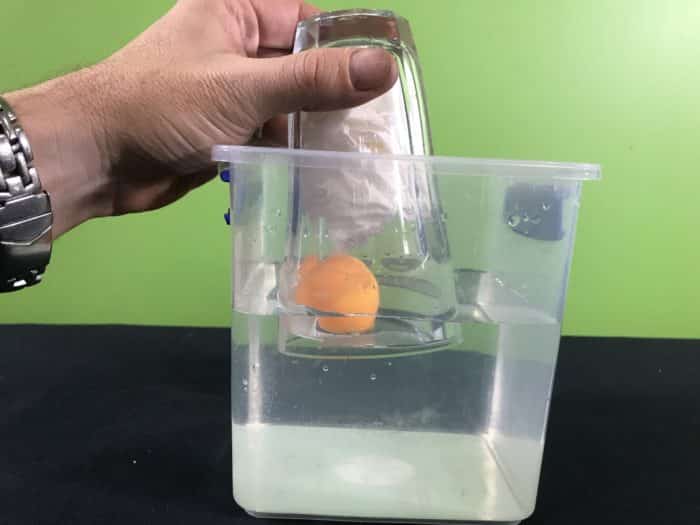
You will need
- One clear container filled with water
- Clear drinking glass
- Tissue paper
- Ping pong ball
Method
-
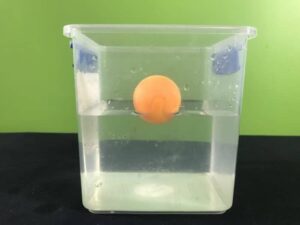
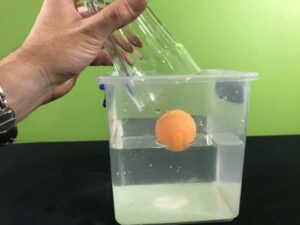
Place the ping pong ball into the clear container filled with water.
-
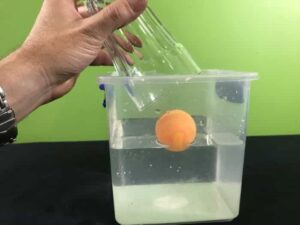
Put the glass over the ping pong ball so that the ball sits inside the glass.
-
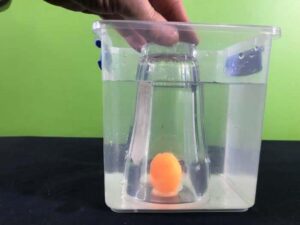
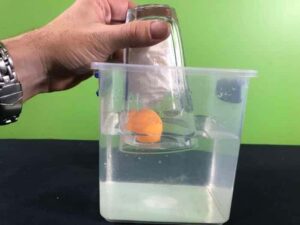
Push the glass down into the water, while it is still over the ball. The water level should rise around the glass and the ball should remain dry.
-
Remove the glass from the water.
-
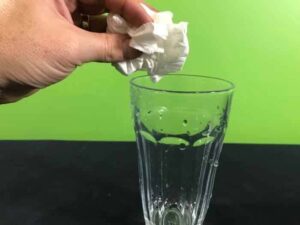
Scrunch some paper into a ballput it into the glass.
-
Again place the glass, upside-down into the water and push down. The tissue paper should not get wet. Why?
-
School science visits since 2004!
– Curriculum-linked & award-winning incursions.
– Over 40 primary & high school programs to choose from.
– Designed by experienced educators.
– Over 2 million students reached.
– Face to face incursions & online programs available.
– Early learning centre visits too!
-

-
Get the Unit of Work on Pressure here!
Want to dive into air pressure?
Get the 60-minute video + PDFs + curriculum links for your class here!

The science behind it
Why Does This Happen?
Air Takes Up Space
It cannot get simpler than this: air is a “thing” that occupies space! Even though we cannot see it, air is made of molecules that exert pressure. In this experiment, the air pressure trapped inside the glass is strong enough to exclude the water and keep the ping pong ball at the bottom.
Using a dry tissue taped to the bottom of the glass is a classic way to prove this. When you submerge the glass vertically, the air has nowhere to go. It forms a protective “bubble” that prevents the water from reaching the tissue. You would have noticed the water level in your main container rise as you pushed the glass down; this is due to displacement, where the volume of the trapped air pushes the water out of the way.
This exact principle is used in deep-sea diving bells and underwater airlocks. As long as the internal air pressure is maintained at a level equal to or greater than the surrounding water pressure, the water cannot enter the cabin. This allows divers to work at great depths while staying relatively dry!
Variables to test
Find out more about variable testing here.
-
Liquid Density
Does this work with all liquids? Try using oil or a sugar-heavy syrup. Does the density of the liquid make it harder to push the glass down? -
Volume and Pressure
What happens if you change the shape or size of the glass? Does a taller, thinner glass hold more or less air than a short, wide one? -
Depth Perception
If you push the glass very deep (like in a swimming pool), does the water eventually start to creep up into the glass? (Hint: Air can be compressed under high pressure!)

Teacher's note
Curriculums change, and so does the way you implement them in your classroom. Please use your own experience and knowledge of your students to use these resources to best effect for student learning.
Still want the curriculum links?
Here are the suggested links:
Australian Curriculum (ACARA) Science:
NSW Science syllabuses:
Victorian Curriculum Science:
Want this experiment — and many more — running in your classroom?
Have us visit your school — every student gets three hands-on experiments in 60–90 minutes with a qualified presenter.








