
Broom balance trick
Learn how to balance a broom on your fingers with this cool science experiment. Easy to do with cheap materials. A simple mind blowing trick!
Adult supervision for setup
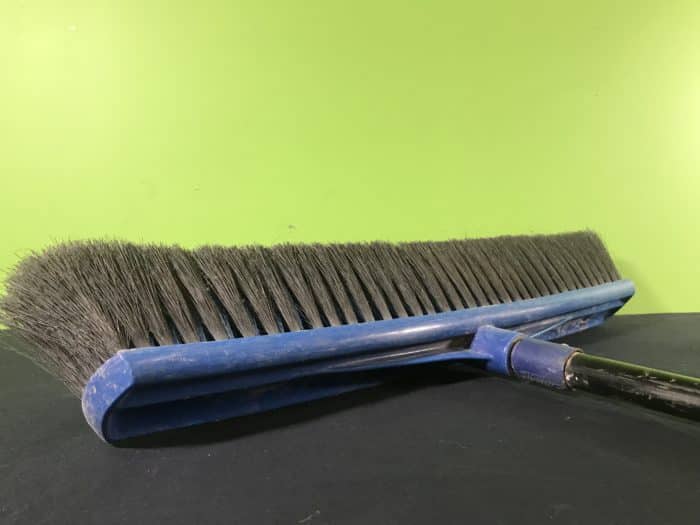
You will need
- One broom
Method
-
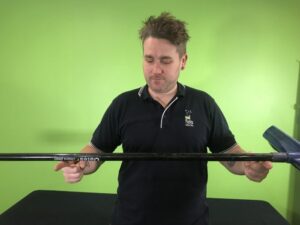
Spread your hands as far apart as you can along the broom.
Pick up the broom using only one finger of each hand… it’ll be heavy on the broom end.
-
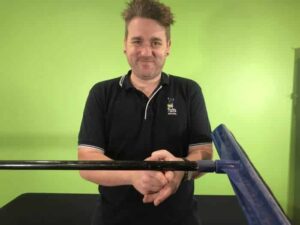
Slowly slide you fingers together at the same speed.
You will find that the finger close to the broom head doesn’t move much compared to other finger.
Once you get your fingers together you have found the broom’s centre of gravity.
-
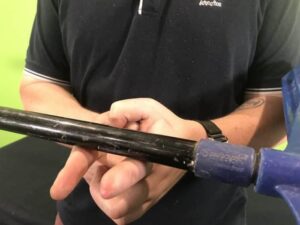
Can you balance the whole broom using one finger on that point?
Try other odd shaped objects, e.g. baseball bats, golf clubs and hockey sticks… be careful!
Try repeating the experiment, only placing your hands in a different spot.
Do you find the centre of gravity each time no matter what?
-
Get the Unit of Work on Forces here!
- Push, pull
- Friction & spin!
From inertia to centripetal force, this unit covers many concepts about Newton’s Laws!
Includes cross-curricular teaching ideas, student quizzes, a sample marking rubric, scope & sequences & more
-
School science visits since 2004!
– Curriculum-linked & award-winning incursions.
– Over 40 primary & high school programs to choose from.
– Designed by experienced educators.
– Over 2 million students reached.
– Face to face incursions & online programs available.
– Early learning centre visits too!
-

The science behind it
Why Does This Happen
The Science of the Broom Balance Trick
The “Broom Balance” is a classic physics demonstration that reveals a secret about every physical object: the Centre of Mass (or Centre of Gravity). This is the specific point where the mass of an object is perfectly balanced in all directions.
The Secret of the Sliding Fingers
When you slide your fingers toward each other from opposite ends of a broom, they will always meet exactly at the broom’s centre of balance. This happens because of friction and torque.
- Weight Distribution: A broom is asymmetrical; the “bristle” end is much heavier than the handle end. This means the centre of gravity is not in the middle of the stick, but much closer to the bristles.
- Frictional Resistance: The finger that is further away from the centre of gravity carries less weight. Less weight means less friction, so that finger slides easily.
- The “Switch”: As one finger gets closer to the centre of gravity, it begins to carry more of the broom’s weight. The friction increases until that finger “sticks,” and the other finger (which now has less friction) starts to slide. This back-and-forth continues until they meet at the balance point.
Real-World Applications
Understanding the centre of balance is critical for anything that moves or stands still!
- Athletics: Figure skaters and gymnasts must manipulate their centre of gravity to perform stable spins and landings.
- Engineering: Builders use these principles to ensure bridges and skyscrapers don’t topple over during high winds or earthquakes.
- Geology: The centre of balance in a rock formation determines its stability; if it shifts too far, a landslide occurs.
- Everyday Life: If you lean too far forward, you fall because your mass has moved outside your base of support.
Variables to test
Find out more on variables here.
-
Object Symmetry
Try different brooms or even a mop. Does the demonstration work every time, regardless of how heavy the head of the broom is? -
Mass Removal
What happens if you pull off the bristle end of the broom? Where does the centre of gravity shift to when the object becomes a simple cylinder (the handle)? -
Tool Geometry
Try this with other long objects like a kayak paddle, a rake, or a baseball bat. Does the “meeting point” always accurately reflect where the heaviest part is located? -
Surface Friction
What if you wear a glove on one hand and leave the other bare? Does changing the coefficient of friction on one side change where your fingers meet?
To keep your experiment valid, try to slide your fingers at a slow, steady pace. Jerky movements can sometimes “trick” the friction and lead to an uneven balance!

Teacher's note
Curriculums change, and so does the way you implement them in your classroom. Please use your own experience and knowledge of your students to use these resources to best effect for student learning.
Still want the curriculum links?
Here are the suggested links:
Australian Curriculum (ACARA) Science:
NSW Science syllabuses:
Victorian Curriculum Science:
Want this experiment — and many more — running in your classroom?
Have us visit your school — every student gets three hands-on experiments in 60–90 minutes with a qualified presenter.








