
How to stand on eggs!
In this crazy and fun experiment we take a crack at seeing how you can stand on eggs! Get to learn about how and why this experiment happens!
Adult supervision for setup
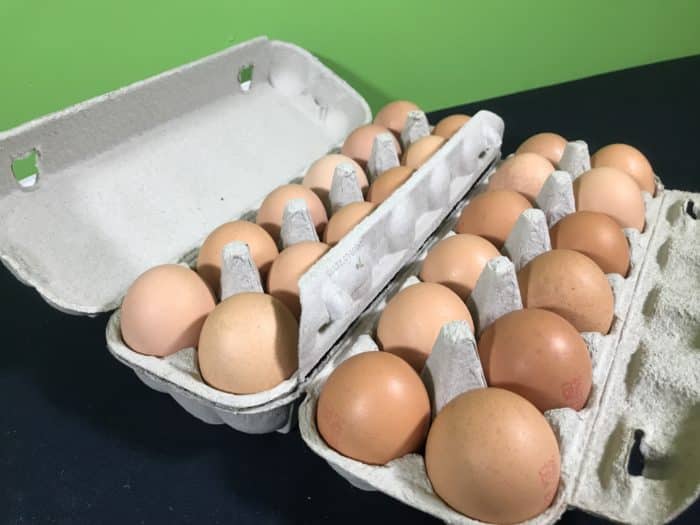
You will need
- Two cartons of eggs
- One wooden board, or a large book
- Measuring weights
- Three chairs
- Be aware of egg vapour allergies in your class
Method
-
Place three chairs around the two open cartons of eggs.
-
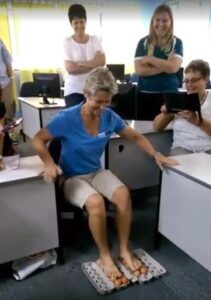
Sit on the middle chair and place your hands on the other two chairs.
-
Put one foot on each carton of eggs.
-
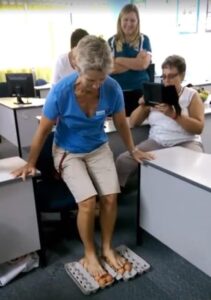
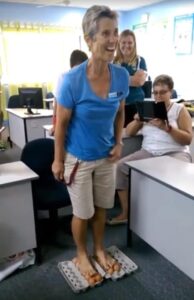
Supporting your weight with the two chairs, carefully raise yourself upright so that you slowly put more weight on the eggs until you are completely standing on them without the support of the chairs!
-
Get the Unit of Work on Forces here!
- Push, pull
- Friction & spin!
From inertia to centripetal force, this unit covers many concepts about Newton’s Laws!
Includes cross-curricular teaching ideas, student quizzes, a sample marking rubric, scope & sequences & more
-
School science visits since 2004!
– Curriculum-linked & award-winning incursions.
– Over 40 primary & high school programs to choose from.
– Designed by experienced educators.
– Over 2 million students reached.
– Face to face incursions & online programs available.
– Early learning centre visits too!

-

The science behind it
Why Does This Happen
Standing on Eggs
Eggshells are surprisingly strong if they are compressed. The curved shape of the eggshell allows the force of your weight to be spread horizontally and vertically throughout the entire shell, rather than focusing the pressure on a single point where it would crack.
You can think of an eggshell as being like a 360-degree arched bridge. Engineers have known about the strength of arches for thousands of years. Arches are very stable because they effectively channel weight into the ground or the supporting structure. Some structures built by the ancient Romans have survived thousands of years due to arches built into their design, proving just how much weight this shape can support!
Road safety application
The curved surfaces of a bike helmet help to distribute forces around the skull rather than directly onto one spot during a bike crash. However, it’s not just the shape that protects you; it’s also the ability of the foam within the helmet to crumple and absorb the impact energy experienced when colliding with the ground.
Curved surfaces also distribute forces in cars. Modern cars are designed with crumple zones that work in a similar way to bike helmets. These zones are engineered to deform during a crash, soaking up the massive impact forces so that the energy doesn’t reach the people inside the vehicle.
Variables to test
Find out more on variables here.
-
Efficiency
Is there a way to arrange the eggs so that you can use fewer of them and they still survive the weight? -
Alternative Materials
Can this be done with balloons? What about water balloons? Does the internal pressure of the balloon change the “arch” strength? -
Orientation
Does it matter if the eggs are on their side or upside-down? Does the “pointy” end of the egg provide more or less stability than the wider end?
Going further
Try testing exactly how strong eggshells are with this activity! By using just the shells, you can see how the dome shape alone can support stacks of heavy books.


Teacher's note
Curriculums change, and so does the way you implement them in your classroom. Please use your own experience and knowledge of your students to use these resources to best effect for student learning.
Still want the curriculum links?
Here are the suggested links:
Australian Curriculum (ACARA) Science:
NSW Science syllabuses:
Victorian Curriculum Science:
Want this experiment — and many more — running in your classroom?
Have us visit your school — every student gets three hands-on experiments in 60–90 minutes with a qualified presenter.








