
Blow ’em apart!
Who is Bernoulli and what is his theory? You can take a crack at proving his theory wrong with this great and fun experiment! Try and blow 'em apart!
Adult supervision for setup
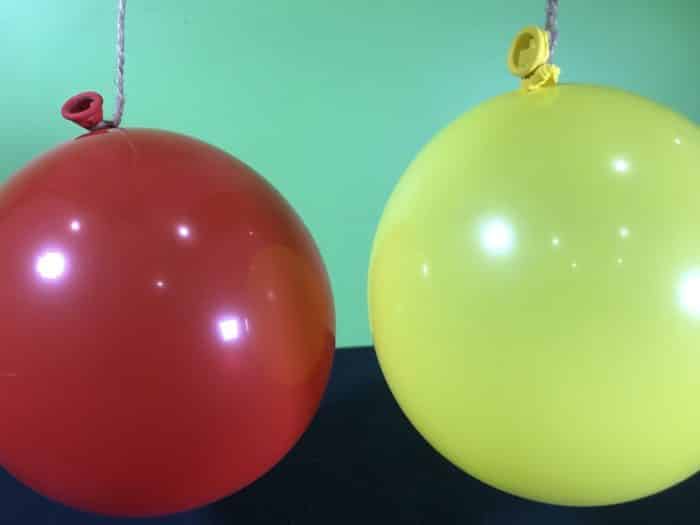
You will need
- Two balloons
- Two 20cm length strings
- One rod or stick
- Two equally-high stacks of books
Method
-
Stack 2 pillars of books, and place the rod across the two stacks.

-
Blow the balloons up, tie the balloon ends and attach 1 string to each balloon.
-
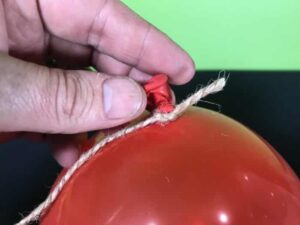
Tie the strings to the rod, so that the balloons hang freely from the rod.
-
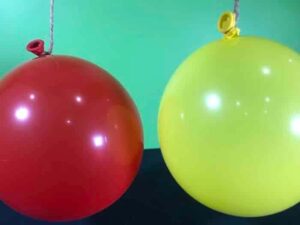
Make sure the balloons are the same height.
-
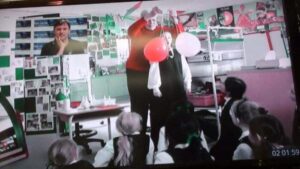
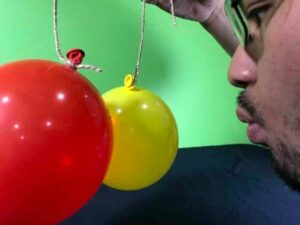
Blow between the balloons, can you blow them apart? Try using a hairdryer!
“Can you blow these balloons apart?”
Why can’t you do it?
-
School science visits since 2004!
– Curriculum-linked & award-winning incursions.
– Over 40 primary & high school programs to choose from.
– Designed by experienced educators.
– Over 2 million students reached.
– Face to face incursions & online programs available.
– Early learning centre visits too!
-

-
Get the Unit of Work on Pressure here!
- Want to dive into air pressure?
- It’s all about air pressure in many ways!
From how storms form to how planes fly, this unit covers many concepts about air pressure.
Includes cross-curricular teaching ideas, student quizzes, a sample marking rubric, scope & sequences & more
The science behind it
Why Does This Happen
Bernoulli Balloon Blow Apart
The mathematician Daniel Bernoulli discovered a fundamental rule of fluid dynamics: moving air has lower pressure than still air.
In this experiment, you likely expected the balloons to fly apart when you blew between them. Instead, they moved together! This happened because your breath created a high-speed, low-pressure zone in the narrow gap between the balloons. The relatively higher air pressure of the still air on the outside of the balloons then pushed them inward toward the centre.
Low air pressure occurs when air is sped up because the kinetic energy of the molecules is being used primarily for forward motion rather than bouncing off one another. With fewer collisions between the air molecules in that fast stream, the pressure drops. Slower-moving air molecules in the surrounding room have more energy to “push” into that space, forcing the balloons together.
The curved surface of the balloon also plays a role through the Coanda Effect, where a fluid (like air) tends to stay attached to a curved surface. This causes the air to “wrap” around the edges, maintaining the low-pressure zone. This same principle is used to create lift on aeroplane wings and downforce on F1 race cars!
Further Demonstrations
You can see this same effect in action with a funnel and ping-pong balls or by making vortex smoke rings.
Variables to test
Find out more on variables here.
-
Surface Area
Does it matter if you use small or large balloons? Does a larger balloon provide more surface area for the atmospheric pressure to push against? -
Gas Density
Try blowing between two helium-filled balloons. Since helium is less dense than air, does the reaction happen faster? -
Inertia
What if the balloons are filled with water? Will your breath still be powerful enough to overcome the inertia (resistance to movement) of the heavy water-filled balloons?

Teacher's note
Curriculums change, and so does the way you implement them in your classroom. Please use your own experience and knowledge of your students to use these resources to best effect for student learning.
Still want the curriculum links?
Here are the suggested links:
Australian Curriculum (ACARA) Science:
NSW Science syllabuses:
Victorian Curriculum Science:
Want this experiment — and many more — running in your classroom?
Have us visit your school — every student gets three hands-on experiments in 60–90 minutes with a qualified presenter.








