
The impossible puff
Can you beat the impossible puff? The is science activity is based on Bernoulli's principle and is surprising to see. Part of over 150 free activity ideas.
Adult supervision for setup
You will need
- One Ping Pong ball
- One funnel
Method
-
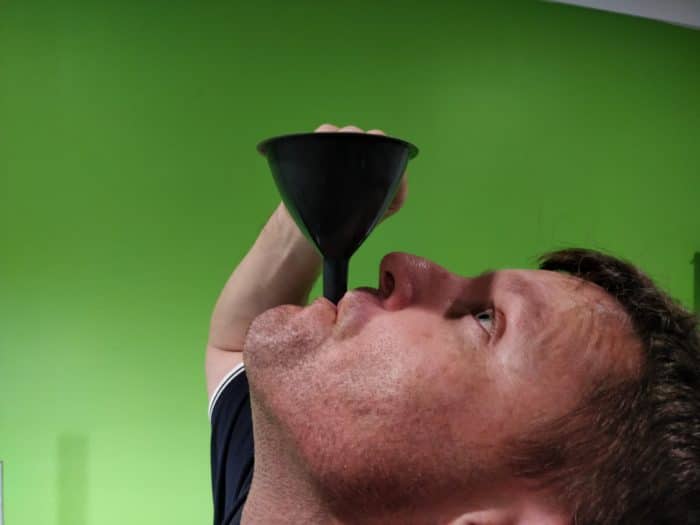
Place the ball into the funnel. Blow through the funnel spout.
Can you get the ball to come out? Is there another way of blowing the ball out of the funnel?
-
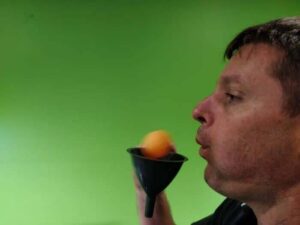
Try blowing across the top of the funnel. This will work, but why?
-
School science visits since 2004!
– Curriculum-linked & award-winning incursions.
– Over 40 primary & high school programs to choose from.
– Designed by experienced educators.
– Over 2 million students reached.
– Face to face incursions & online programs available.
– Early learning centre visits too!
-

-
Get the Unit of Work on Pressure here!
- Want to dive into air pressure?
- It’s all about air pressure in many ways!
From how storms form to how planes fly, this unit covers many concepts about air pressure.
Includes cross-curricular teaching ideas, student quizzes, a sample marking rubric, scope & sequences & more

The science behind it
Why Does This Happen
The Science of the Impossible Puff
In physics, things generally move from high-pressure areas to low-pressure areas. The greater the difference in pressure, the stronger the force. You can see this in nature with a tornado, which has incredibly low pressure in the centre of its funnel.
The mathematician Daniel Bernoulli discovered that moving air has less pressure than still air. When you blow into the funnel, the air is forced to squeeze through the narrow gap between the ball and the funnel walls. This causes the air to speed up significantly.
Because the air moving around the ball is traveling so fast, it creates a low-pressure zone directly underneath and around the sides of the ball. The higher atmospheric pressure in the room then pushes down on the ball, effectively “sucking” it into the funnel. Counter-intuitively, the harder you blow, the lower the pressure becomes and the tighter the ball is held in place!
Variables to test
Find out more on variables here.
-
Funnel Geometry
Does the size or angle of the funnel make a difference? Does a steeper funnel create a stronger “lock” on the ball? -
Mass vs. Airflow
Can you do this with a heavier ball, like a golf ball? Does it require more lung power to create enough of a pressure drop to overcome the extra weight? -
Aerodynamics
What happens if you use a cube shape instead of a ball? Does the air still flow smoothly enough to create low pressure, or does the turbulence around the sharp edges break the effect?

Teacher's note
Curriculums change, and so does the way you implement them in your classroom. Please use your own experience and knowledge of your students to use these resources to best effect for student learning.
Still want the curriculum links?
Here are the suggested links:
Australian Curriculum (ACARA) Science:
NSW Science syllabuses:
Victorian Curriculum Science:
Want this experiment — and many more — running in your classroom?
Have us visit your school — every student gets three hands-on experiments in 60–90 minutes with a qualified presenter.








