
Make a Volcano
Learn about chemical reactions and how volcanoes work with this fun, simple and easy experiment that can be done at home or in the classroom!
Adult supervision for setup
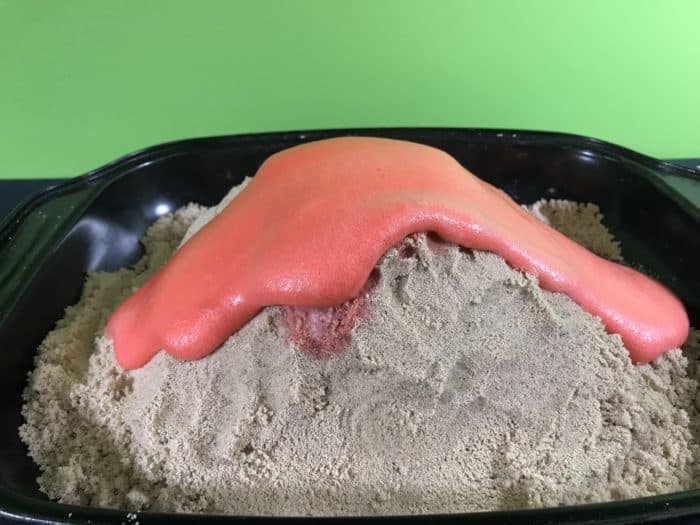
You will need
- 100mL of Vinegar
- 4 Tablespoons of bicarbonate soda mixed with 150mL of water + 10mL of detergent (a few squirts)
- A few drops of orange or red food colouring
- A 500mL container
- And for a more realistic-looking volcano, brown coloured play dough
Method
-
Run this expeiremnt where you are allowed to get messy (we run this on tray to contain the mess).
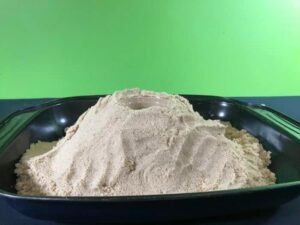
Build your volcano out of sand, mud, dirt or playdough on a tray. Place a 500mL container into the crater of the volcano.
-
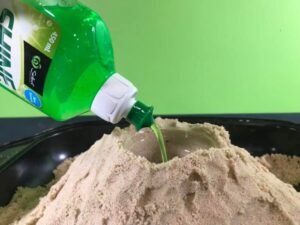
Mix the detergent, red food colouring and vinegar in the 500 mL container.
-
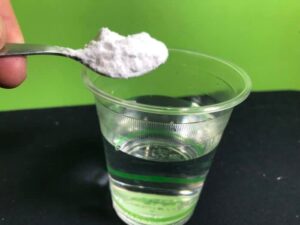
Mix the bicarbonate soda and water into seperate glass and stir.
-
Pour the bicarbonate soda and water mixture into the volcano in the volcano (that already has your detergent, food colouring and vinegar mixture).
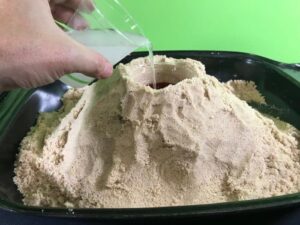
-
…and stand back!!!
Why did this happen? Read below…
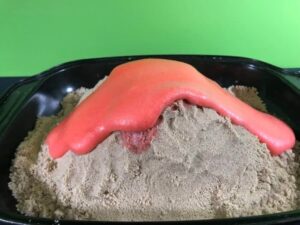
-
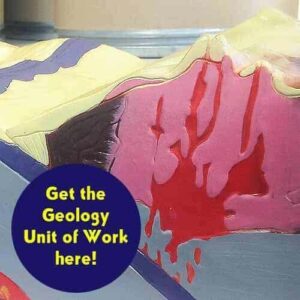
Get the Unit of Work on Geology here!
- The Earth’s layers, the rock cycle, volcanoes, earthquakes & more!
From soil science to mineral testing, these hands-on experiments your students will discover the importance of natural resources and the role of plate tectonics in shaping our world.
Includes cross-curricular teaching ideas, student quizzes, a sample marking rubric, scope & sequences & more
-
School science visits since 2004!
– Curriculum-linked & award-winning incursions.
– Over 40 primary & high school programs to choose from.
– Designed by experienced educators.
– Over 2 million students reached.
– Face to face incursions & online programs available.
– Early learning centre visits too!
-

The science behind it
Why Does This Happen?
The Science of How to Make a Volcano
Building a model volcano is a classic science activity, but it’s important to distinguish between the chemical reaction in your model and the geological processes that power a real eruption.
How Real Volcanoes Erupt
Real volcanic activity is driven by Plate Tectonics. The Earth’s outer crust is broken into giant plates that drift on the asthenosphere, a layer of the mantle that behaves like a very slow-moving fluid. Where these plates collide (convergent boundaries) or pull apart (divergent boundaries), magma can rise to the surface.
The “violence” of an eruption depends on two main factors:
- Viscosity: Thick, “sticky” magma traps gas bubbles more easily than runny magma.
- Gas Pressure: When gas can’t escape thick magma, pressure builds up until it reaches a breaking point, resulting in an explosive eruption. Runny magma allows gases to escape easily, leading to “effusive” eruptions where lava flows smoothly at temperatures between 700°C and 1200°C.
Volcanoes can also form at hotspots, which are areas far from plate boundaries where a plume of hot magma melts through the crust to create a vent.
The Chemistry of Your Model
Your model volcano uses an acid-base reaction to simulate an eruption. When you mix vinegar (acetic acid) and bicarbonate soda (a base), they react to form carbonic acid and sodium acetate.
Vinegar + Bicarbonate Soda → Carbonic Acid + Sodium Acetate
Carbonic acid is very unstable and immediately breaks down into liquid water and carbon dioxide gas (CO2). The detergent in your mix traps this gas, creating a foam that expands and spills over the “crater” of your model.
Variables to test
An experiment is only a “fair test” if you change one variable at a time!
-
Reactant Concentration
Vary the amount of vinegar or bicarbonate soda used. Does diluting the vinegar with water slow down the reaction rate? -
Surfactant Influence
Does using more detergent or a different brand change the viscosity of the “lava” foam? Does it make the bubbles smaller or larger? -
Crater Geometry
Vary the width of the bottle opening (the crater). Does a narrower opening create a higher pressure eruption, shooting the foam further? -
Thermal Energy
Try using warm vinegar versus cold vinegar. Does heat increase the kinetic energy of the particles and make the volcano erupt faster?

Teacher's note
Curriculums change, and so does the way you implement them in your classroom. Please use your own experience and knowledge of your students to use these resources to best effect for student learning.
Still want the curriculum links?
Here are the suggested links:
Australian Curriculum (ACARA) Science:
NSW Science syllabuses:
Victorian Curriculum Science:
Want this experiment — and many more — running in your classroom?
Have us visit your school — every student gets three hands-on experiments in 60–90 minutes with a qualified presenter.








