
Bend Water
Find out how to bend water with static electricity and why it works! Part of over 150 free science experiments on the Fizzics website. Find out more…
Adult supervision for setup
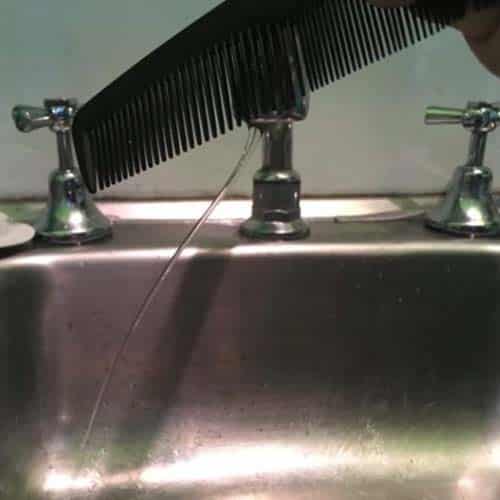
You will need
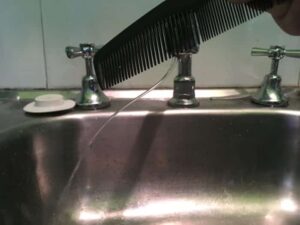
- One nylon comb
- A water tap
Method
-
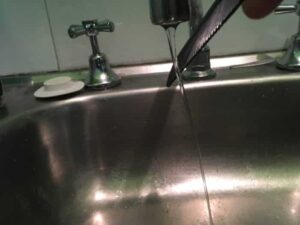
Turn the tap on slowly, stop when you just get a complete stream of water to flow, i.e. small flow.
-
Run the comb through your hair at least 10 times. Dry hair makes the experiment work better.
-
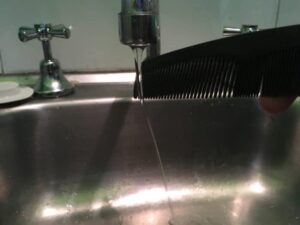
Move the comb toward the stream of water. What happens to the stream?
-
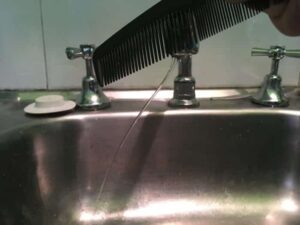
Run the comb through your hair again and repeat the experiment. Does the stream change again?
-
Get the Electricity & Magnetism Unit of Work here!
- How does electricity actually flow?
- What makes magnets become magnetic?
- Why is there electromagnetism and what does this tell us about electricity & magnetism?
- From series & parallel circuits to conductors & insulators, there’s a lot to explore & learn!
Includes cross-curricular teaching ideas, student quizzes, a sample marking rubric, scope & sequences & more.

-
School science visits since 2004!
– Curriculum-linked & award-winning incursions.
– Over 40 primary & high school programs to choose from.
– Designed by experienced educators.
– Over 2 million students reached.
– Face to face incursions & online programs available.
– Early learning centre visits too!

-

The science behind it
Why Does This Happen
The Science of Bending Water
When you rub a plastic comb through your hair, you are witnessing static electricity in action. This happens because the friction between the materials causes a transfer of electrons (tiny, negatively charged particles). Depending on the materials used, one object will lose electrons and become positively charged, while the other gains them and becomes negatively charged.
Opposites attract! But why is the water attracted to the comb if the water hasn’t been rubbed? This is because water molecules are polar—they have a slightly positive end and a slightly negative end. When the charged comb comes near the stream, the water molecules flip so their opposite charge faces the comb. This creates an electrostatic attraction strong enough to pull the water stream out of its vertical path!
This build-up of charge, known as the triboelectric effect, isn’t just for kitchen experiments. On a massive scale, the movement of ice crystals and water droplets inside a storm cloud creates huge imbalances of charge. When that electrical energy finally discharges to find a neutral balance, we see it as a flash of lightning.
Variables to test
Find out more on variables here.
-
Material Conductivity
What happens if you use a metal comb instead of a plastic one? Metals are conductors, meaning they allow electrons to flow through them easily. Does this make it harder to keep a “static charge” on the surface? -
Surface Area
Try using a thick plastic pipe instead of a comb. Does a larger object hold more net charge and bend the water further? -
Stream Velocity
Does the water bend as much if you turn the tap on high? This looks at the relationship between the electrostatic force and the momentum of the falling water. -
Humidity Factors
Try this on a rainy day versus a very dry day. Water vapour in the air can actually “bleed off” static charge from your comb. Does high humidity make the experiment fail?
If you want to see this force in another way, try picking up small pieces of paper or even hovering your comb over a Styrofoam ball!

Teacher's note
Curriculums change, and so does the way you implement them in your classroom. Please use your own experience and knowledge of your students to use these resources to best effect for student learning.
Still want the curriculum links?
Here are the suggested links:
Australian Curriculum (ACARA) Science:
NSW Science syllabuses:
Victorian Curriculum Science:
Want this experiment — and many more — running in your classroom?
Have us visit your school — every student gets three hands-on experiments in 60–90 minutes with a qualified presenter.








