
Newton colour wheel
Learn more about colour addition by creating a Newton colour wheel. easy to make and a fun science craft activity for kids. Find out more
Adult supervision for setup
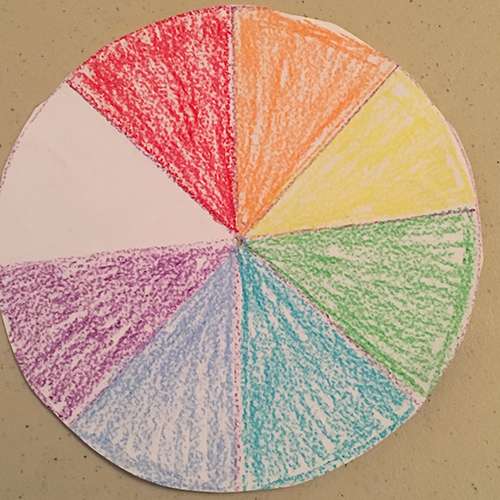
You will need
- Coloured pens, or a coloured printer
- Paper
- Pencil
- Cardboard
- Glue
- Wooden skewer
- Sticky tape
Method
-
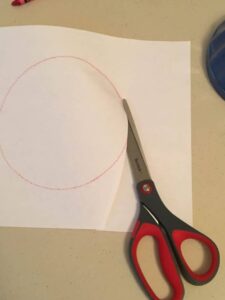
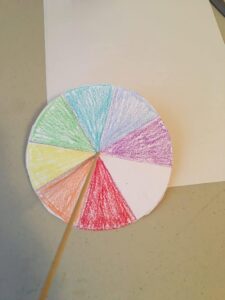
Cut out a round piece of paper and divide the wheel into eight equal sized segments.
-
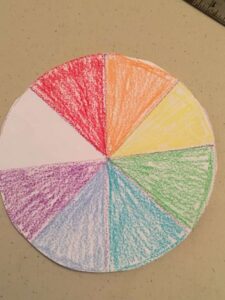
Colour in the segments in the order of the colours of the rainbow;
Red | Orange | Yellow | Green | Blue | Indigo | Violet
*It’s ok if you can’t get the ‘perfect’ colours for indigo & violet, just use purple.
-
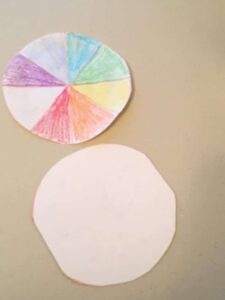
Glue the picture on some cardboard and allow to dry.
-
Piece the middle of the disc with a nail or wooden skewer.
-
Whilst watching the coloured wheel, spin the kebab stick between fingers… what colour do you see? Why?
-
School science visits since 2004!
– Curriculum-linked & award-winning incursions.
– Over 40 primary & high school programs to choose from.
– Designed by experienced educators.
– Over 2 million students reached.
– Face to face incursions & online programs available.
– Early learning centre visits too!
-

-
Get the Unit of Work on Light & Colour here!
- What is colour addition vs subtraction?
- What is opacity, translucence & transparency?
- What is the difference between refraction & reflection?
- Explore UV light, lenses, thermochromism and more!
Includes cross-curricular teaching ideas, student quizzes, a sample marking rubric, scope & sequences & more
The science behind it
Why Does This Happen?
The Science of the Newton Colour Wheel
The Newton Colour Wheel, or Newton’s Disc, is a classic experiment that demonstrates that white light is not a “pure” colour, but is actually a combination of all the colours of the visible spectrum: red, orange, yellow, green, blue, indigo, and violet.
Colour Addition vs. Colour Subtraction
There are two main ways that colours mix, and they work in opposite ways. Understanding the difference is the key to this experiment.
- Colour Addition (Light): When you spin the disc, the different wavelengths of light reflect off the coloured segments and hit your eyes in rapid succession. Your brain cannot process the individual flashes fast enough, so it blurs them together. This “adds” the light waves together to create white light.
- Colour Subtraction (Pigment): This is what happens when you mix paint or ink. Each pigment absorbs (subtracts) certain wavelengths of light. If you mix all the colours of paint together, they eventually absorb all visible light, leaving you with black.
Persistence of Vision
The reason the wheel appears to turn white is due to persistence of vision. This is the same trick of the mind that makes movies look like they are moving smoothly rather than being a series of still photos. As the wheel spins faster, the “afterimage” of one colour overlaps with the next, resulting in a neutral or white appearance.
Variables to test
Find out more on variables here.
-
Segment Order
Try mixing the colour order on the wheel. Does it change the “whiteness” of the result if the colours aren’t in the natural order of the rainbow (ROYGBIV)? -
Spectral Balance
Remove some of the colours on the wheel (for example, use only red and blue). What secondary colour do you see when it spins? This is a great way to explore complementary colours. -
Light Interaction
What happens if you shine a coloured light (like a green LED) on the wheel while it spins? How does the ambient light source affect the reflected light you see? -
Rotational Speed
At what specific speed does the brain stop seeing individual colours? Try using a slow-motion camera to see the transition point between individual colours and the combined white light.

Teacher's note
Curriculums change, and so does the way you implement them in your classroom. Please use your own experience and knowledge of your students to use these resources to best effect for student learning.
Still want the curriculum links?
Here are the suggested links:
Australian Curriculum (ACARA) Science:
NSW Science syllabuses:
Victorian Curriculum Science:
Want this experiment — and many more — running in your classroom?
Have us visit your school — every student gets three hands-on experiments in 60–90 minutes with a qualified presenter.








