
Star Wars Slinky Sounds!
Try out these cool Slinky Star Wars Sounds with easy to find materials. A fun science experiment for the kids and all to enjoy!
Adult supervision for setup
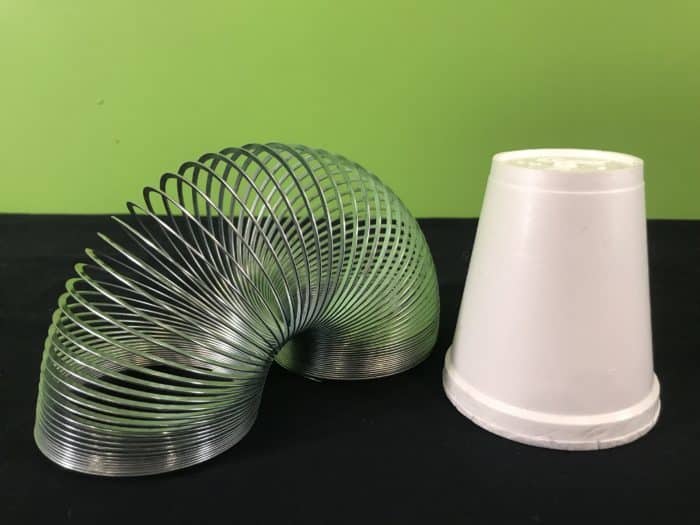
You will need
- A styrofoam cup (plastic cups work too)
- A metal slinky (plastic won't do!)
Method
-
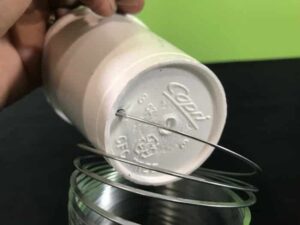
Push the end of the metal slinky through the base of the styrofoam cup. You can secure this further by pushing the end of the slinky through the cup again in another place to form a hook shape.
-
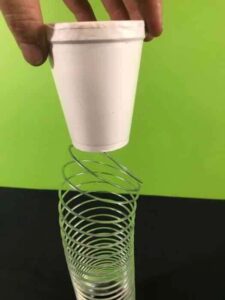
Hold the top of the styrofoam cup as pictured so that the metal slinky dangles downwards to the floor.
-
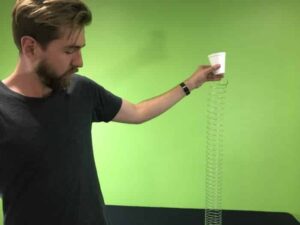
Gently shake the cup from side to side. You should hear the sound effects that can be similar to those heard in Star Wars! Try bouncing the metal slinky up and down on the floor to get a sharper sound.
-
School science visits since 2004!
– Curriculum-linked & award-winning incursions.
– Over 40 primary & high school programs to choose from.
– Designed by experienced educators.
– Over 2 million students reached.
– Face to face incursions & online programs available.
– Early learning centre visits too!
-

-
Get the Unit of Work on Sound here!
- What is amplitude?
- What is frequency?
- How does sound travel and what does it look like and more!
Includes cross-curricular teaching ideas, student quizzes, a sample marking rubric, scope & sequences & more
The science behind it
What is going on?
The Science of Star Wars Slinky Sounds
The iconic “pew-pew” blaster sounds from Star Wars weren’t made in a computer—they were discovered in the real world! Foley artist Ben Burtt created them by striking the high-tension guy-wires of a radio mast with a wrench. You can recreate this legendary sound effect using a metal slinky and a simple cup.
Vibration and Resonance
When you tap or shake the slinky, you create a vibration that travels along the metal coils. On its own, the slinky is very quiet, but the cup changes everything.
- Energy Transfer: As the vibrations reach the end of the slinky, they are transferred directly into the material of the cup.
- Acoustic Amplification: The cup acts as a resonator. Because the cup has a large surface area and contains a hollow space of air, it vibrates in sympathy with the slinky, pushing more air molecules and making the sound much louder.
- Dispersion: The “laser” sound occurs because different frequencies (pitches) travel through the metal at different speeds. High-pitched sounds travel faster than low-pitched sounds, causing the note to “slide” or “chirp” as it reaches your ear.
Variables to test
Find out more on variables here.
-
Material Density
Try a metal slinky versus a plastic slinky. Metal is denser and more elastic than plastic—how does this change the velocity of the sound waves and the “metallic” quality of the tone? -
Resonator Composition
Compare a styrofoam cup to a plastic or paper cup. Styrofoam is full of tiny air bubbles—does this dampen the sound, or does the rigid plastic provide a sharper “crack”? -
Tension and Length
Do the sounds change if you change the length of the slinky? Stretching the slinky increases tension—does this raise the pitch of the laser blast? -
Cup Size
Try a small espresso cup versus a large popcorn bucket. Does the volume of the air space change the depth or “bass” of the sound?
To ensure a fair test, try to strike the slinky with the same amount of force each time, so you can be sure the change in sound is due to the materials you are testing!

Teacher's note
Curriculums change, and so does the way you implement them in your classroom. Please use your own experience and knowledge of your students to use these resources to best effect for student learning.
Still want the curriculum links?
Here are the suggested links:
Australian Curriculum (ACARA) Science:
NSW Science syllabuses:
Victorian Curriculum Science:
Want this experiment — and many more — running in your classroom?
Have us visit your school — every student gets three hands-on experiments in 60–90 minutes with a qualified presenter.








