
Crystal Snowflakes
Grow a snowflake using borax! With adult supervision this is a fantastic activity to run in class or as you approach Christmas. Find out more…
Adult supervision for setup
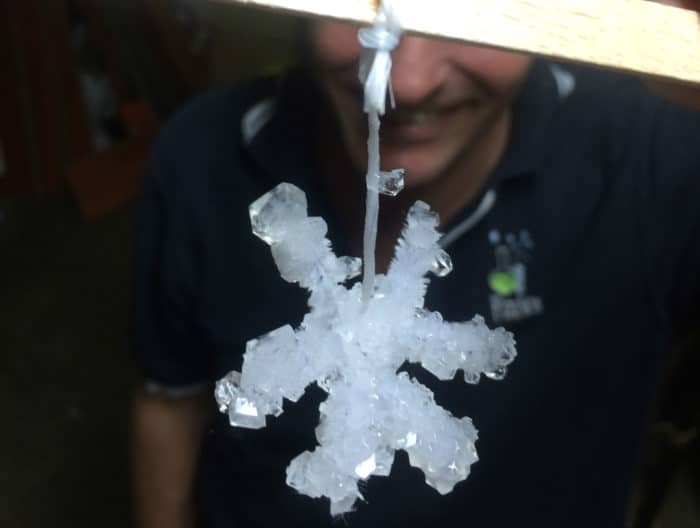
You will need
- Adult Help
- 2 Cups of hot water (roughly 250mL)
- 4 Teaspoons of Borax (found in the laundry section of the supermarket)
- 1 piece of string (about 10cm)
- 1 Popsicle stick
- 4 pipe-cleaners
- Scissors
- 1 measuring cup of water (250mL)
- 1 teaspoon
Method
-
Twist several pipe-cleaners together into the shape you want your crystal to be, we suggest shaping it into a snowflake.
The shape needs to be able to fit inside your cup, without touching the bottom or sides. If the shape is not submerged, add extra water and borax in the ratio of 1 teaspoon of Borax for every 60mL of hot water.
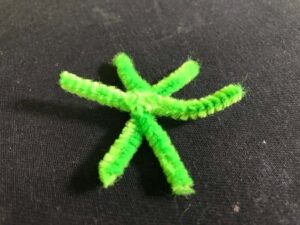
-
Tie one end of the piece of string onto the pipe-cleaners you have twisted together.
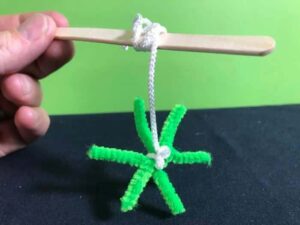
-
Tie the other end of the string onto the Popsicle stick.
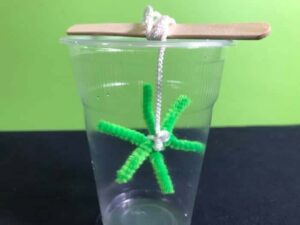
-
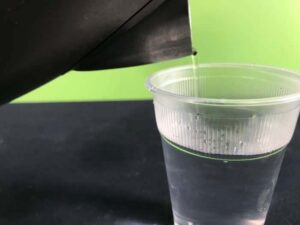
With care, and a parent’s help, pour 250mL of hot water into a cup and add four teaspoons of borax into the water.
-
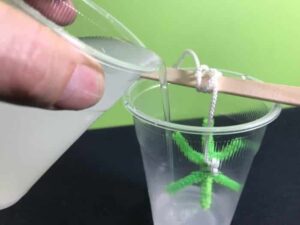
Stir the borax and water mixture until the borax is completely dissolved.
-
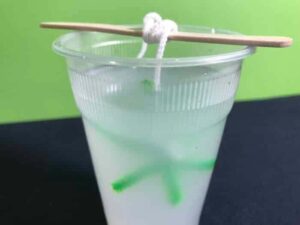
Suspend the pipe-cleaners, the ones you have shaped earlier, borax solution from the string and pipe-cleaner. Make sure that the pipe-cleaner does not touch the sides of bottom of the cup.
And wait, for two or three days.
-
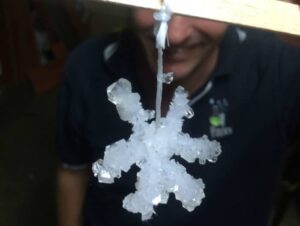
Over the next two or three days you should see your Borax Crystal forming on the pipe-cleaner.
After two or three days remove the crystal from the solution.
-
Get the Unit of Work on Mixtures here!
- How can we separate mixtures?
- What are the different techniques?
- From chromatography to magnetism, join us to explore the variety of ways we can separate mixtures!
Includes cross-curricular teaching ideas, student quizzes, a sample marking rubric, scope & sequences & more
-
School science visits since 2004!
– Curriculum-linked & award-winning incursions.
– Over 40 primary & high school programs to choose from.
– Designed by experienced educators.
– Over 2 million students reached.
– Face to face incursions & online programs available.
– Early learning centre visits too!
-

The science behind it
Why Does This Happen:
The Science of Borax Crystal Snowflakes
When you dissolve borax in boiling water, you are creating a supersaturated solution. This is a special state where the water contains much more dissolved material than it would normally be able to hold at room temperature. Because the hot water molecules are moving rapidly and are spread further apart, they can “hide” more borax molecules between them.
As the water cools down, the solution becomes unstable. The water can no longer hold all that dissolved borax, so the borax begins to precipitate—it falls out of the liquid state and turns back into a solid. To do this effectively, the borax molecules look for a surface to latch onto. In this experiment, your pipe-cleaner snowflake acts as a seeding crystal (or nucleation site), providing a perfect home for the crystals to start growing.
Crystal Growth and Time
In the world of chemistry and geology, there is a golden rule: the longer it takes for a crystal to form, the larger the crystal will be.
If a solution cools very quickly, millions of tiny crystals form all at once. If it cools slowly over days or weeks, the molecules have time to stack themselves perfectly onto existing structures, creating massive gemstones or large salt pillars. This principle applies to everything from crystal growing kits to the way volcanic crystals form in cooling magma!
Variables to test
Find out more on variables here.
-
Rate of Cooling
Place one jar in the fridge and wrap another in a towel to keep it warm for as long as possible. Does the cooling rate affect how big your crystal “snowflakes” get? -
Solute Concentration
Try using different amounts of borax in the same volume of water. Is there a saturation limit where the crystals stop getting better and just become a messy clump at the bottom? -
Substrate Texture
Try growing crystals on a smooth piece of plastic vs. a fuzzy pipe-cleaner. How does the surface area of the object change the number of crystals that form? -
Solvent Purity
Does using distilled water versus tap water change the clarity or structure of the crystals?
Remember, for a “fair test,” keep all jars in the same location and only change one thing at a time. This is how scientists ensure their results are valid!

Teacher's note
Curriculums change, and so does the way you implement them in your classroom. Please use your own experience and knowledge of your students to use these resources to best effect for student learning.
Still want the curriculum links?
Here are the suggested links:
Australian Curriculum (ACARA) Science:
NSW Science syllabuses:
Victorian Curriculum Science:
Want this experiment — and many more — running in your classroom?
Have us visit your school — every student gets three hands-on experiments in 60–90 minutes with a qualified presenter.








