
Make a bouncy ball!
Find out how to Make a bouncy polymer ball with easy to find materials. Part of > 150 free science experiments on this site!
Adult supervision for setup
You will need
- Plastic cups x2
- One marker pen
- One tablespoon
- One teaspoon
- 100g of cornflour
- 100g of Borax
- 100mL of PVA glue (Elmer's Glue recommended)
- 100mL of hot water
- Food Colouring
- Adult help
Method
-
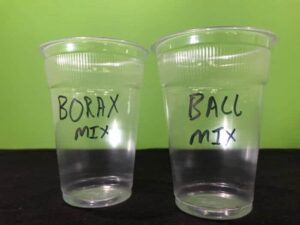
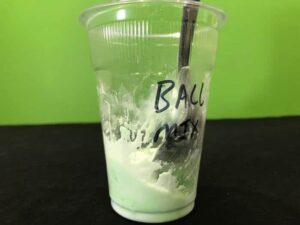
Using the maker pen, label one of the plastic cups “Borax Mixture” and the other “Ball Mixture.
-
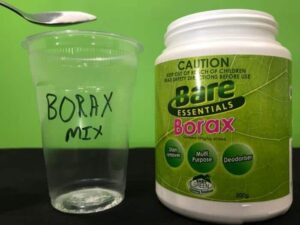
Put two tablespoons of hot water and half a teaspoon of borax into the cup labelled “Borax Mixture.” Add a couple of drops of food colouring and stir until all the borax has dissolved.
-
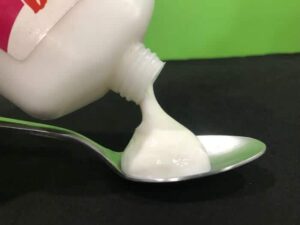
Add one tablespoon of PVA glue into the cup labelled “Ball Mixture.”
-
Add half a teaspoon of the “Borax Mixture” and one tablespoon of cornflour into the cup Labelled “Ball Mixture.”
Leave the ingredients to sit for about 15 seconds.
-
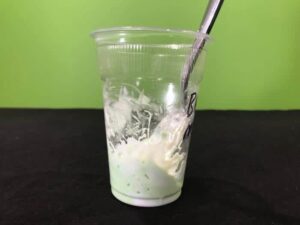
Using a spoon, thoroughly stir the material in the cup labelled “ball mixture.”
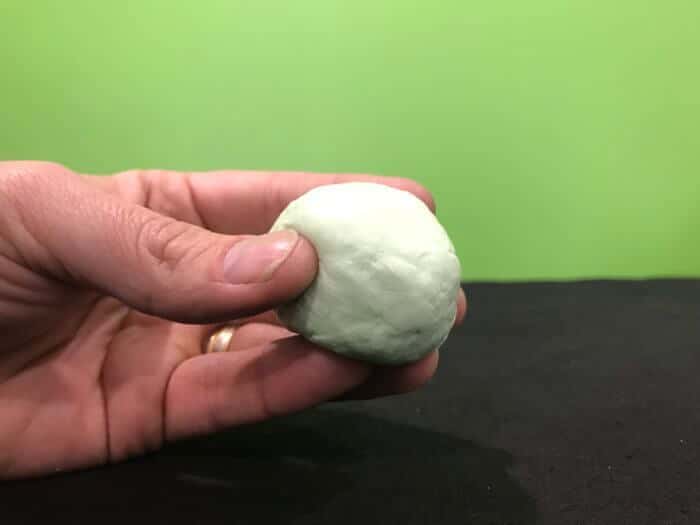
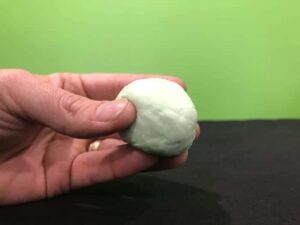
Once the mixture is too thick to stir, scoop it out and roll it in your hands. At first it will be sticky and messy, but as you knead it will become easier to work with.
You may need to experiment with different amounts of cornflour as the glue recipes can change over time (and different brands have different amounts of each ingredient in them).
-
After a few minutes, drop your polymer ball onto a table.
-
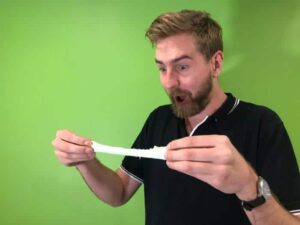
If it does not bounce, keep kneading it.
-
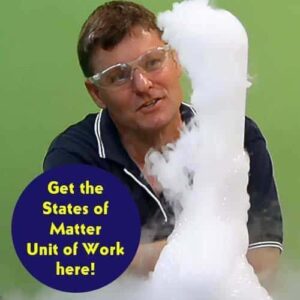
Get the Unit of Work on States of Matter here!
- What are the different states of matter?
- How does heat affect the size of materials?
- How does liquid nitrogen affect materials and much more!
Includes cross-curricular teaching ideas, student quizzes, a sample marking rubric, scope & sequences & more
-
School science visits since 2004!
– Curriculum-linked & award-winning incursions.
– Over 40 primary & high school programs to choose from.
– Designed by experienced educators.
– Over 2 million students reached.
– Face to face incursions & online programs available.
– Early learning centre visits too!

-

The science behind it
Why Does This Happen?
The Science of Making a Bouncy Ball
The secret to your homemade bouncy ball lies in the chemistry of polymers. The “PVA” in PVA glue stands for Polyvinyl Alcohol. In science, “poly” means “many,” and a polymer is a giant molecule made of many smaller units linked together in long, repeating chains. In the bottle, these chains slip and slide past each other easily, which is why the glue flows like a thick liquid.
When you add Borax (sodium tetraborate) to the glue, a chemical reaction called cross-linking occurs. Borate ions act like tiny bridges that “grab” the long polymer chains and link them together. This stops the chains from sliding freely, transforming the liquid glue into a rubbery slime.
By adding cornflour to this mixture, you create a hybrid material. Cornflour is a Non-Newtonian solid; it feels soft when touched gently but becomes hard and rigid when under high pressure (like when it hits the floor). When you roll this mixture into a ball and throw it, the combined elasticity of the cross-linked PVA and the pressure-reacting cornflour allows the ball to store potential energy and quickly release it as kinetic energy, making the ball bounce!
Variables to test
Find out more on variables here.
-
Cross-linker Concentration
Vary the amount of Borax used. Does adding more Borax create a stiffer, more brittle ball, or does it make it even bouncier by increasing the density of the cross-links? -
Polymer Volume
Vary the amount of PVA glue. How does the ratio of glue to cornflour change the viscosity and “stretchiness” of your ball? -
Thermal Energy
Try using warm versus cold ingredients. Heat usually affects the reaction rate and how well the polymers dissolve. Does temperature change how smoothly the ball forms? -
Particle Interaction
Try making a ball without the cornflour. How does the bounce height compare when the Non-Newtonian component is missing?
Remember, for a “fair test,” ensure you only change one variable at a time while keeping the rest identical. This is the only way to know for sure what caused your ball to bounce higher!

Teacher's note
Curriculums change, and so does the way you implement them in your classroom. Please use your own experience and knowledge of your students to use these resources to best effect for student learning.
Still want the curriculum links?
Here are the suggested links:
Australian Curriculum (ACARA) Science:
NSW Science syllabuses:
Victorian Curriculum Science:
Want this experiment — and many more — running in your classroom?
Have us visit your school — every student gets three hands-on experiments in 60–90 minutes with a qualified presenter.








