
Making Cornflour Slime
Get your hands sticky, goey and (optionally) colourful. Learn how to make cornflour slime! Part of > 150 free science experiments.
Adult supervision for setup

You will need
- Cornflour (maize starch)
- Water
- Food colouring
- Bowl
- Spoon
Method
-
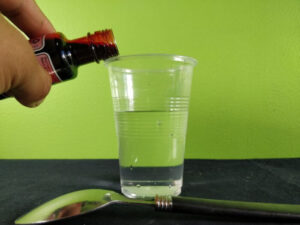
Add a few drops of the food colouring into the water and stir it with the spoon.
-
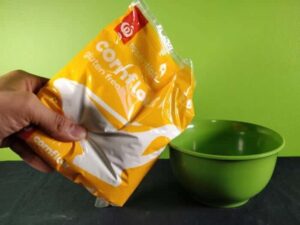
Pour some cornflour into the bowl.
-
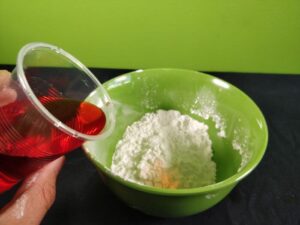
Slowly add the water and food colouring mixture into the bowl and mix it with your hands.
-
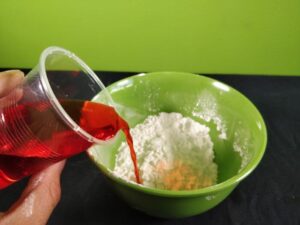
If the slime is too powdery, add more water and food colouring.
-
If it is too runny add more flour.
-
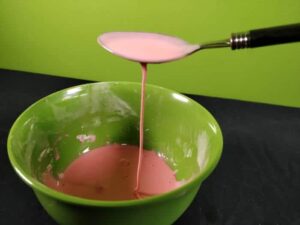
You know your slime is done if when you poke it hard and fast it feels like a solid. But when you poke it slow and gently it feels like a liquid. This is called a non-Newtonian liquid.

-
Get the Unit of Work on States of Matter here!
- What are the different states of matter?
- How does heat affect the size of materials?
- How does liquid nitrogen affect materials and much more!
Includes cross-curricular teaching ideas, student quizzes, a sample marking rubric, scope & sequences & more

-
School science visits since 2004!
– Curriculum-linked & award-winning incursions.
– Over 40 primary & high school programs to choose from.
– Designed by experienced educators.
– Over 2 million students reached.
– Face to face incursions & online programs available.
– Early learning centre visits too!
-

The science behind it
Why Does This Happen?
The Science of Cornflour Slime
Cornflour slime (often called “Oobleck”) is a fascinating substance that defies our normal expectations of how liquids behave. If you were to look at cornflour under a microscope, you would see that the particles are relatively large with jagged, uneven edges.
When you move the slime slowly or apply very little force, these particles have enough space and time to slide past one another, allowing the mixture to act like a liquid. However, if you apply a sudden force—like a quick stir or a hard punch—those jagged edges snag on each other. This causes the particles to lock together, making the slime behave like a solid. As soon as the force is removed, they can slide again, and the material “melts” back into a liquid state.
This “shear-thickening” behaviour means that cornflour slime is a Non-Newtonian fluid. Unlike “Newtonian” fluids (like water), which have a constant viscosity (thickness) regardless of how hard they are stirred, the viscosity of this slime changes depending on the shear rate—the amount of pressure or speed applied to it.
Teaching her brother how to make pink slime because, #science ! 👩🏼🔬
Thanks @FizzicsEd for the ideas 💫#FlattenTheCurve #StayHomeAustralia #WomenInSTEM pic.twitter.com/7xZcqwc35k
— Melina Georgousakis (@Melina_Gee) April 8, 2020
Real-World Applications
Scientists and engineers are finding clever ways to use these “smart” fluids in modern technology:
- Liquid Body Armour: Researchers are developing protective vests using Non-Newtonian fluids. The gear remains flexible for the wearer to move comfortably, but becomes instantly rigid and bulletproof upon the high-speed impact of a projectile.
- Smart Speed Bumps: Imagine a speed bump filled with a shear-thickening fluid! If you drive over it slowly, the fluid moves out of the way and the bump stays soft. If you speed over it, the fluid reacts to the force and becomes solid, giving your car a jolt to remind you to slow down.
Variables to test
Find out more on variables here.
- Concentration Ratios: Vary the amount of water used. Is there a specific saturation point where the slime stops behaving like a solid and just stays liquid?
- Starch Sources: Try cornflour versus wheat flour or potato starch. Since different plants produce different starch molecule shapes, does the type of flour change the “jaggedness” and the final effect?
- Thermal Energy: Does warm versus cold water change the viscosity? Heat usually increases the kinetic energy of the molecules—does this help them slide past each other more easily?
- Additive Influence: Does removing the food colouring or adding a pinch of salt change the way the particles interact?
Remember to only change one variable at a time to ensure your experiment is a fair test!

Teacher's note
Curriculums change, and so does the way you implement them in your classroom. Please use your own experience and knowledge of your students to use these resources to best effect for student learning.
Still want the curriculum links?
Here are the suggested links:
Australian Curriculum (ACARA) Science:
NSW Science syllabuses:
Victorian Curriculum Science:
Want this experiment — and many more — running in your classroom?
Have us visit your school — every student gets three hands-on experiments in 60–90 minutes with a qualified presenter.








