
Fizzy bath bombs
A fun science experiment to do at home or in the school classroom making colourful bicarbonate soda fizzy bombs with vinegar bought from the supermarket
Adult supervision for setup
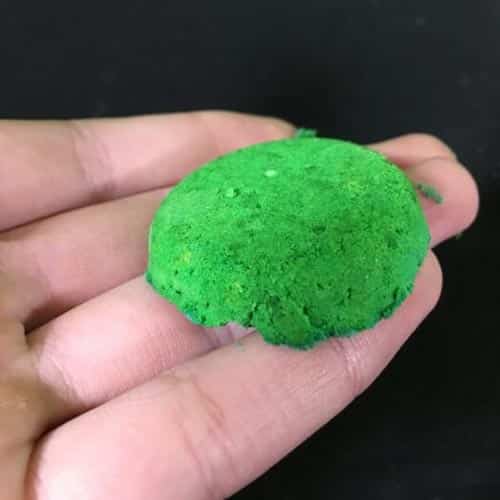
You will need
- A container
- A spoon
- ½ a cup of bicarbonate soda
- Food colouring
- Water
- Muffin tray or ice cube tray
Method
-
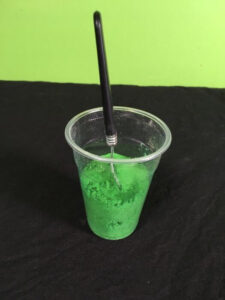
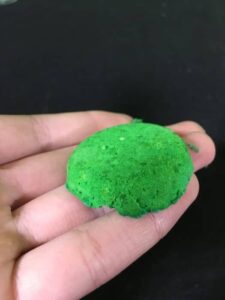
Pour bicarb soda into container, carefully mix in a few drops of food colouring at a time with a spoon until you get the desired colour. The mixture should be crumbly, and holds its shape when pressed with the spoon. If not, add a few drops of water and mix, repeat until it does.
-
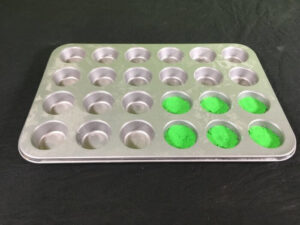
Fill the muffin tray or ice cube tray with the mixture, about 2/3 of the way up. Pack down with the back of the spoon.
-
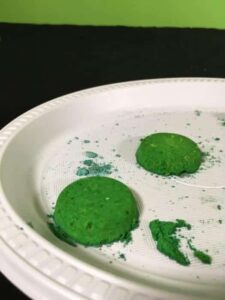
Leave to dry for an hour then turn out onto a plate.
-
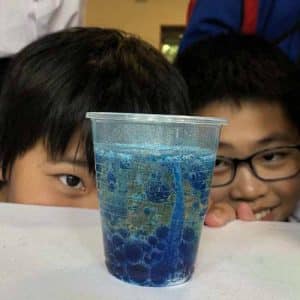
Drip vinegar on top of the fizzy bomb or chuck one into a cup of vinegar!
-
School science visits since 2004!
– Curriculum-linked & award-winning incursions.
– Over 40 primary & high school programs to choose from.
– Designed by experienced educators.
– Over 2 million students reached.
– Face to face incursions & online programs available.
– Early learning centre visits too!
-

-
Want to dive into acid-base chemistry?
Get the 30-minute video + PDF + curriculum links for your class here!

The science behind it
What is the chemical reaction occurring here?
The Science of Fizzy Bath Bombs
The spectacular fizzing of a bath bomb is a perfect example of an acid-base reaction. While many homemade bath bombs use citric acid (in powder form) mixed with bicarbonate soda, the chemical principle remains the same as the classic vinegar and bicarb experiment.
When the “base” (sodium bicarbonate) meets an “acid” (like vinegar or citric acid) in the presence of water, they react to form carbonic acid and a salt (sodium acetate). Carbonic acid is very unstable and immediately breaks down into water and carbon dioxide gas (CO2). Those thousands of tiny bubbles you see are actually pockets of carbon dioxide gas escaping the liquid!
Vinegar + Bicarbonate Soda → Carbonic Acid + Sodium Acetate
In a dry bath bomb, the acid and base are pressed together but cannot react because they need a solvent (water) to allow the ions to move and collide. The moment you drop the bomb into the bath, the water acts as the trigger, starting the reaction and releasing the trapped scents and colours.
Want to explore more? Check out more vinegar and bicarbonate soda experiments here!
Variables to test
Find out more on variables here.
-
Reactant Purity
Is baking soda the same as bicarbonate soda? (Hint: check the ingredients for “cream of tartar”). Does using pure sodium bicarbonate produce a stronger reaction than a pre-mixed baking powder? -
Inert Additives
Add bath crystals (Epsom salts) versus no crystals. Do these extra minerals interfere with the reaction rate, or do they simply sit in the mixture without changing the fizz? -
Chemical Influence of Dyes
Remove the food colouring. Does the presence of the dye change the pH level of the mixture or affect how well the bomb holds its shape? -
Thermal Energy
Does a bath bomb fizz faster in a hot bath versus a cold one? This looks at how temperature affects the speed of chemical particles during a reaction.
Remember, if you plan on actually using these in the tub, keep the food colouring to a minimum to avoid staining the bath (or yourself!).

Teacher's note
Curriculums change, and so does the way you implement them in your classroom. Please use your own experience and knowledge of your students to use these resources to best effect for student learning.
Still want the curriculum links?
Here are the suggested links:
Australian Curriculum (ACARA) Science:
NSW Science syllabuses:
Victorian Curriculum Science:
Want this experiment — and many more — running in your classroom?
Have us visit your school — every student gets three hands-on experiments in 60–90 minutes with a qualified presenter.








