
Make a balloon hovercraft
Make a balloon hovercraft with simple materials! This works surprisingly well and helps kids understand forces and air pressure
Adult supervision for setup
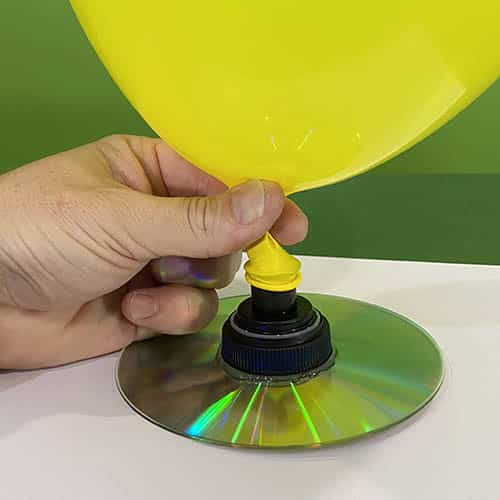
You will need
- A CD that you don't mind being wrecked
- A pop-top bottle lid (sports drinks & various juice companies sell bottles with these lids)
- A balloon
- A hot glue gun and adult supervision
- A4 paper or mat that you can do craft on
- Safety glasses
Method
-
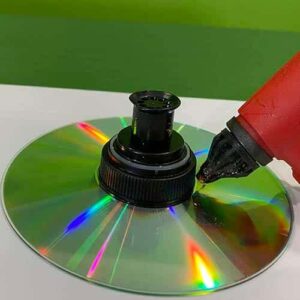
Use the hot glue gun to connect the pop-top bottle lid to the CD. Make sure that you keep this lid centred to the CD as much as possible.
-
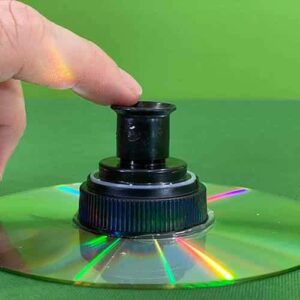
Once the hot glue has cooled and dried, press the sports drink lid down so that the valve is shut inside the lid.
-
Blow up a balloon and then attach it to the pop-top bottle lid.

-
As the valve is closed, the air should not rush out of the balloon whilst attached to the lid.
-
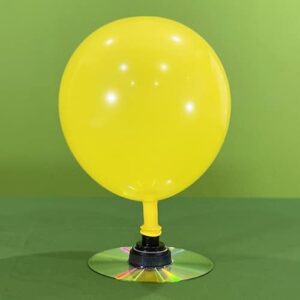
Open the lid valve and give your balloon hovercraft a little push. You should see it glide across the desk easily!

-
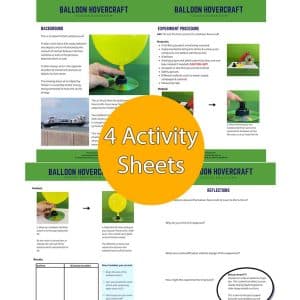
Go further – buy 4 x student activity sheets as extension worksheets.
This student science booklet has been created by experienced science educators from the Fizzics Education team.
Use these student worksheets as blackline masters for your science class!

-
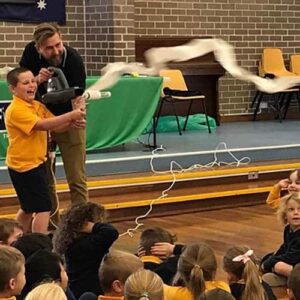
School science visits since 2004!
– Curriculum-linked & award-winning incursions.
– Over 40 primary & high school programs to choose from.
– Designed by experienced educators.
– Over 2 million students reached.
– Face to face incursions & online programs available.
– Early learning centre visits too!
-

The science behind it
What is going on?
You reduced friction!
Friction is the force that exists between two objects and is influenced by the amount of contact between the two surfaces as well as the pressure between them. Even smooth surfaces have microscopic “peaks and valleys” that catch on each other. Friction always acts in the opposite direction to movement and causes objects to slow down by turning motion into heat.
The air thrust from the balloon pushes the hovercraft’s mass away from the table, thereby reducing the friction between the CD and the table. Your balloon hovercraft continues to be able to slide across a desk or smooth floor as long as there is enough air pressure in the balloon to hold the CD up from the surface. This simple experiment is just a miniature version of what occurs with commercial hovercrafts, whereby industrial fans introduce tremendous amounts of force to hold up the hovercraft.
Road safety application
Contact with the ground is essential for tyres to be safe, allowing you to control your vehicle. The tread of your tyre is designed to disperse water whilst keeping your tyre in constant contact with the road. The greater the contact, the greater the frictional forces.
You can lose control of your vehicle if you lose contact, and therefore friction, with the road. This often occurs when a car aquaplanes, whereby water is forced under the wheels which reduces tyre contact to the road and reduces your ability to steer or brake your vehicle.
Variables to test
-
Volume
Does the size of the balloon or the volume of air inside change how long it hovers? -
Surface Texture
What happens when you make the surface rougher, like moving from a desk to a carpet? -
Base Material
Can you create the same effect with something other than a CD, like a paper plate or plastic lid? -
Weight
How much extra mass can the air cushion support before friction takes over again?
Going further
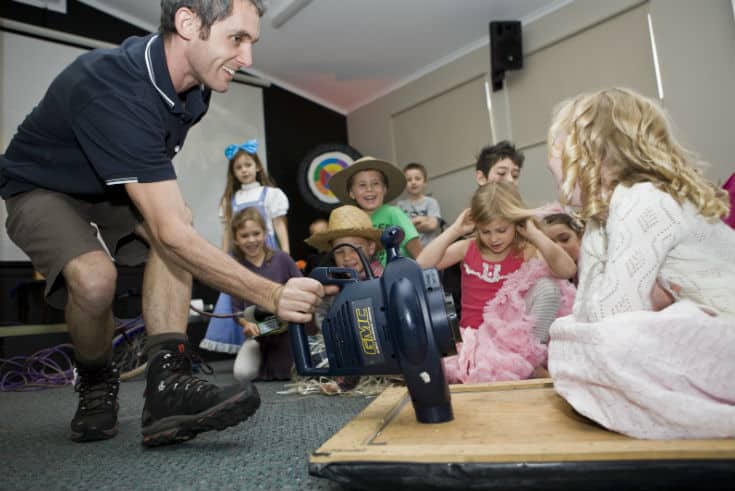
Liquids can slide on pockets of gas too. During our liquid nitrogen show, we demonstrate the Leidenfrost effect which in a way emulates hovercrafts.
In this case, we show rapidly boiling liquid nitrogen droplets sliding along a smooth surface due to the gas trapped beneath each droplet caused during the rapid boiling. This vapour layer acts as a lubricant, preventing the liquid from touching the floor and allowing it to skip along with almost zero resistance. This can be quite a spectacular effect!
Teacher's note
Curriculums change, and so does the way you implement them in your classroom. Please use your own experience and knowledge of your students to use these resources to best effect for student learning.
Still want the curriculum links?
Here are the suggested links:
Australian Curriculum (ACARA) Science:
NSW Science syllabuses:
Victorian Curriculum Science:
Want this experiment — and many more — running in your classroom?
Have us visit your school — every student gets three hands-on experiments in 60–90 minutes with a qualified presenter.








