
Make your own Spectrometer
Learn how to make your own homemade spectrometer using simple materials. Use light to analyse substances! Part of >150 free science expeirments.
Adult supervision for setup
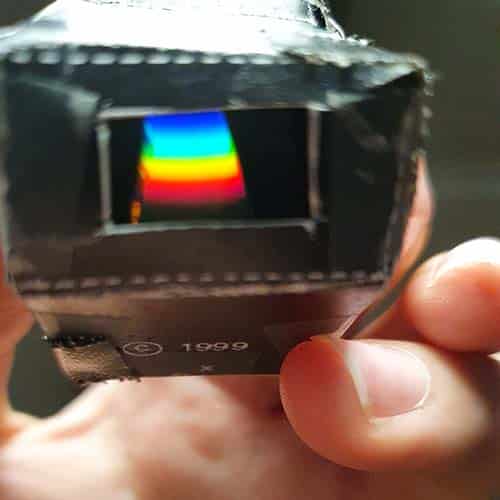
You will need
- Spectrometer Template
- Cardboard
- Scissors
- Glue or Sticky tape
- CD or DVD
- Optional: Box cutter
- Adult help
Method
-
Print out the spectrometer template. Using the glue, stick the template onto the cardboard.
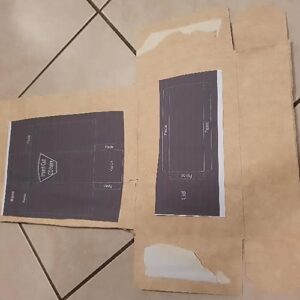
-
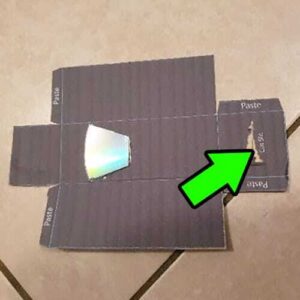
Cut the template out as shown in the image.
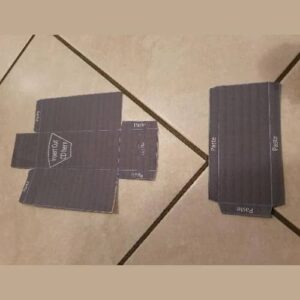
-
Get adult help for this step.
Cut the CD into the shape onto the template. Be careful when cutting the CD so that the reflective part does not peel off. Now glue down the CD onto the template where it says insert CD here.
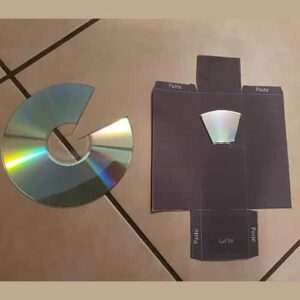
-
Cut a thin slit where it says “cut slit” on the template using the scissors.
Optional: With an adult, you may find it easier to use a box cutter instead of scissors, but either works.
-
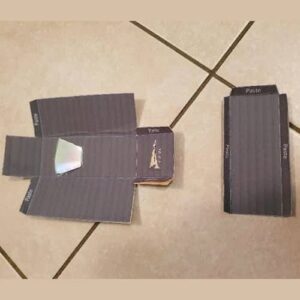
Fold on all the hard lines upwards as shown in the picture.
-
Fold the base into a box without the lid, you can either glue where it says “paste”, however we find that sticky tape is stronger.
-
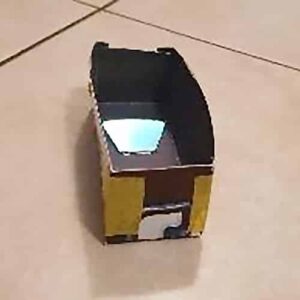
Fold the lid and place it on top, ensure there is a gap left between the side closest to the CD, this will be the observation point to look through. Now tape or glue the sides together.
-
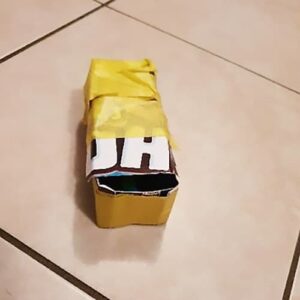
To test your spectrometer put the slit in front of a light and look through the gap you should be able to see a unique light pattern for different sources of light.
Danger – don’t look at the Sun!
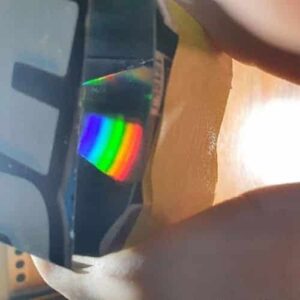
-
Look at different artificial light sources. This picture is from a 4000K LED light source.
Danger – don’t look at the Sun!
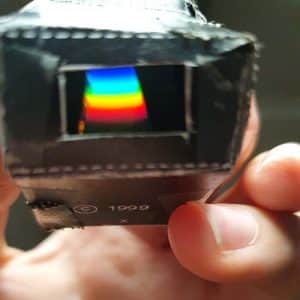
-
School science visits since 2004!
– Curriculum-linked & award-winning incursions.
– Over 40 primary & high school programs to choose from.
– Designed by experienced educators.
– Over 2 million students reached.
– Face to face incursions & online programs available.
– Early learning centre visits too!
-

-
Get the Unit of Work on Light & Colour here!
- What is colour addition vs subtraction?
- What is opacity, translucence & transparency?
- What is the difference between refraction & reflection?
- Explore UV light, lenses, thermochromism and more!
Includes cross-curricular teaching ideas, student quizzes, a sample marking rubric, scope & sequences & more
The science behind it
What is going on?
The Science of Spectrometry
A CD has tiny grooves that are invisible to the eye. When light is shined on these grooves, the CD acts as a diffraction grating, separating the light through reflections into the visible coloured spectrum. Using the spectrometer, the light enters through the slit and is separated into its component colours which are viewed on the surface of the CD.
These colours have important properties; they can determine the chemical composition of the light source, the addition of specific wavelengths, and even show the surface temperature of the light. The study of spectrometry goes all the way back to the 1600s, when Isaac Newton first discovered that white light could be split into all the colours of the rainbow. Since then, we’ve found that different light sources produce unique patterns, known as spectral signatures, depending on the nature of the source and its temperature.
The table below shows how different sources of light have different intensities of colours.
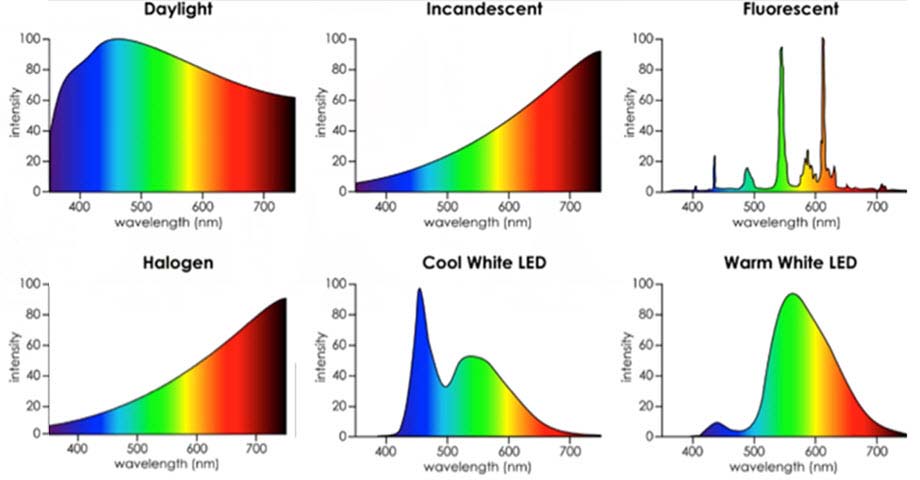
Using this spectrometer on different light sources
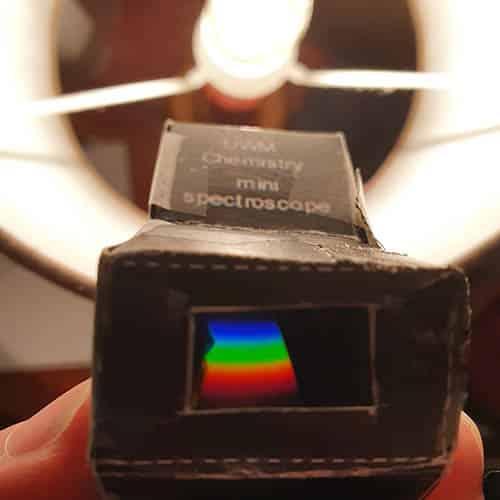
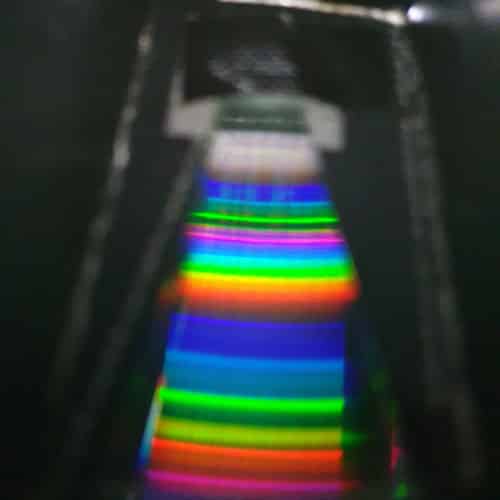
Applications
Astronomers use spectrometry to gather information when observing distant stars. Because each chemical element has its own unique spectral pattern (like a fingerprint), astronomers can determine a star’s element composition simply by looking at these colours. They can also determine the star’s surface temperature, density, and even its rotational velocity using these patterns.
Learn more about spectrometry here.
Variables to explore
-
Light Sources
Explore a range of sources such as LEDs, fluorescent globes, candles, streetlights, and old halogen globes. How do the spectral lines differ? -
Surface Temperature
Explore globes with different temperature ratings (e.g., Warm White vs. Cool White). -
Smart Globes
If you have an RGB smart globe, explore the patterns you see when you change it to specific colours like red, green, or blue.

Teacher's note
Curriculums change, and so does the way you implement them in your classroom. Please use your own experience and knowledge of your students to use these resources to best effect for student learning.
Still want the curriculum links?
Here are the suggested links:
Australian Curriculum (ACARA) Science:
NSW Science syllabuses:
Victorian Curriculum Science:
Want this experiment — and many more — running in your classroom?
Have us visit your school — every student gets three hands-on experiments in 60–90 minutes with a qualified presenter.








