
Hot air expands demonstration
A classic demonstration of hot air rising! Show kids that hot air expands with this simple science activity. Part of over 150 free experiments!
Adult supervision for setup
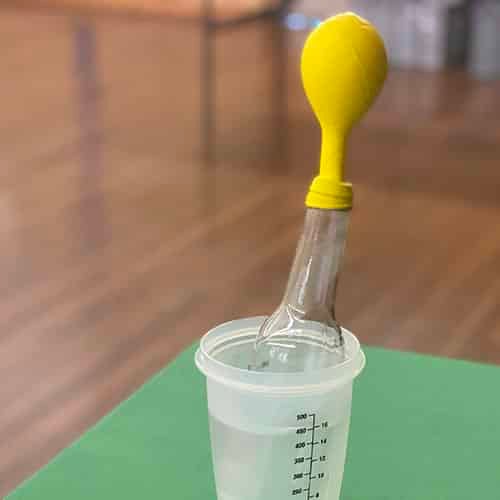
You will need
- Hot water from a kettle or thermos CAUTION: adults to use this only!
- A glass bottle
- A balloon
- A tall plastic container
Method
-
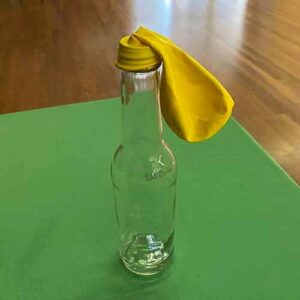
Attach your balloon onto your glass bottle.
-
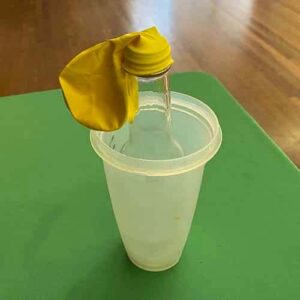
Place your glass bottle into the large plastic cup.
-
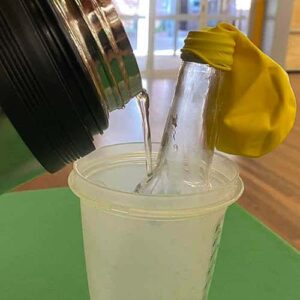
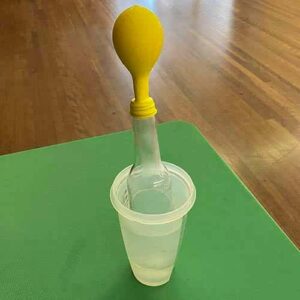
Carefully pour the hot water over the neck of the glass bottle. You should start to see the balloon start to inflate.
CAUTION: adults to use this only!
-
Keep going until the balloon is inflated as per the picture!
Try placing the bottle into cold water… what happens to the inflated balloon now?
-
School science visits since 2004!
– Curriculum-linked & award-winning incursions.
– Over 40 primary & high school programs to choose from.
– Designed by experienced educators.
– Over 2 million students reached.
– Face to face incursions & online programs available.
– Early learning centre visits too!

-

-
Get the Unit of Work on Heat Energy here!
- What actually is heat?
- How does heat move through different materials?
- How does heat change the properties of materials and more!
Includes cross-curricular teaching ideas, student quizzes, a sample marking rubric, scope & sequences & more

The science behind it
What is going on?
Why Heat Inflates Air
The rule is simple: hot gases expand, and cold gases contract!
All gases are made of freely moving molecules. When you add heat energy to a gas, those molecules move faster and collide more forcefully against the sides of the vessel holding them. The more frequently and powerfully these molecules strike the walls, the higher the internal air pressure becomes.
By placing the glass bottle in hot water, heat energy moved into the trapped air. This increased the kinetic energy of the air molecules inside, raising the pressure. Because the balloon is flexible, this increased pressure pushed the rubber outwards, causing the balloon to inflate!
Variable testing
More about variable testing here.
-
Balloon Volume
Try different size balloons. Does a larger balloon require more heat to show a visible change in inflation? -
Temperature Range
With an adult, try different water temperatures. Is there a “threshold” temperature where the balloon suddenly starts to stand up? -
Container Geometry
Try different shaped bottles. Does the volume of air inside the bottle change how quickly the balloon reacts to the heat?
Going further: Gay-Lussac’s Law
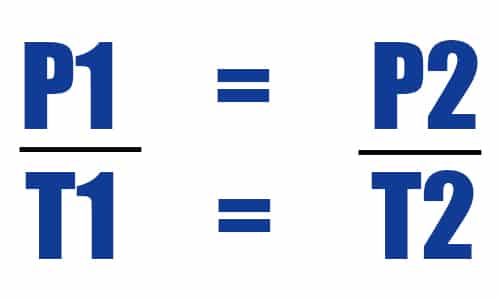
What you have observed is a perfect example of how the pressure of a gas is directly proportional to its temperature. In simple terms: if you increase the temperature, you increase the pressure (as long as the volume stays the same).
This is known as Gay-Lussac’s Law, which states: The pressure of a given mass of gas varies directly with the absolute temperature of the gas, when the volume is kept constant.
P1 / T1 = P2 / T2
Whereby:
- P1 = Initial pressure
- T1 = Initial temperature
- P2 = Final pressure
- T2 = Final temperature
Interactive Simulation
Explore the effect of changing temperature, volume, and pressure in this interactive simulation by the University of Colorado Boulder PhET project. Click on “Ideal” to see how molecules react in a perfect environment!

Teacher's note
Curriculums change, and so does the way you implement them in your classroom. Please use your own experience and knowledge of your students to use these resources to best effect for student learning.
Still want the curriculum links?
Here are the suggested links:
Australian Curriculum (ACARA) Science:
NSW Science syllabuses:
Victorian Curriculum Science:
Want this experiment — and many more — running in your classroom?
Have us visit your school — every student gets three hands-on experiments in 60–90 minutes with a qualified presenter.








