
Tornado in a jar
Create a tornado in a jar easily with materials found around the home. Part of over 150 free science experiments on the Fizzics Education website!
Adult supervision for setup
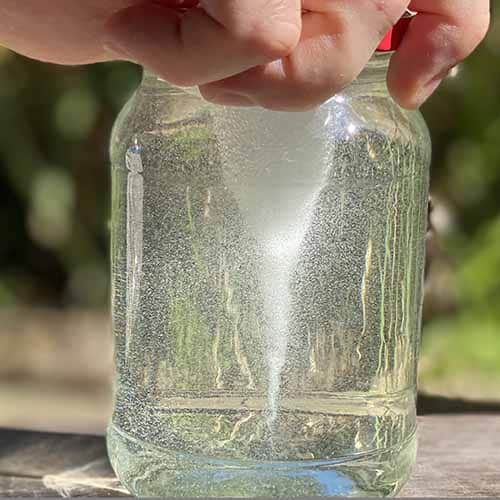
You will need
- A glass jar with a lid
- Detergent
- Water
Method
-
Fill the glass jar almost completely with water, leaving a small air space at the top of the jar. Now add a small amount of detergent.
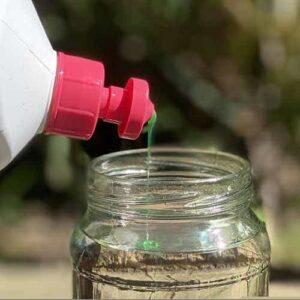
-
Ensuring that the lid is tight, grip the top of the jar and give the jar a quick shake up and down to get some bubbles to form.
Now, quickly swirl the jar around for a couple of seconds. The swirling motion is best done if the bottom of the jar swirls wider than the top of the jar.
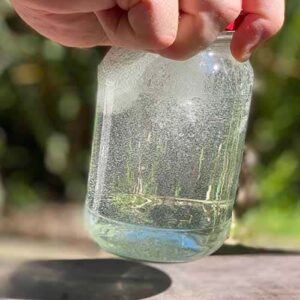
-
Stop swirling the jar and you should see a bubble tornado!
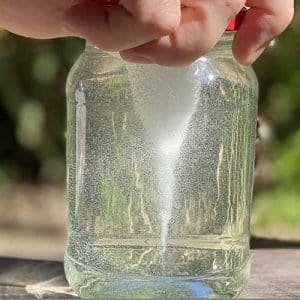
-
School science visits since 2004!
– Curriculum-linked & award-winning incursions.
– Over 40 primary & high school programs to choose from.
– Designed by experienced educators.
– Over 2 million students reached.
– Face to face incursions & online programs available.
– Early learning centre visits too!
-

-
Get the Unit of Work on Pressure here!
- Want to dive into air pressure?
- It’s all about air pressure in many ways!
From how storms form to how planes fly, this unit covers many concepts about air pressure.
Includes cross-curricular teaching ideas, student quizzes, a sample marking rubric, scope & sequences & more
The science behind it
What is going on?
The Physics of a Tornado in a Jar
This experiment is a fantastic demonstration of momentum, centripetal force, and friction!
When you swirl the jar, you impart a force onto the liquid, causing the water to push outwards against the glass. Once you stop swirling, friction begins to slow down the water that is touching the edges of the jar. However, the water in the middle keeps moving.
The water is pulled into a funnel-shaped vortex by centripetal force, which directs the liquid towards the centre of the jar. As the water moves inward, it speeds up due to the conservation of angular momentum. This is the same reason an ice skater spins faster when they pull their arms in! The combination of these forces creates the spinning vortex you see in the jar.
Variable testing
Find out more about variable testing here.
-
Viscosity
Try different liquids, such as oil or syrup. Can you still form a stable vortex in thicker, more viscous liquids, or does friction slow them down too quickly? -
Surface Tension
Does it matter if there is no detergent? Detergent helps reveal the vortex by creating tiny bubbles that get trapped in the flow, but does the water move differently without it? -
Container Geometry
Try different shaped containers, like square bottles or tall cylinders. How does the shape of the “walls” affect the centripetal pull?
How do real tornadoes form?
A classic version of a natural vortex is a tornado. These form when warm, moist air meets cold, dry air, creating instability in the atmosphere. Find out more about the complex weather patterns behind them below:

Teacher's note
Curriculums change, and so does the way you implement them in your classroom. Please use your own experience and knowledge of your students to use these resources to best effect for student learning.
Still want the curriculum links?
Here are the suggested links:
Australian Curriculum (ACARA) Science:
NSW Science syllabuses:
Victorian Curriculum Science:
Want this experiment — and many more — running in your classroom?
Have us visit your school — every student gets three hands-on experiments in 60–90 minutes with a qualified presenter.








