
Tornado in a bottle
Create a tornado in a bottle! Part of over 150 free science experiments on the Fizzics Educaiton website. Find out more…
Adult supervision for setup

You will need
- Two plastic bottles with the same size with lids
- A hammer
- A thick nail to poke a hole in the lids with
- Thick, waterproof sticky tape
- Food colouring (optional)
- Glitter (optional)
- Water
- Adult supervision with the hammer and nail
Method
-
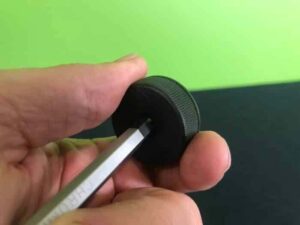
Make a hole in the centre of two bottle lids using a thick nail.
-
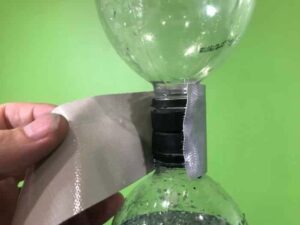
Using some thick, canvas-backed plastic tape (needs to be waterproof), attach the lids together so that the tops of the lids are touching and the hole goes through both lids.
-
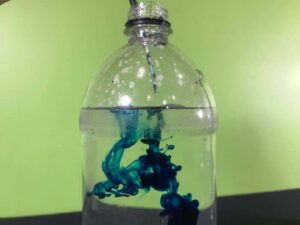
Fill one bottle 3/4 full with water. Add some food colouring and glitter.
-
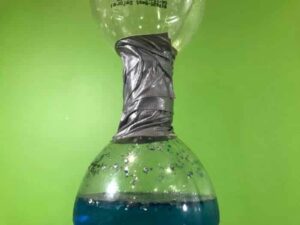
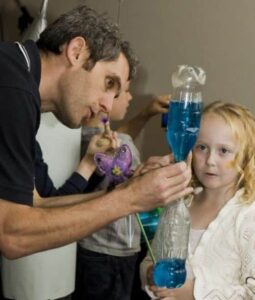
Attach the lids to the bottles so that one bottle sits on top of the other. Invert so that the water runs from one bottle to the other. Observe what happens.
-
Invert the bottles again, and this time, give the bottles a rapid twirl in a horizontal direction. This should start off your vortex, or ‘tornado in a bottle’.
-
School science visits since 2004!
– Curriculum-linked & award-winning incursions.
– Over 40 primary & high school programs to choose from.
– Designed by experienced educators.
– Over 2 million students reached.
– Face to face incursions & online programs available.
– Early learning centre visits too!
-

-
Get the Unit of Work on Pressure here!
- Want to dive into air pressure?
- It’s all about air pressure in many ways!
From how storms form to how planes fly, this unit covers many concepts about air pressure.
Includes cross-curricular teaching ideas, student quizzes, a sample marking rubric, scope & sequences & more
The science behind it
Why Does This Happen?
The Science of a Tornado in a Bottle
The vortex spins because of centripetal force—the same force that famously makes an ice skater spinning on the spot twirl faster when their arms are pulled into their body. This is known as the conservation of angular momentum. As the water spins and moves towards the narrow neck of the bottle, it must spin faster to maintain that momentum.
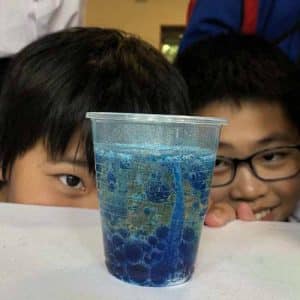
The real secret to the “tornado” is displacement. In a normal bottle, water tries to fall out while air tries to get in, causing a slow “glug-glug” sound as they fight for space in the neck. However, the funnel-shaped vortex creates a hollow “eye” in the centre.
This opening allows air from the bottom bottle to flow steadily upward at the same time the water is spiralling downward. Because the air and water no longer have to take turns passing through the opening, the water pours into the bottom bottle significantly faster than it would without the vortex.
Variables to test
Find out more on variables here.
-
Viscosity
Try using different liquids, such as canola oil, honey, or glycerine. Does a thicker liquid spin as fast, or does internal friction slow the vortex down? -
Aperture Size
What happens when you change the size of the opening between the bottles? Does a wider hole make the tornado disappear faster? -
Scale
Can you make a tornado happen inside a much larger bottle, like a 10-litre water cooler jug? Does it require more energy to start the spin?

Teacher's note
Curriculums change, and so does the way you implement them in your classroom. Please use your own experience and knowledge of your students to use these resources to best effect for student learning.
Still want the curriculum links?
Here are the suggested links:
Australian Curriculum (ACARA) Science:
NSW Science syllabuses:
Victorian Curriculum Science:
Want this experiment — and many more — running in your classroom?
Have us visit your school — every student gets three hands-on experiments in 60–90 minutes with a qualified presenter.








