
Moon illusion tester
Is there really a moon illusion? How can you test it? This science activity is a great way to test an ancient puzzle using simple materials!
Adult supervision for setup

You will need
- One cardboard roll
Method
-
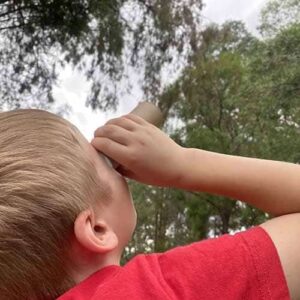
Put the cardboard tube up to your eye and out the moon into your field of view.
You might notice this image above… the moon can be found during the day as well as the night!
Have a read of other misconceptions that are well known in science teaching here.
-
Line up an image of the Moon at Moonrise and then every hour as it rises and falls during its path across the sky.
Keep an eye out for changes in size during its path in one evening. You could even take a photo of each stage and then measure it with a ruler or a tool in photoshop (assuming that you take the image from the same distance each time).
Do you see a measurable change in size as the Moon as it approaches its apex in the sky?

-
School science visits since 2004!
– Curriculum-linked & award-winning incursions.
– Over 40 primary & high school programs to choose from.
– Designed by experienced educators.
– Over 2 million students reached.
– Face to face incursions & online programs available.
– Early learning centre visits too!

-

The science behind it
What is going on?
The illusion of the moon seeming larger in the sky has been around since antiquity. To be honest, the real reason that this occurs is still a matter of debate.
A possible solution
There are two things to consider:
- The Moon’s physical size, ie. it’s real, measurable size. The physical size of the Moon is straight forward as it can be measured accurately.
- The Moon’s apparent size, aka angular size, which is the perceived size of an object based on its distance and angle from us. The apparent or angular size is more difficult. Think about the apparent size of the Sun and the Moon; they almost look the same size. However the Sun is much larger than Moon and the Moon is much closer to us, making their diameters seem the same size. In simple terms, the angular size of the Sun is much smaller than the moon as it is much farther away.
The issue lies in that it is difficult for the human eye to compare the size of something when it is in the sky with nothing of known size to compare it too. It’s suspected that the change in angular size as the Moon moves to the top of the sky causes us to think that it gets bigger as it reaches it zenith, ie. the top of it’s path in the sky.
What about Supermoons?
That’s different! Supermoons are real, as the orbit path of the moon is not perfectly circular and as such there are times when the Moon is closer to the Earth than other times.
Find out more about Supermoons here.
Below shows an animation of when a true Supermoon occurs:
You can also listen to the Supermoon Work Equinox that occurred in early 2019 on the FizzicsTWIST podcast
Teacher's note
Curriculums change, and so does the way you implement them in your classroom. Please use your own experience and knowledge of your students to use these resources to best effect for student learning.
Still want the curriculum links?
Here are the suggested links:
Australian Curriculum (ACARA) Science:
NSW Science syllabuses:
Victorian Curriculum Science:
Want this experiment — and many more — running in your classroom?
Have us visit your school — every student gets three hands-on experiments in 60–90 minutes with a qualified presenter.








