
Make rock candy
Making rock candy is a classic science experiment that kids love! It's all about super saturated solutions of sugar… plus you can eat your science 🙂
Adult supervision for setup
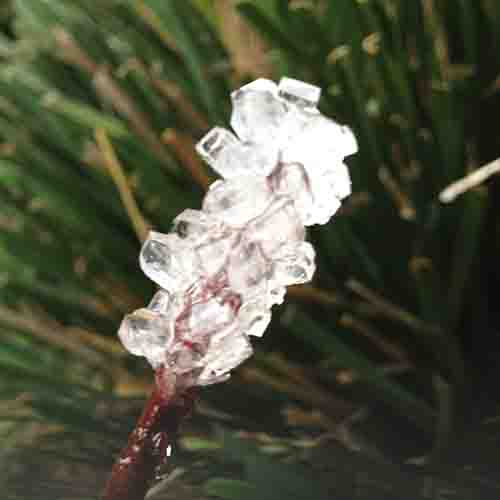
You will need
- Adult Help
- 300g Of Sugar
- Saucepan or kettle with 500mL of water
- Wooden kebab stick or chopstick
- 2 Clothes pegs
- A glass
- A metal spoon
- A place to leave the experiment setup away from ants
- Optional: food colouring
Method
-
With adult help, carefully heat the water in a saucepan. You may want to add some food colouring as an optional extra too!
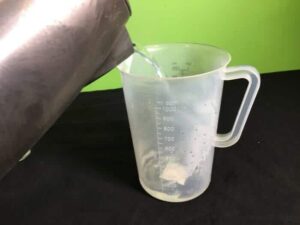
-
Stir in the sugar slowly, stirring constantly whilst the sugar dissolves. Keep adding sugar until you cannot dissolve the sugar crystals anymore. At this point just add a tiny bit more water and dissolve the leftover crystals as well.
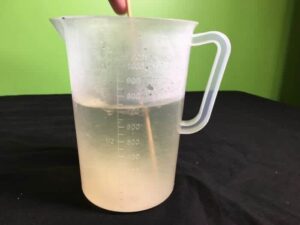
-
Pour the saturated sugar solution carefully into a glass.
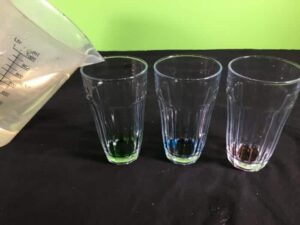
-
Using pegs to suspend a chopstick on the saturated sugar solution
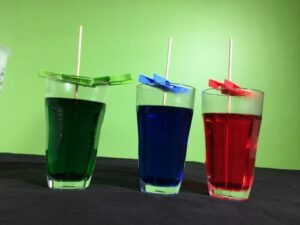
Use two clothes pegs to suspend the wooden kebab stick or chopstick in the sugar solution without the stick touching the sides of the glass. Place the glass in space where ants cannot get at it (you might want to cover the experiment with a cloth).
-
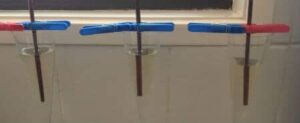
Multiple rock candy experiments
You may want to setup several experiments to see if the crystal formation differs with different amounts of sugar in the water. It’s all about variable testing!
-
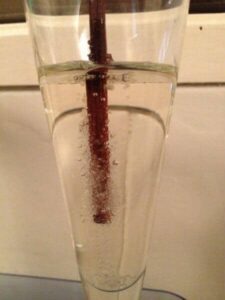
Rock candy beginning to grow on the chopstick
Observe the experiment over several days, taking note of when crystals start to form.
-
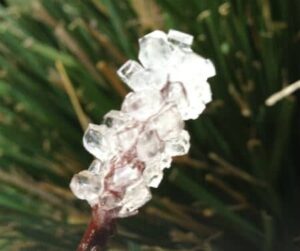
Rock candy crystals
Run the experiment until you have grown the large sugar crystals along the stick (without the crystals touching the side of the glass).
-
Get the Unit of Work on Mixtures here!
- How can we separate mixtures?
- What are the different techniques?
- From chromatography to magnetism, join us to explore the variety of ways we can separate mixtures!
Includes cross-curricular teaching ideas, student quizzes, a sample marking rubric, scope & sequences & more
-
School science visits since 2004!
– Curriculum-linked & award-winning incursions.
– Over 40 primary & high school programs to choose from.
– Designed by experienced educators.
– Over 2 million students reached.
– Face to face incursions & online programs available.
– Early learning centre visits too!
-

The science behind it
Why Does This Happen?
The Science of Making Rock Candy
In this experiment, you created a super-saturated solution! Ordinarily, water can only dissolve a certain amount of sugar at room temperature (this is the saturation point). However, by heating the water, the molecules move faster and spread further apart, allowing much more sugar to be dissolved than normal.
As the solution cools down, it becomes unstable because it is holding more sugar than it “should” be able to at a lower temperature. This creates the perfect environment for crystallisation. Because you used a kebab stick (especially if it was pre-dusted with sugar), you provided nucleation points. These are microscopic rough spots or “seed crystals” that give the dissolved sugar molecules a place to latch onto and begin building a solid structure.
The sugar molecules are more attracted to the rough surface of the stick than the smooth glass of the jar. Over several days, as the water slowly evaporates and the temperature remains cool, more and more molecules stack themselves onto the stick, causing your rock candy to grow larger and larger!
A great rule of thumb in geology and chemistry is: the longer it takes to form a crystal, the larger the crystal will be. You can see this in everything from crystal growing kits to the way gemstones form deep underground! This also explains why liquid nitrogen ice-cream is so smooth—it freezes so fast that the ice crystals stay tiny.
- Learn how crystals are formed by volcanoes.
- Deep dive into the technical side of crystal seeding here.
Variables to test
Find out more on variables here.
-
Solvent Temperature
Try starting the experiment with hot versus cold water. How does the thermal energy change the amount of sugar the water can “hold” before it reaches saturation? -
Solute Concentration
Vary the amount of sugar used. Is there a “magic ratio” that produces the fastest growth without the solution turning into a solid block? -
Liquid Medium
What happens if you use other liquids like apple juice or tea? Different liquids have different chemical properties; do they help or hinder crystal growth? -
Substrate Texture
Try different materials for the sugar to cling to, such as cotton string, a smooth plastic stick, or a rough wooden skewer. Which surface area provides the best nucleation points? -
Evaporation Rate
If you cover the jar with a lid versus leaving it open, does the rate of evaporation change how quickly the crystals form?
Remember, for a “fair test,” only change one variable at a time. Keeping everything else identical ensures that your results are valid and accurate!

Teacher's note
Curriculums change, and so does the way you implement them in your classroom. Please use your own experience and knowledge of your students to use these resources to best effect for student learning.
Still want the curriculum links?
Here are the suggested links:
Australian Curriculum (ACARA) Science:
NSW Science syllabuses:
Victorian Curriculum Science:
Want this experiment — and many more — running in your classroom?
Have us visit your school — every student gets three hands-on experiments in 60–90 minutes with a qualified presenter.








